Ku Cheng-Lung, von Bernuth Horst, Picard Capucine, Zhang Shen-Ying, Chang Huey-Hsuan, Yang Kun, Chrabieh Maya, Issekutz Andrew C, Cunningham Coleen K, Gallin John, Holland Steven M, Roifman Chaim, Ehl Stephan, Smart Joanne, Tang Mimi, Barrat Franck J, Levy Ofer, McDonald Douglas, Day-Good Noorbibi K, Miller Richard, Takada Hidetoshi, Hara Toshiro, Al-Hajjar Sami, Al-Ghonaium Abdulaziz, Speert David, Sanlaville Damien, Li Xiaoxia, Geissmann Frédéric, Vivier Eric, Maródi László, Garty Ben-Zion, Chapel Helen, Rodriguez-Gallego Carlos, Bossuyt Xavier, Abel Laurent, Puel Anne, Casanova Jean-Laurent
Laboratory of Human Genetics of Infectious Diseases, U550, Institut National de la Santé et de la Recherche Médicale, 75015 Paris, France.
J Exp Med. 2007 Oct 1;204(10):2407-22. doi: 10.1084/jem.20070628. Epub 2007 Sep 24.
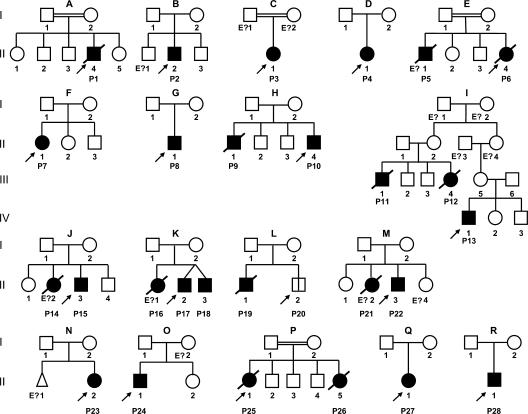
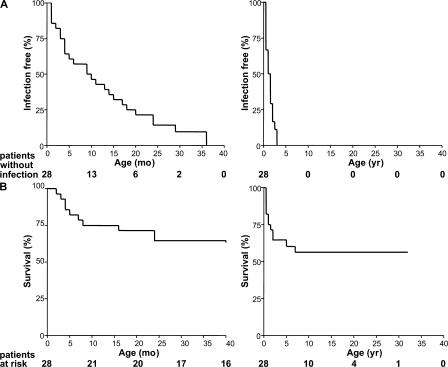
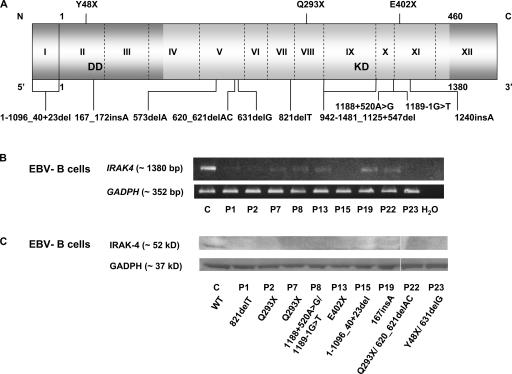
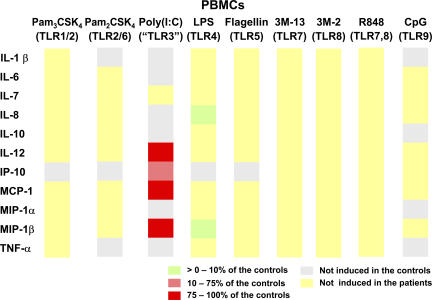
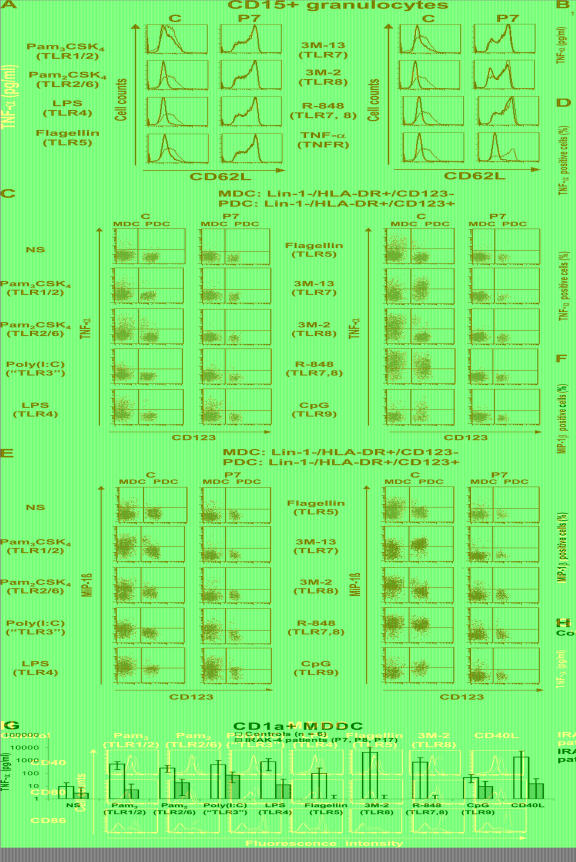
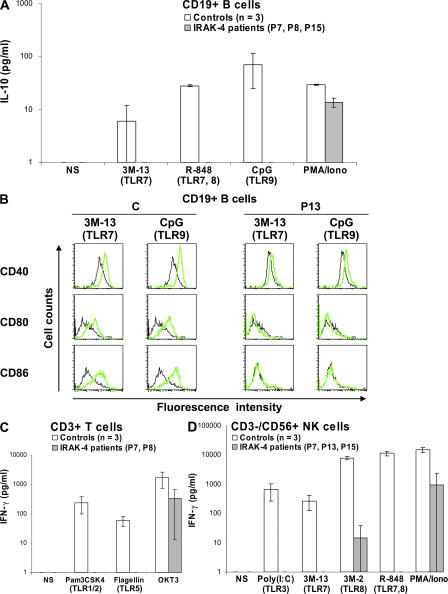
Human interleukin (IL) 1 receptor-associated kinase 4 (IRAK-4) deficiency is a recently discovered primary immunodeficiency that impairs Toll/IL-1R immunity, except for the Toll-like receptor (TLR) 3- and TLR4-interferon (IFN)-alpha/beta pathways. The clinical and immunological phenotype remains largely unknown. We diagnosed up to 28 patients with IRAK-4 deficiency, tested blood TLR responses for individual leukocyte subsets, and TLR responses for multiple cytokines. The patients' peripheral blood mononuclear cells (PBMCs) did not induce the 11 non-IFN cytokines tested upon activation with TLR agonists other than the nonspecific TLR3 agonist poly(I:C). The patients' individual cell subsets from both myeloid (granulocytes, monocytes, monocyte-derived dendritic cells [MDDCs], myeloid DCs [MDCs], and plasmacytoid DCs) and lymphoid (B, T, and NK cells) lineages did not respond to the TLR agonists that stimulated control cells, with the exception of residual responses to poly(I:C) and lipopolysaccharide in MDCs and MDDCs. Most patients (22 out of 28; 79%) suffered from invasive pneumococcal disease, which was often recurrent (13 out of 22; 59%). Other infections were rare, with the exception of severe staphylococcal disease (9 out of 28; 32%). Almost half of the patients died (12 out of 28; 43%). No death and no invasive infection occurred in patients older than 8 and 14 yr, respectively. The IRAK-4-dependent TLRs and IL-1Rs are therefore vital for childhood immunity to pyogenic bacteria, particularly Streptococcus pneumoniae. Conversely, IRAK-4-dependent human TLRs appear to play a redundant role in protective immunity to most infections, at most limited to childhood immunity to some pyogenic bacteria.
人类白细胞介素(IL)-1受体相关激酶4(IRAK-4)缺陷是一种最近发现的原发性免疫缺陷病,它会损害Toll/IL-1R免疫,Toll样受体(TLR)3和TLR4介导的干扰素(IFN)-α/β途径除外。其临床和免疫表型在很大程度上仍不清楚。我们诊断了多达28例IRAK-4缺陷患者,检测了单个白细胞亚群的血液TLR反应以及多种细胞因子的TLR反应。患者的外周血单个核细胞(PBMC)在用除非特异性TLR3激动剂聚肌胞苷酸(poly(I:C))以外的TLR激动剂激活后,不会诱导所检测的11种非IFN细胞因子。患者来自髓系(粒细胞、单核细胞、单核细胞衍生的树突状细胞[MDDC]、髓样树突状细胞[MDC]和浆细胞样树突状细胞)和淋巴系(B细胞、T细胞和NK细胞)谱系的单个细胞亚群,对刺激对照细胞的TLR激动剂均无反应,但MDC和MDDC对聚肌胞苷酸和脂多糖有残余反应。大多数患者(28例中的22例;79%)患有侵袭性肺炎球菌疾病,且该病常反复发作(22例中的13例;59%)。除严重葡萄球菌疾病外(28例中的9例;32%),其他感染很少见。几乎一半的患者死亡(28例中的12例;43%)。分别在8岁和14岁以上的患者中未发生死亡和侵袭性感染。因此,依赖IRAK-4的TLR和IL-1R对儿童抵抗化脓性细菌,尤其是肺炎链球菌的免疫至关重要。相反,依赖IRAK-4的人类TLR在大多数感染的保护性免疫中似乎起冗余作用,最多仅限于儿童对某些化脓性细菌的免疫。