Kwon Yung-Keun, Choi Sun Shim, Cho Kwang-Hyun
Department of Bio and Brain Engineering and KI for the BioCentury, Korea Advanced Institute of Science and Technology, 335 Gwahangno, Yuseong-gu, Daejeon, 305-701, Republic of Korea.
BMC Bioinformatics. 2007 Oct 15;8:384. doi: 10.1186/1471-2105-8-384.
A number of studies on biological networks have been carried out to unravel the topological characteristics that can explain the functional importance of network nodes. For instance, connectivity, clustering coefficient, and shortest path length were previously proposed for this purpose. However, there is still a pressing need to investigate another topological measure that can better describe the functional importance of network nodes. In this respect, we considered a feedback loop which is ubiquitously found in various biological networks.
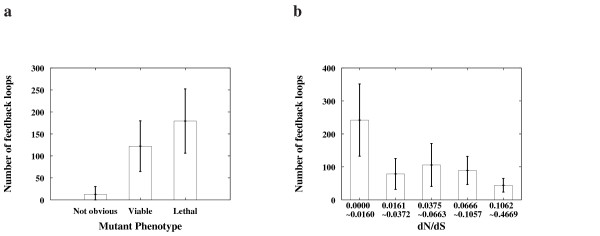
We discovered that the number of feedback loops (NuFBL) is a crucial measure for evaluating the importance of a network node and verified this through a signal transduction network in the hippocampal CA1 neuron of mice as well as through generalized biological network models represented by Boolean networks. In particular, we observed that the proteins with a larger NuFBL are more likely to be essential and to evolve slowly in the hippocampal CA1 neuronal signal transduction network. Then, from extensive simulations based on the Boolean network models, we proved that a network node with the larger NuFBL is likely to be more important as the mutations of the initial state or the update rule of such a node made the network converge to a different attractor. These results led us to infer that such a strong positive correlation between the NuFBL and the importance of a network node might be an intrinsic principle of biological networks in view of network dynamics.
The presented analysis on topological characteristics of biological networks showed that the number of feedback loops is positively correlated with the functional importance of network nodes. This result also suggests the existence of unknown feedback loops around functionally important nodes in biological networks.
已经开展了多项关于生物网络的研究,以揭示能够解释网络节点功能重要性的拓扑特征。例如,此前曾为此目的提出了连通性、聚类系数和最短路径长度等指标。然而,仍迫切需要研究另一种能够更好地描述网络节点功能重要性的拓扑度量。在这方面,我们考虑了在各种生物网络中普遍存在的反馈回路。
我们发现反馈回路数量(NuFBL)是评估网络节点重要性的关键指标,并通过小鼠海马CA1神经元中的信号转导网络以及由布尔网络表示的广义生物网络模型对此进行了验证。特别是,我们观察到在海马CA1神经元信号转导网络中,具有较大NuFBL的蛋白质更有可能是必需的且进化缓慢。然后,基于布尔网络模型进行的大量模拟证明,具有较大NuFBL的网络节点可能更重要,因为该节点的初始状态或更新规则的突变会使网络收敛到不同的吸引子。鉴于网络动态性,这些结果使我们推断NuFBL与网络节点重要性之间如此强的正相关可能是生物网络的内在原理。
对生物网络拓扑特征的分析表明,反馈回路数量与网络节点的功能重要性呈正相关。这一结果还表明在生物网络中功能重要节点周围存在未知的反馈回路。