Zemojtel Tomasz, Penzkofer Tobias, Schultz Jörg, Dandekar Thomas, Badge Richard, Vingron Martin
Department of Computational Molecular Biology, Max-Planck-Institute for Molecular Genetics, Ihnestrasse 73, D-14195 Berlin, Germany.
BMC Genomics. 2007 Oct 26;8:392. doi: 10.1186/1471-2164-8-392.
Long interspersed nuclear elements (LINE-1s, L1s) have been recently implicated in the regulation of mammalian transcriptomes.
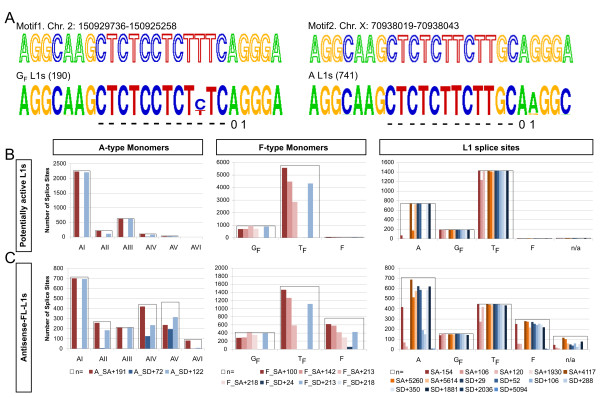
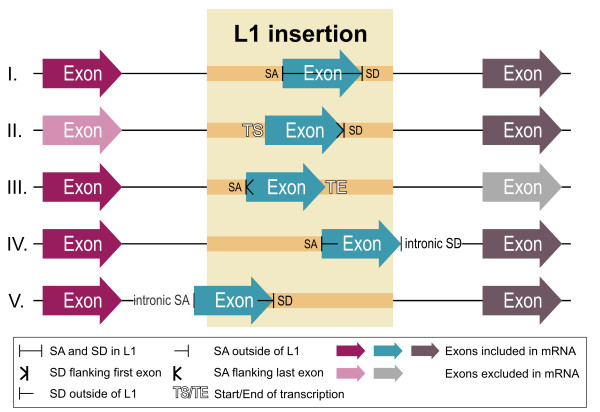
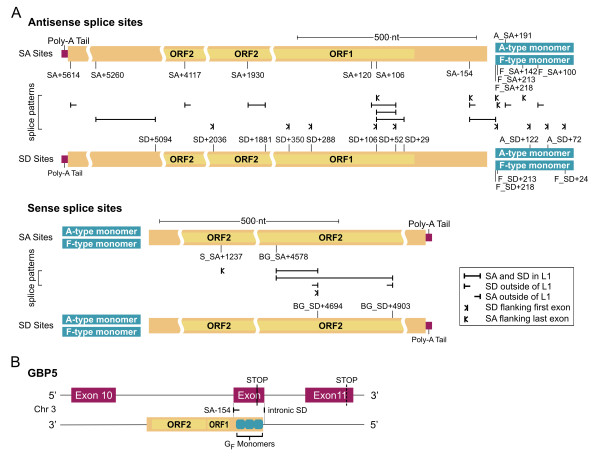
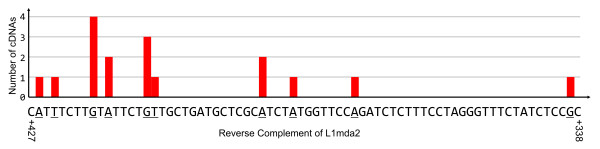
Here, we show that members of the three active mouse L1 subfamilies (A, GF and TF) contain, in addition to those on their sense strands, conserved functional splice sites on their antisense strands, which trigger multiple exonization events. The latter is particularly intriguing in the light of the strong antisense orientation bias of intronic L1s, implying that the toleration of antisense insertions results in an increased potential for exonization.
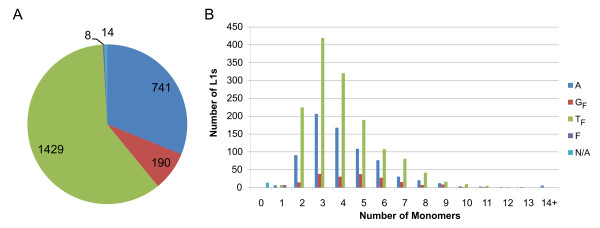
In a genome-wide analysis, we have uncovered evidence suggesting that the mobility of the large number of retrotransposition-competent mouse L1s (approximately 2400 potentially active L1s in NCBIm35) has significant potential to shape the mouse transcriptome by continuously generating insertions into transcriptional units.
长散在核元件(LINE-1s,L1s)最近被认为参与哺乳动物转录组的调控。
在此,我们表明,三个活跃的小鼠L1亚家族(A、GF和TF)的成员,除了其正义链上的那些位点外,其反义链上还含有保守的功能性剪接位点,这些位点会引发多个外显子化事件。鉴于内含子L1s强烈的反义方向偏向性,后者尤其引人关注,这意味着反义插入的耐受性会导致外显子化的可能性增加。
在全基因组分析中,我们发现有证据表明,大量具有逆转录转座能力的小鼠L1s(在NCBIm35中约有2400个潜在活跃的L1s)的移动性具有通过持续向转录单元中插入片段来塑造小鼠转录组的巨大潜力。