Department of Ecology, University of Michigan, Ann Arbor, Michigan, United States of America.
PLoS Negl Trop Dis. 2007 Oct 22;1(1):e33. doi: 10.1371/journal.pntd.0000033.
Early warning systems (EWS) are management tools to predict the occurrence of epidemics of infectious diseases. While climate-based EWS have been developed for malaria, no standard protocol to evaluate and compare EWS has been proposed. Additionally, there are several neglected tropical diseases whose transmission is sensitive to environmental conditions, for which no EWS have been proposed, though they represent a large burden for the affected populations.
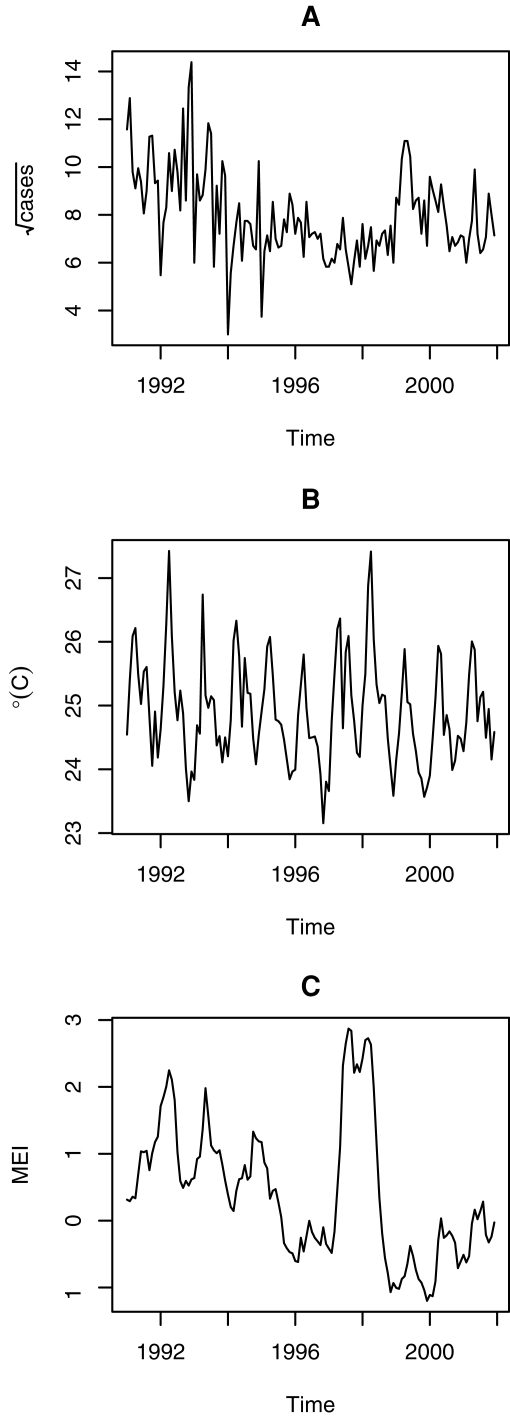
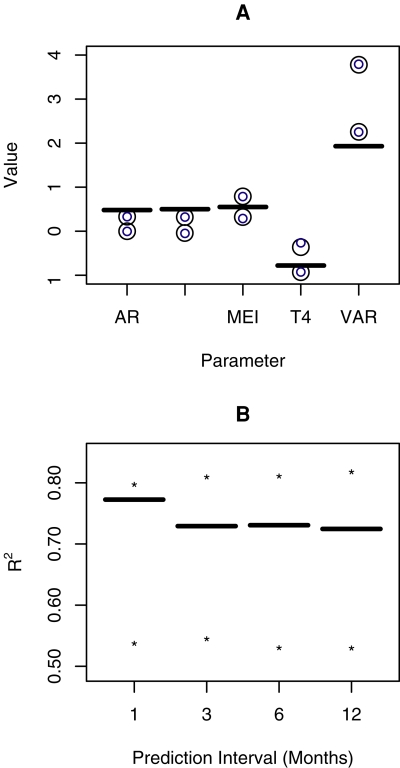
METHODOLOGY/PRINCIPAL FINDINGS: In the present paper, an overview of the available linear and non-linear tools to predict seasonal time series of diseases is presented. Also, a general methodology to compare and evaluate models for prediction is presented and illustrated using American cutaneous leishmaniasis, a neglected tropical disease, as an example. The comparison of the different models using the predictive R(2) for forecasts of "out-of-fit" data (data that has not been used to fit the models) shows that for the several linear and non-linear models tested, the best results were obtained for seasonal autoregressive (SAR) models that incorporate climatic covariates. An additional bootstrapping experiment shows that the relationship of the disease time series with the climatic covariates is strong and consistent for the SAR modeling approach. While the autoregressive part of the model is not significant, the exogenous forcing due to climate is always statistically significant. Prediction accuracy can vary from 50% to over 80% for disease burden at time scales of one year or shorter.
CONCLUSIONS/SIGNIFICANCE: this study illustrates a protocol for the development of EWS that includes three main steps: (i) the fitting of different models using several methodologies, (ii) the comparison of models based on the predictability of "out-of-fit" data, and (iii) the assessment of the robustness of the relationship between the disease and the variables in the model selected as best with an objective criterion.
预警系统(EWS)是预测传染病流行的管理工具。虽然已经开发出基于气候的疟疾预警系统,但尚未提出评估和比较 EWS 的标准协议。此外,还有几种被忽视的热带病,其传播对环境条件敏感,但尚未提出 EWS,尽管它们对受影响的人群造成了很大的负担。
方法/主要发现:本文概述了可用于预测疾病季节性时间序列的线性和非线性工具。还提出了一种比较和评估预测模型的通用方法,并使用被忽视的热带病——美国皮肤利什曼病作为示例进行了说明。使用预测“失配”数据(未用于拟合模型的数据)的预测 R²比较不同模型表明,在所测试的几种线性和非线性模型中,包含气候协变量的季节性自回归(SAR)模型的结果最佳。此外,bootstrap 实验表明,疾病时间序列与气候协变量之间的关系对于 SAR 建模方法是强大且一致的。虽然模型的自回归部分不显著,但由于气候引起的外生强制作用始终具有统计学意义。对于一年或更短时间尺度的疾病负担,预测精度可以从 50%到 80%以上不等。
结论/意义:本研究说明了一种 EWS 开发的协议,包括三个主要步骤:(i)使用多种方法拟合不同的模型,(ii)基于“失配”数据的可预测性比较模型,以及(iii)使用客观标准评估所选最佳模型中疾病与变量之间关系的稳健性。