Herbert Karl E, Mistry Yogita, Hastings Richard, Poolman Toryn, Niklason Laura, Williams Bryan
Department of Cardiovascular Sciences, University of Leicester, Leicester, UK.
Circ Res. 2008 Feb 1;102(2):201-8. doi: 10.1161/CIRCRESAHA.107.158626. Epub 2007 Nov 8.
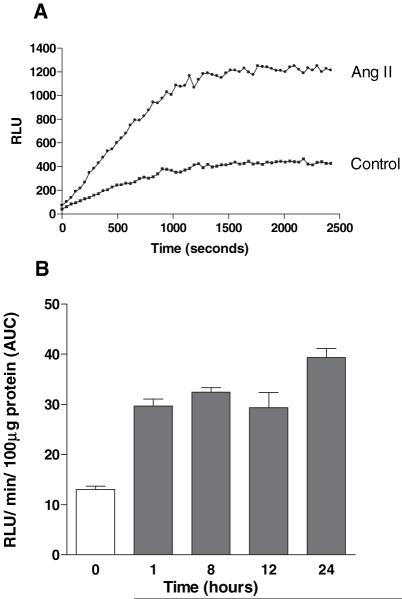
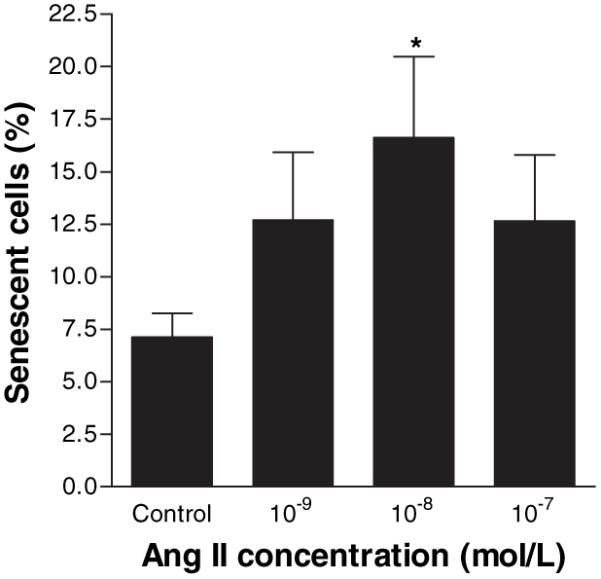
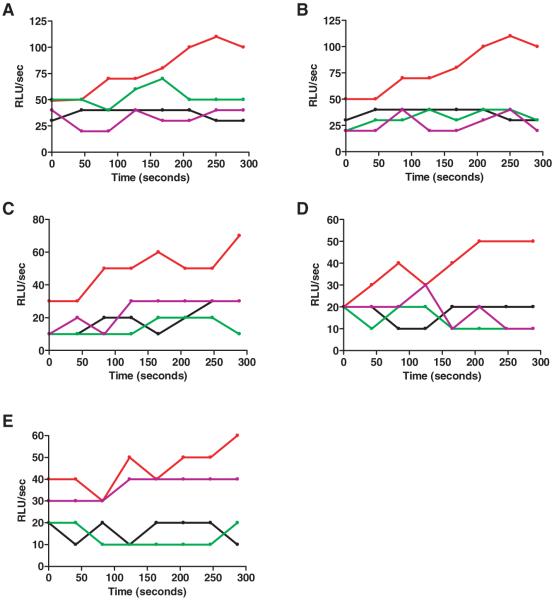
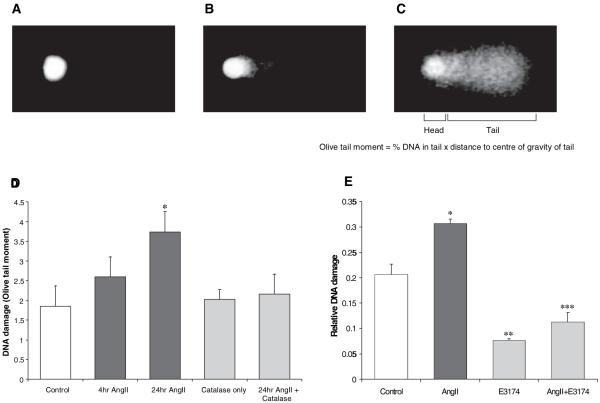
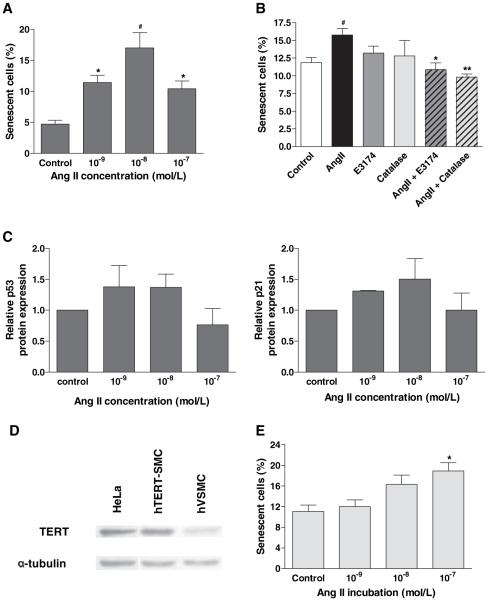
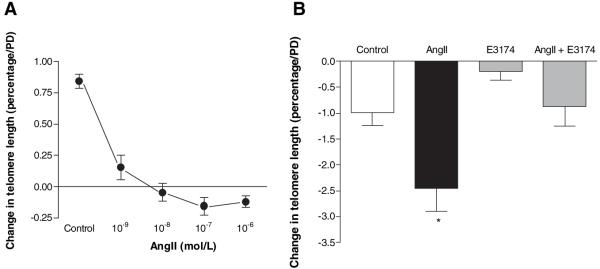
Angiotensin II (Ang II) induces reactive oxygen species (ROS) production by human vascular smooth muscle cells (hVSMCs). ROS have been implicated in the development of both acute stress-induced premature senescence (SIPS) and chronic replicative senescence. Global oxidative DNA damage triggers SIPS and telomere DNA damage accelerates replicative senescence, both mediated via p53. This study tests the hypothesis that DNA is an important target for Ang II-induced ROS leading to senescence via telomere-dependent and independent pathways. DNA damage was quantified using the Comet assay, telomere DNA length by Southern blotting and hVSMC senescence by senescence-associated beta-galactosidase staining. Exposure to Ang II increased DNA damage in hVSMCs within 4 hours. Inhibition by an AT1 receptor antagonist (losartan metabolite: E3174) or catalase, confirmed that Ang II-induced DNA damage was AT1 receptor-mediated, via the induction of ROS. Acute exposure to Ang II resulted in SIPS within 24 hours that was prevented by coincubation with E3174 or catalase. SIPS was associated with increased p53 expression but was not dependent on telomere attrition because overexpression of human telomerase did not prevent Ang II-induced SIPS. Exposure to Ang II over several population doublings accelerated the rate of telomere attrition (by >2-fold) and induced premature replicative senescence of hVSMCs--an effect that was also attenuated by E3174 or catalase. These data demonstrate that Ang II-induced ROS-mediated DNA damage results in accelerated biological aging of hVSMCs via 2 mechanisms: (1) Acute SIPS, which is telomere independent, and (2) accelerated replicative senescence which is associated with accelerated telomere attrition.
血管紧张素II(Ang II)可诱导人血管平滑肌细胞(hVSMCs)产生活性氧(ROS)。ROS与急性应激诱导的早衰(SIPS)和慢性复制性衰老的发生均有关联。全身性氧化DNA损伤会引发SIPS,端粒DNA损伤则会加速复制性衰老,二者均通过p53介导。本研究检验了以下假设:DNA是Ang II诱导的ROS导致衰老的重要靶点,其通过端粒依赖性和非依赖性途径发挥作用。使用彗星试验对DNA损伤进行定量,通过Southern印迹法检测端粒DNA长度,并用衰老相关β-半乳糖苷酶染色法检测hVSMC衰老情况。暴露于Ang II 4小时内,hVSMCs中的DNA损伤增加。AT1受体拮抗剂(氯沙坦代谢物:E3174)或过氧化氢酶的抑制作用证实,Ang II诱导的DNA损伤是由AT1受体介导的,通过ROS的诱导实现。急性暴露于Ang II 24小时内会导致SIPS,与E3174或过氧化氢酶共同孵育可预防这种情况。SIPS与p53表达增加有关,但不依赖于端粒损耗,因为人端粒酶的过表达并不能预防Ang II诱导的SIPS。经过几次群体倍增后暴露于Ang II会加速端粒损耗速率(超过2倍),并诱导hVSMCs过早出现复制性衰老——E3174或过氧化氢酶也可减弱这种效应。这些数据表明Ang II诱导的ROS介导的DNA损伤通过两种机制导致hVSMCs生物衰老加速:(1)急性SIPS,其不依赖于端粒;(2)加速的复制性衰老,其与加速的端粒损耗有关。