Jin Guangxu, Zhang Shihua, Zhang Xiang-Sun, Chen Luonan
Academy of Mathematics and Systems Science, Chinese Academy of Science, Beijing, China.
PLoS One. 2007 Nov 21;2(11):e1207. doi: 10.1371/journal.pone.0001207.
It has been recognized that modular organization pervades biological complexity. Based on network analysis, 'party hubs' and 'date hubs' were proposed to understand the basic principle of module organization of biomolecular networks. However, recent study on hubs has suggested that there is no clear evidence for coexistence of 'party hubs' and 'date hubs'. Thus, an open question has been raised as to whether or not 'party hubs' and 'date hubs' truly exist in yeast interactome.
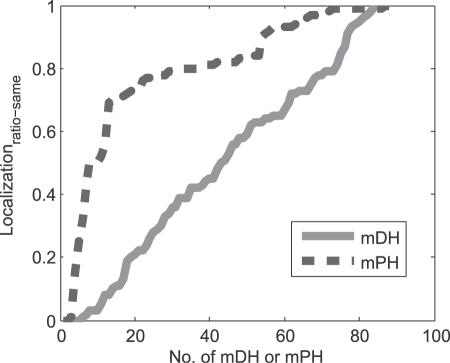
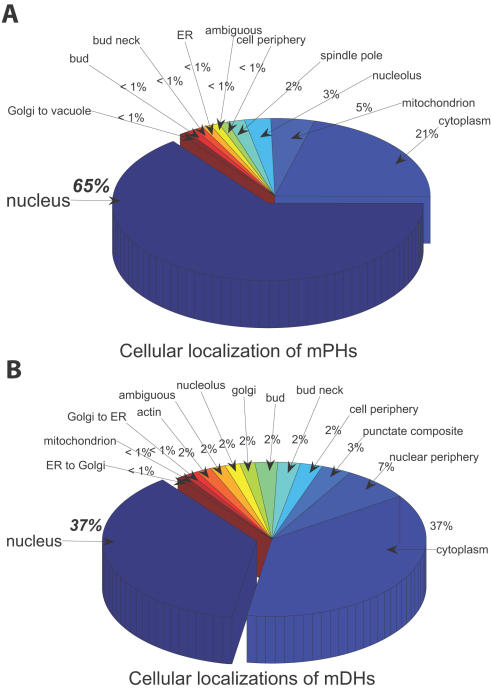
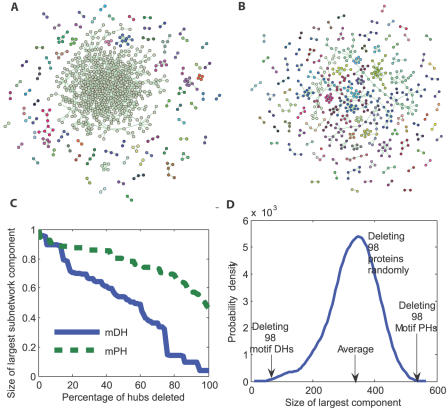
In contrast to previous studies focusing on the partners of a hub or the individual proteins around the hub, our work aims to study the network motifs of a hub or interactions among individual proteins including the hub and its neighbors. Depending on the relationship between a hub's network motifs and protein complexes, we define two new types of hubs, 'motif party hubs' and 'motif date hubs', which have the same characteristics as the original 'party hubs' and 'date hubs' respectively. The network motifs of these two types of hubs display significantly different features in spatial distribution (or cellular localizations), co-expression in microarray data, controlling topological structure of network, and organizing modularity.
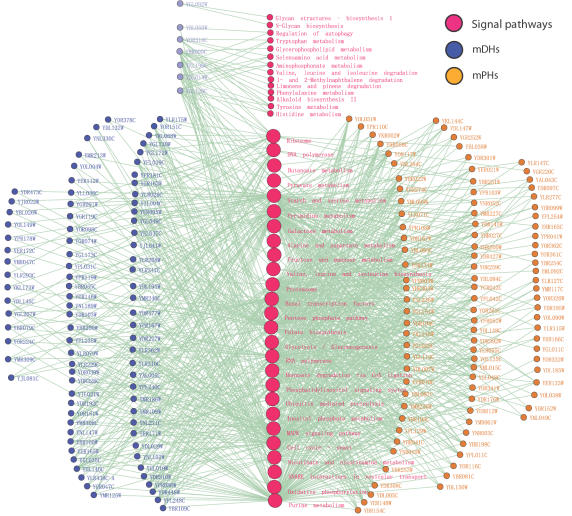
By virtue of network motifs, we basically solved the open question about 'party hubs' and 'date hubs' which was raised by previous studies. Specifically, at the level of network motifs instead of individual proteins, we found two types of hubs, motif party hubs (mPHs) and motif date hubs (mDHs), whose network motifs display distinct characteristics on biological functions. In addition, in this paper we studied network motifs from a different viewpoint. That is, we show that a network motif should not be merely considered as an interaction pattern but be considered as an essential function unit in organizing modules of networks.
人们已经认识到模块化组织遍及生物复杂性。基于网络分析,提出了“聚会中心”和“约会中心”来理解生物分子网络模块化组织的基本原理。然而,最近关于中心节点的研究表明,没有明确证据支持“聚会中心”和“约会中心”共存。因此,一个开放性问题被提出,即在酵母相互作用组中“聚会中心”和“约会中心”是否真的存在。
与之前专注于中心节点的伙伴或中心节点周围单个蛋白质的研究不同,我们的工作旨在研究中心节点的网络基序或包括中心节点及其邻居在内的单个蛋白质之间的相互作用。根据中心节点的网络基序与蛋白质复合物之间的关系,我们定义了两种新的中心节点类型,“基序聚会中心”和“基序约会中心”,它们分别具有与原始的“聚会中心”和“约会中心”相同的特征。这两种类型的中心节点的网络基序在空间分布(或细胞定位)、微阵列数据中的共表达、控制网络的拓扑结构以及组织模块性方面表现出显著不同的特征。
借助网络基序,我们基本解决了先前研究提出的关于“聚会中心”和“约会中心”的开放性问题。具体而言,在网络基序而非单个蛋白质的层面上,我们发现了两种类型的中心节点,即基序聚会中心(mPHs)和基序约会中心(mDHs),它们的网络基序在生物学功能上表现出不同的特征。此外,在本文中我们从不同的角度研究了网络基序。也就是说,我们表明网络基序不应仅仅被视为一种相互作用模式,而应被视为组织网络模块的基本功能单元。