Sentissi Othman, Epelbaum Jacques, Olié Jean-Pierre, Poirier Marie-France
Hopital Sainte-Anne, SHU Psychiatry, CH Sainte-Anne, Paris, France.
Schizophr Bull. 2008 Nov;34(6):1189-99. doi: 10.1093/schbul/sbm141. Epub 2007 Dec 28.
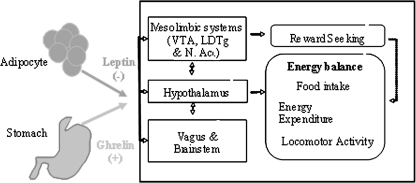
Energy homeostasis is achieved by the integration of peripheral metabolic signals by the neural circuits involving specific hypothalamic nuclei and brain stem regions. These neural circuits mediate many of the effects of the adipocyte-derived hormone leptin and gut-derived hormone ghrelin. The former is strongly anorexigenic while the latter is the only orexigenic agent active when administered by a peripheral route. Abnormal regulation of these 2 antagonistic regulatory peptides in patients with schizophrenia could play a role in the impairment in the regulation of food intake and energy balance. This bibliographical analysis aims to compare 27 prospective and cross-sectional studies published on circulating leptin and ghrelin levels during acute and chronic administration of antipsychotics treatment, especially atypical ones. Fasting morning leptin levels of schizophrenic patients increase rapidly in the first 2 weeks after atypical antipsychotic (AAP) treatment (mostly olanzapine and clozapine) and remain somehow elevated after that period up to several months. On the contrary, conventional antipsychotics (such as haloperidol) do not interfere with leptin levels. In contrast to leptin, fasting morning ghrelin levels decrease during the first few weeks after the beginning of AAPs treatment while they increase in the longer run. Surprisingly, body weight gain and correlations between the variation of these 2 peptides and adiposity and metabolism-related parameters such as the body mass index and abdominal perimeter were not systematically considered. Finally, an objective evaluation of feeding behavior during antipsychotic treatment remains to be determined.
能量稳态是通过涉及特定下丘脑核团和脑干区域的神经回路整合外周代谢信号来实现的。这些神经回路介导了脂肪细胞衍生激素瘦素和肠道衍生激素胃饥饿素的许多作用。前者具有强烈的厌食作用,而后者是唯一经外周途径给药时具有活性的促食欲剂。精神分裂症患者中这两种拮抗调节肽的异常调节可能在食物摄入和能量平衡调节受损中起作用。本文献分析旨在比较27项关于抗精神病药物治疗(尤其是非典型药物)急性和慢性给药期间循环瘦素和胃饥饿素水平的前瞻性和横断面研究。精神分裂症患者空腹晨瘦素水平在非典型抗精神病药物(AAP)治疗(主要是奥氮平和氯氮平)后的前2周迅速升高,在此之后的几个月内仍保持某种程度的升高。相反,传统抗精神病药物(如氟哌啶醇)不会干扰瘦素水平。与瘦素相反,空腹晨胃饥饿素水平在AAPs治疗开始后的最初几周内下降,而从长远来看则会升高。令人惊讶的是,体重增加以及这两种肽的变化与肥胖和代谢相关参数(如体重指数和腹围)之间的相关性并未得到系统考虑。最后,抗精神病药物治疗期间进食行为的客观评估仍有待确定。