de Boer Jetske G, Hordijk Cornelis A, Posthumus Maarten A, Dicke Marcel
Laboratory of Entomology, Wageningen University, P.O. Box 8031, 6700 EH, Wageningen, The Netherlands.
J Chem Ecol. 2008 Mar;34(3):281-90. doi: 10.1007/s10886-007-9405-z. Epub 2008 Jan 10.
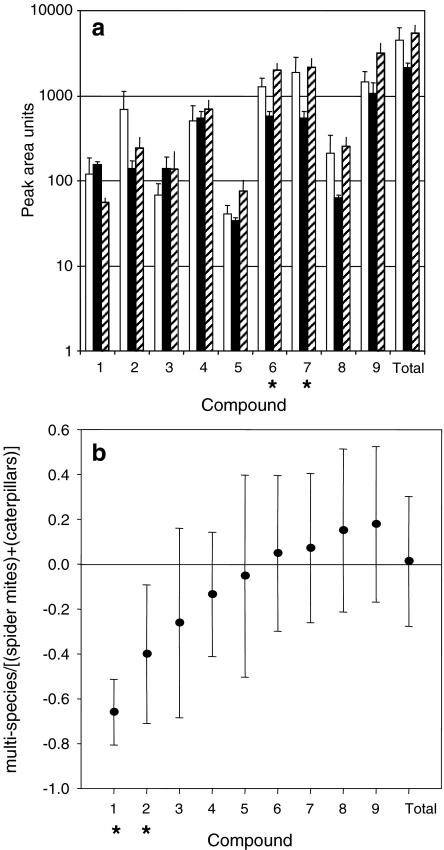
It is well established that plants infested with a single herbivore species can attract specific natural enemies through the emission of herbivore-induced volatiles. However, it is less clear what happens when plants are simultaneously attacked by more than one species. We analyzed volatile emissions of lima bean and cucumber plants upon multi-species herbivory by spider mites (Tetranychus urticae) and caterpillars (Spodoptera exigua) in comparison to single-species herbivory. Upon herbivory by single or multiple species, lima bean and cucumber plants emitted volatile blends that comprised mostly the same compounds. To detect additive, synergistic, or antagonistic effects, we compared the multi-species herbivory volatile blend with the sum of the volatile blends induced by each of the herbivore species feeding alone. In lima bean, the majority of compounds were more strongly induced by multi-species herbivory than expected based on the sum of volatile emissions by each of the herbivores separately, potentially caused by synergistic effects. In contrast, in cucumber, two compounds were suppressed by multi-species herbivory, suggesting the potential for antagonistic effects. We also studied the behavioral responses of the predatory mite Phytoseiulus persimilis, a specialized natural enemy of spider mites. Olfactometer experiments showed that P. persimilis preferred volatiles induced by multi-species herbivory to volatiles induced by S. exigua alone or by prey mites alone. We conclude that both lima bean and cucumber plants effectively attract predatory mites upon multi-species herbivory, but the underlying mechanisms appear different between these species.
众所周知,受到单一食草动物物种侵害的植物可以通过释放食草动物诱导的挥发物来吸引特定的天敌。然而,当植物同时受到多种物种攻击时会发生什么,目前尚不清楚。我们分析了利马豆和黄瓜植株在受到叶螨(二斑叶螨)和毛虫(甜菜夜蛾)多物种取食时的挥发物排放情况,并与单一物种取食进行了比较。在受到单一或多种物种取食时,利马豆和黄瓜植株释放的挥发性混合物大多由相同的化合物组成。为了检测加性、协同或拮抗作用,我们将多物种取食的挥发性混合物与每种食草动物单独取食诱导的挥发性混合物之和进行了比较。在利马豆中,大多数化合物在多物种取食时比根据每种食草动物单独排放的挥发物之和预期的诱导作用更强,这可能是由协同作用引起的。相比之下,在黄瓜中,两种化合物在多物种取食时受到抑制,表明存在拮抗作用的可能性。我们还研究了捕食螨加州新小绥螨(一种叶螨的专门天敌)的行为反应。嗅觉仪实验表明,加州新小绥螨更喜欢多物种取食诱导的挥发物,而不是甜菜夜蛾单独诱导的挥发物或仅由猎物螨诱导的挥发物。我们得出结论,利马豆和黄瓜植株在多物种取食时都能有效地吸引捕食螨,但这些物种之间的潜在机制似乎有所不同。