Berglund S, Grunewald C, Pettersson H, Cnattingius S
Department of Clinical Science and Education, Södersjukhuset, Karolinska Institute, Stockholm, Sweden.
BJOG. 2008 Feb;115(3):316-23. doi: 10.1111/j.1471-0528.2007.01602.x.
To describe possible causes of delivery-related severe asphyxia due to malpractice.
A nationwide descriptive study in Sweden.
All women asking for financial compensation because of suspected medical malpractice in connection with childbirth during 1990-2005.
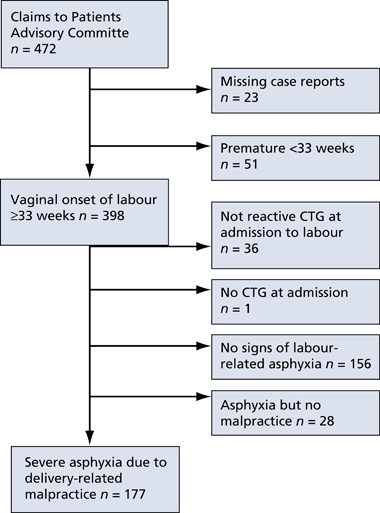
We included infants with a gestational age of >or=33 completed gestational weeks, a planned vaginal onset of delivery, reactive cardiotocography at admission for labour and severe asphyxia-related outcomes presumably due to malpractice. As asphyxia-related outcomes, we included cases of neonatal death and infants with diagnosed encephalopathy before the age of 28 days.
Severe asphyxia due to malpractice during labour.
A total of 472 case records were scrutinised. One hundred and seventy-seven infants were considered to suffer from severe asphyxia due to malpractice around labour. The most common events of malpractice in connection with delivery were neglecting to supervise fetal wellbeing in 173 cases (98%), neglecting signs of fetal asphyxia in 126 cases (71%), including incautious use of oxytocin in 126 cases (71%) and choosing a nonoptimal mode of delivery in 92 cases (52%).
There is a great need and a challenge to improve cooperation and to create security barriers within our labour units. The most common cause of malpractice is that stated guidelines for fetal surveillance are not followed. Midwives and obstetricians need to improve their shared understanding of how to act in cases of imminent fetal asphyxia and how to choose a timely and optimal mode of delivery.
描述因医疗失误导致的分娩相关严重窒息的可能原因。
在瑞典开展的一项全国性描述性研究。
1990年至2005年期间,所有因怀疑分娩时存在医疗失误而要求经济赔偿的女性。
我们纳入了孕周≥33周、计划经阴道分娩、入院待产时胎心监护反应型且可能因医疗失误导致严重窒息相关后果的婴儿。作为窒息相关后果,我们纳入了新生儿死亡病例以及出生28天内被诊断为脑病的婴儿。
分娩时因医疗失误导致的严重窒息。
共审查了472份病例记录。177名婴儿被认为在分娩前后因医疗失误而遭受严重窒息。与分娩相关的最常见医疗失误事件包括:173例(98%)未监测胎儿健康状况,126例(71%)未注意到胎儿窒息迹象,其中126例(71%)包括催产素使用不当,92例(52%)选择了非最佳分娩方式。
在我们的产房内,非常需要且面临挑战的是改善合作并建立安全屏障。最常见的医疗失误原因是未遵循规定的胎儿监测指南。助产士和产科医生需要更好地共同理解在胎儿即将窒息的情况下如何采取行动以及如何选择及时且最佳的分娩方式。