Herbeck Diane M, Hser Yih-Ing, Teruya Cheryl
Integrated Substance Abuse Programs, Semel Institute for Neuroscience and Human Behavior, University of California, Los Angeles, 1640 South Sepulveda Boulevard Suite 200, Los Angeles, CA 90025, USA.
Addict Behav. 2008 May;33(5):699-712. doi: 10.1016/j.addbeh.2007.12.003. Epub 2007 Dec 23.
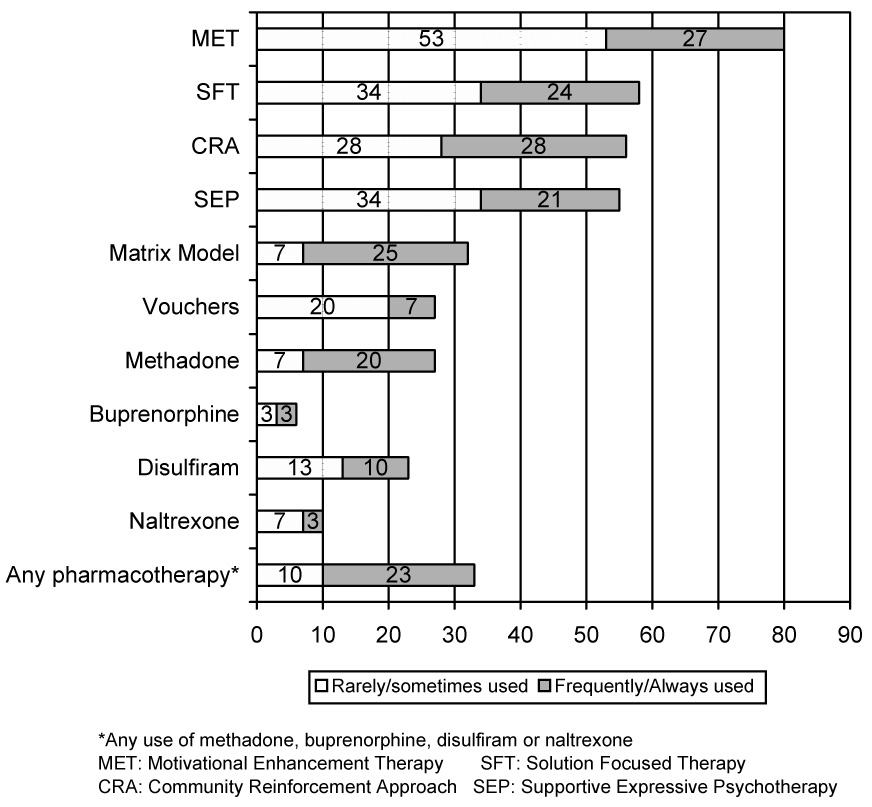
To better understand the extent that empirically supported and promising substance abuse treatment approaches are implemented in community settings, treatment providers were surveyed regarding their perceptions and use of several psychosocial and pharmacological treatment interventions. Program directors (n=30) and staff members (n=331) from diverse community settings rated the effectiveness and extent of use of various treatment interventions, and provided information on program and workforce characteristics via self-administered questionnaires. On average, program directors and staff rated the psychosocial treatment interventions as effective, with the exception of vouchers/motivational incentives. About half of the treatment providers did not know the effectiveness of certain pharmacological treatments, including buprenorphine and naltrexone. Respondents from the majority of programs (55%-80%) reported using Motivational Enhancement Therapy, Community Reinforcement Approach, and Supportive Expressive Psychotherapy. The extent that programs used several of the treatment interventions was related to organizational training and information resources. The study findings provide important information regarding training and research dissemination efforts.
为了更好地了解在社区环境中实施经实证支持且有前景的药物滥用治疗方法的程度,对治疗提供者就他们对几种心理社会和药物治疗干预措施的看法及使用情况进行了调查。来自不同社区环境的项目主任(n = 30)和工作人员(n = 331)对各种治疗干预措施的有效性和使用程度进行了评分,并通过自填式问卷提供了有关项目和劳动力特征的信息。平均而言,项目主任和工作人员认为心理社会治疗干预措施有效,但代金券/激励性奖励措施除外。约一半的治疗提供者不知道某些药物治疗的有效性,包括丁丙诺啡和纳曲酮。大多数项目(55%-80%)的受访者报告使用了动机增强疗法、社区强化法和支持性表达心理治疗。项目使用几种治疗干预措施的程度与组织培训和信息资源有关。研究结果为培训和研究传播工作提供了重要信息。