Vio Karin, Rodríguez Sara, Yulis Carlos R, Oliver Cristian, Rodríguez Esteban M
Instituto de Anatomía, Histología y Patología, Facultad de Medicina, Universidad Austral de Chile, Valdivia, Chile.
Cerebrospinal Fluid Res. 2008 Jan 24;5:3. doi: 10.1186/1743-8454-5-3.
The subcommissural organ (SCO) is a highly conserved brain gland present throughout the vertebrate phylum; it secretes glycoproteins into the cerebrospinal fluid (CSF), where they aggregate to form Reissner's fiber (RF). SCO-spondin is the major constituent protein of RF. Evidence exists that the SCO also secretes proteins that remain soluble in the CSF. The aims of the present investigation were: (i) to identify and partially characterize the SCO-secretory compounds present in the SCO gland itself and in the RF of the Sprague-Dawley rat and non-hydrocephalic hyh mouse, and in the CSF of rat; (ii) to make a comparative analysis of the proteins present in these three compartments; (iii) to identify the proteins secreted by the SCO into the CSF at different developmental periods.
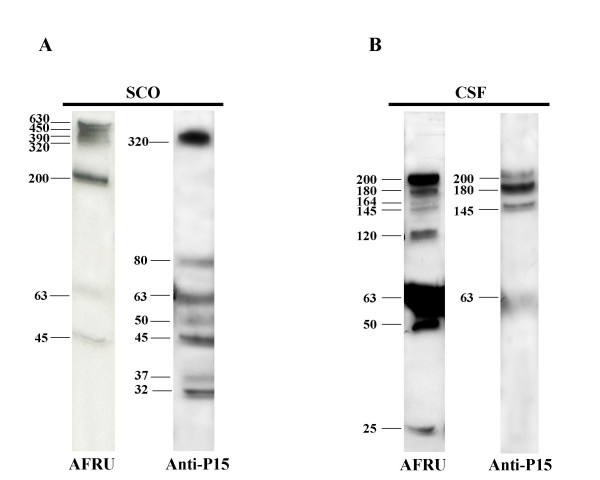
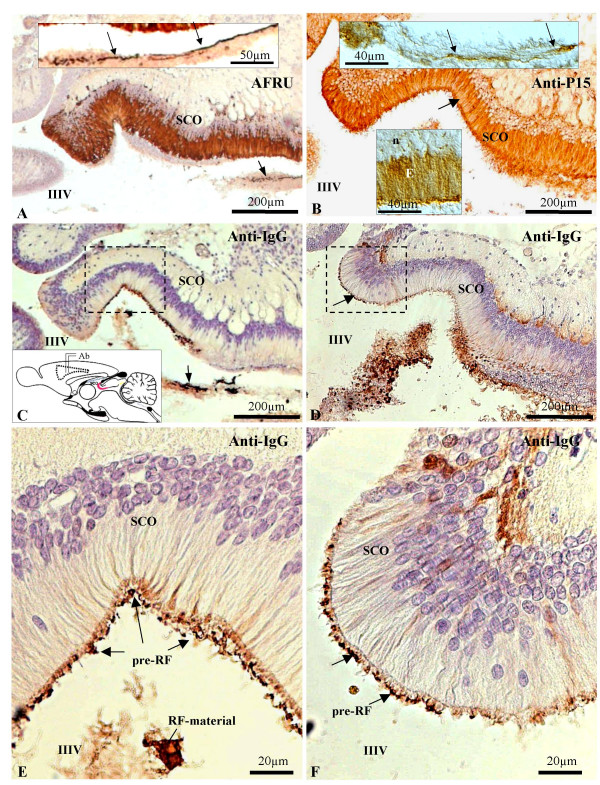
The proteins of the SCO secreted into the CSF were studied (i) by injecting specific antibodies into ventricular CSF in vivo; (ii) by immunoblots of SCO, RF and CSF samples, using specific antibodies against the SCO secretory proteins (AFRU and anti-P15). In addition, the glycosylated nature of SCO-compounds was analysed by concanavalin A and wheat germ agglutinin binding. To analyse RF-glycoproteins, RF was extracted from the central canal of juvenile rats and mice; to investigate the CSF-soluble proteins secreted by the SCO, CSF samples were collected from the cisterna magna of rats at different stages of development (from E18 to PN30).
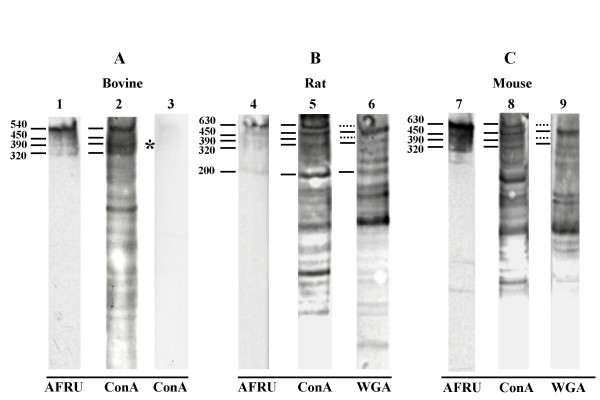
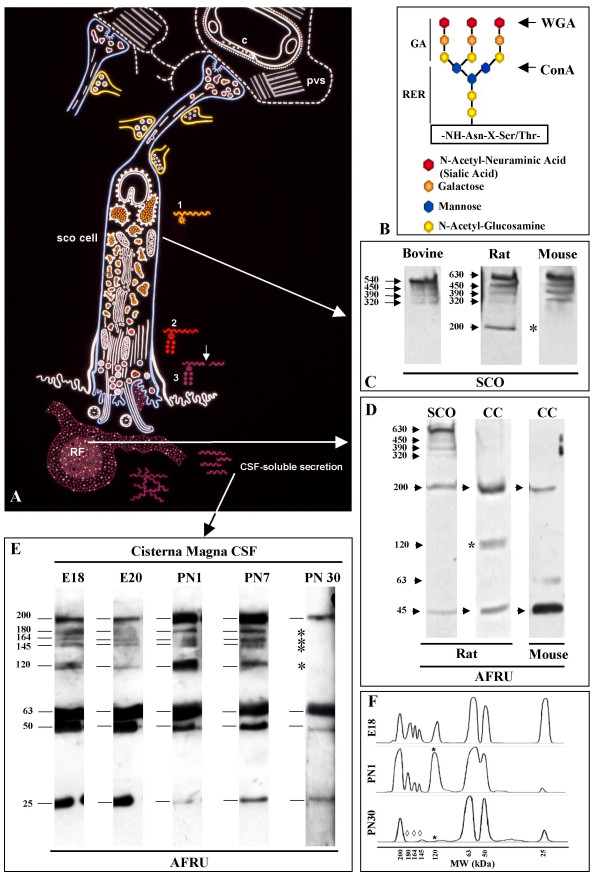
Five glycoproteins were identified in the rat SCO with apparent molecular weights of 630, 450, 390, 320 and 200 kDa. With the exception of the 200-kDa compound, all other compounds present in the rat SCO were also present in the mouse SCO. The 630 and 390 kDa compounds of the rat SCO have affinity for concanavalin A but not for wheat germ agglutinin, suggesting that they correspond to precursor forms. Four of the AFRU-immunoreactive compounds present in the SCO (630, 450, 390, 320 kDa) were absent from the RF and CSF. These may be precursor and/or partially processed forms. Two other compounds (200, 63 kDa) were present in SCO, RF and CSF and may be processed forms. The presence of these proteins in both, RF and CSF suggests a steady-state RF/CSF equilibrium for these compounds. Eight AFRU-immunoreactive bands were consistently found in CSF samples from rats at E18, E20 and PN1. Only four of these compounds were detected in the cisternal CSF of PN30 rats. The 200 kDa compound appears to be a key compound in rats since it was consistently found in all samples of SCO, RF and embryonic and juvenile CSF.
It is concluded that (i) during the late embryonic life, the rat SCO secretes compounds that remain soluble in the CSF and reach the subarachnoid space; (ii) during postnatal life, there is a reduction in the number and concentration of CSF-soluble proteins secreted by the SCO. The molecular structure and functional significance of these proteins remain to be elucidated. The possibility they are involved in brain development has been discussed.
连合下器官(SCO)是整个脊椎动物门中高度保守的脑腺;它将糖蛋白分泌到脑脊液(CSF)中,在那里它们聚集形成赖氏纤维(RF)。SCO-spondin是RF的主要组成蛋白。有证据表明,SCO还分泌可溶于脑脊液的蛋白质。本研究的目的是:(i)鉴定并部分表征存在于Sprague-Dawley大鼠和非脑积水hyh小鼠的SCO腺本身、RF以及大鼠脑脊液中的SCO分泌化合物;(ii)对这三个区室中存在的蛋白质进行比较分析;(iii)鉴定SCO在不同发育时期分泌到脑脊液中的蛋白质。
通过以下方法研究分泌到脑脊液中的SCO蛋白:(i)在体内向脑室脑脊液中注射特异性抗体;(ii)使用针对SCO分泌蛋白的特异性抗体(AFRU和抗P15)对SCO、RF和脑脊液样本进行免疫印迹分析。此外,通过伴刀豆球蛋白A和麦胚凝集素结合分析SCO化合物的糖基化性质。为了分析RF糖蛋白,从幼年大鼠和小鼠的中央管中提取RF;为了研究SCO分泌的脑脊液可溶性蛋白,在不同发育阶段(从E18到PN30)从大鼠的枕大池中收集脑脊液样本。
在大鼠SCO中鉴定出五种糖蛋白,其表观分子量分别为630、450、390、320和200 kDa。除了200 kDa的化合物外,大鼠SCO中存在的所有其他化合物在小鼠SCO中也存在。大鼠SCO的630和390 kDa化合物对伴刀豆球蛋白A有亲和力,但对麦胚凝集素没有亲和力,表明它们对应于前体形式。SCO中存在的四种AFRU免疫反应性化合物(630、450、390、320 kDa)在RF和脑脊液中不存在。这些可能是前体和/或部分加工形式。另外两种化合物(200、63 kDa)存在于SCO、RF和脑脊液中,可能是加工形式。这些蛋白质在RF和脑脊液中的存在表明这些化合物存在稳态的RF/脑脊液平衡。在E18、E20和PN1大鼠的脑脊液样本中始终发现八条AFRU免疫反应性条带。在PN30大鼠的枕大池脑脊液中仅检测到其中四种化合物。200 kDa的化合物似乎是大鼠中的关键化合物,因为它始终存在于SCO、RF以及胚胎和幼年脑脊液的所有样本中。
得出以下结论:(i)在胚胎后期,大鼠SCO分泌可溶于脑脊液并到达蛛网膜下腔的化合物;(ii)在出生后,SCO分泌的脑脊液可溶性蛋白的数量和浓度会减少。这些蛋白质的分子结构和功能意义仍有待阐明。已经讨论了它们参与脑发育的可能性。