
全血在 PMMA 表面形貌纳米结构上行为的微流控研究。
A micro-fluidic study of whole blood behaviour on PMMA topographical nanostructures.
机构信息
International Centre for Young Scientists, National Institute for Materials Science, 1-1 Namiki, Tsukuba, Ibaraki 305-0044, Japan.
出版信息
J Nanobiotechnology. 2008 Feb 19;6:3. doi: 10.1186/1477-3155-6-3.
BACKGROUND
Polymers are attractive materials for both biomedical engineering and cardiovascular applications. Although nano-topography has been found to influence cell behaviour, no established method exists to understand and evaluate the effects of nano-topography on polymer-blood interaction.
RESULTS
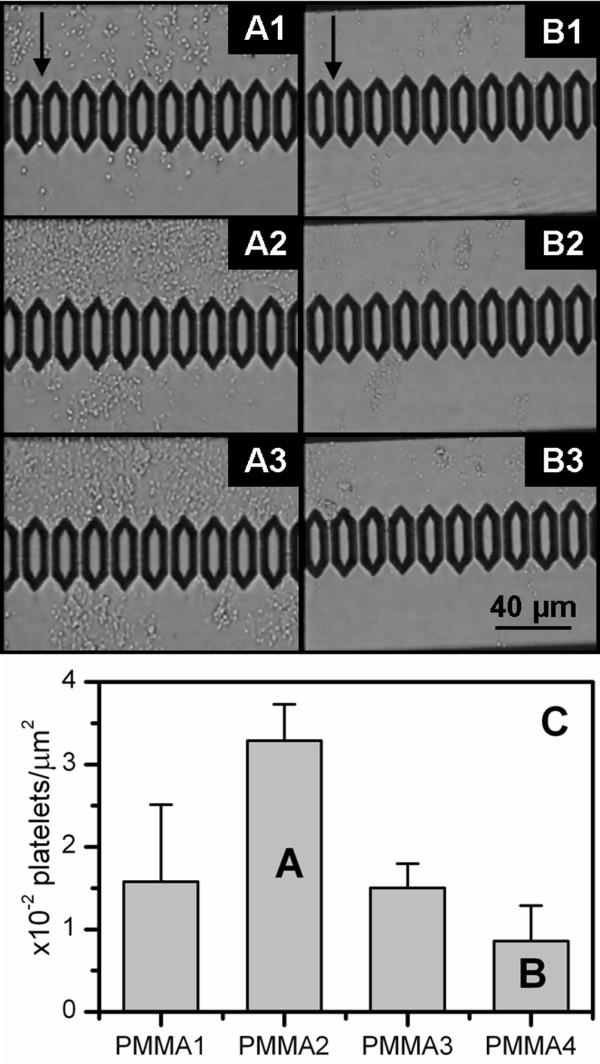
We optimized a micro-fluidic set-up to study the interaction of whole blood with nano-structured polymer surfaces under flow conditions. Micro-fluidic chips were coated with polymethylmethacrylate films and structured by polymer demixing. Surface feature size varied from 40 nm to 400 nm and feature height from 5 nm to 50 nm. Whole blood flow rate through the micro-fluidic channels, platelet adhesion and von Willebrand factor and fibrinogen adsorption onto the structured polymer films were investigated. Whole blood flow rate through the micro-fluidic channels was found to decrease with increasing average surface feature size. Adhesion and spreading of platelets from whole blood and von Willebrand factor adsorption from platelet poor plasma were enhanced on the structured surfaces with larger feature, while fibrinogen adsorption followed the opposite trend.
CONCLUSION
We investigated whole blood behaviour and plasma protein adsorption on nano-structured polymer materials under flow conditions using a micro-fluidic set-up. We speculate that surface nano-topography of polymer films influences primarily plasma protein adsorption, which results in the control of platelet adhesion and thrombus formation.
背景
聚合物是生物医学工程和心血管应用的理想材料。尽管纳米形貌已被发现会影响细胞行为,但目前还没有一种既定的方法来理解和评估纳米形貌对聚合物-血液相互作用的影响。
结果
我们优化了一种微流控装置,以在流动条件下研究全血与纳米结构聚合物表面的相互作用。微流控芯片用聚甲基丙烯酸甲酯薄膜涂覆,并通过聚合物离析进行结构化。表面特征尺寸从 40nm 变化到 400nm,特征高度从 5nm 变化到 50nm。研究了全血在微流道中的流动速率、血小板黏附以及血管性血友病因子和纤维蛋白原在结构化聚合物薄膜上的吸附。全血在微流道中的流动速率随平均表面特征尺寸的增加而降低。在具有较大特征的结构化表面上,全血中血小板的黏附和展开以及从血小板贫血浆中吸附的血管性血友病因子增强,而纤维蛋白原的吸附则呈现相反的趋势。
结论
我们使用微流控装置研究了全血在流动条件下对纳米结构化聚合物材料的行为和血浆蛋白吸附。我们推测聚合物薄膜的表面纳米形貌主要影响血浆蛋白吸附,从而控制血小板黏附和血栓形成。


 Zotero 插件