Laurin Danielle, David Curb J, Masaki Kamal H, White Lon R, Launer Lenore J
Laval University Geriatrics Research Unit, Centre de recherche du CHA, and Faculty of Pharmacy, Laval University, 1050 Chemin Sainte-Foy, Local L2-30, Quebec City, Quebec G1S 4L8, Canada.
Neurobiol Aging. 2009 Nov;30(11):1724-7. doi: 10.1016/j.neurobiolaging.2008.01.008. Epub 2008 Mar 7.
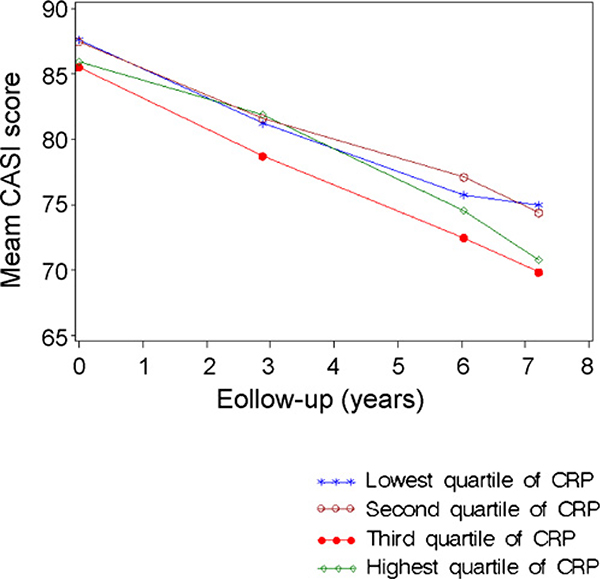
There is evidence for a relationship between raised inflammatory markers, including high sensitivity C-reactive protein (hs-CRP), measured late in life, and an increased risk of cognitive decline and dementia. This study evaluates the association of midlife hs-CRP concentrations with late-life longitudinal trends in cognitive function. Data are from the Honolulu-Asia Aging Study (HAAS), a longitudinal community-based study of Japanese American men. hs-CRP levels were measured on average 25 years before cognitive testing began in 1991. Subjects were followed from up to three follow-up examinations (mean of 6.1 years). At each exam, cognitive function was measured with the Cognitive Abilities Screening Instrument (CASI). This analysis includes a sub-sample of 691 subjects dementia-free in 1991. With incident dementia cases included, those with the highest quartile of hs-CRP had significantly more cognitive decline than those in the lowest quartile, after adjustment for baseline CASI score, demographic and cardiovascular risk factors. When cases were removed, there was no difference in cognitive decline by CRP quartile. This relationship was not modified by the presence of apolipoprotein E varepsilon4. These findings suggest that inflammatory mechanisms during midlife may reflect underlying processes contributing to dementia-related cognitive decline late in life.
有证据表明,包括高敏C反应蛋白(hs-CRP)在内的炎症标志物水平升高与认知能力下降和痴呆症风险增加之间存在关联,这些炎症标志物是在生命后期测量的。本研究评估中年hs-CRP浓度与晚年认知功能纵向变化趋势之间的关联。数据来自檀香山-亚洲老年研究(HAAS),这是一项基于社区的对日本裔美国男性的纵向研究。hs-CRP水平是在1991年认知测试开始前平均25年测量的。对受试者进行了多达三次随访检查(平均6.1年)。每次检查时,使用认知能力筛查工具(CASI)测量认知功能。该分析包括1991年无痴呆症的691名受试者的子样本。纳入新发痴呆症病例后,在对基线CASI评分、人口统计学和心血管危险因素进行调整后,hs-CRP处于最高四分位数的受试者的认知能力下降显著多于最低四分位数的受试者。去除病例后,按CRP四分位数分组的认知能力下降没有差异。这种关系不受载脂蛋白E ε4存在的影响。这些发现表明,中年时期的炎症机制可能反映了导致晚年痴呆症相关认知能力下降的潜在过程。