Laboratory of AI and Biomedical Science (LABS), University of Southern California, Los Angeles, CA, USA.
Artificial Intelligence in Biomedical Imaging Laboratory (AIBIL), Center for AI and Data Science for Integrated Diagnostics (AI2D), Perelman School of Medicine, University of Pennsylvania, Philadelphia, PA, USA.
Transl Psychiatry. 2024 Oct 5;14(1):420. doi: 10.1038/s41398-024-03121-5.
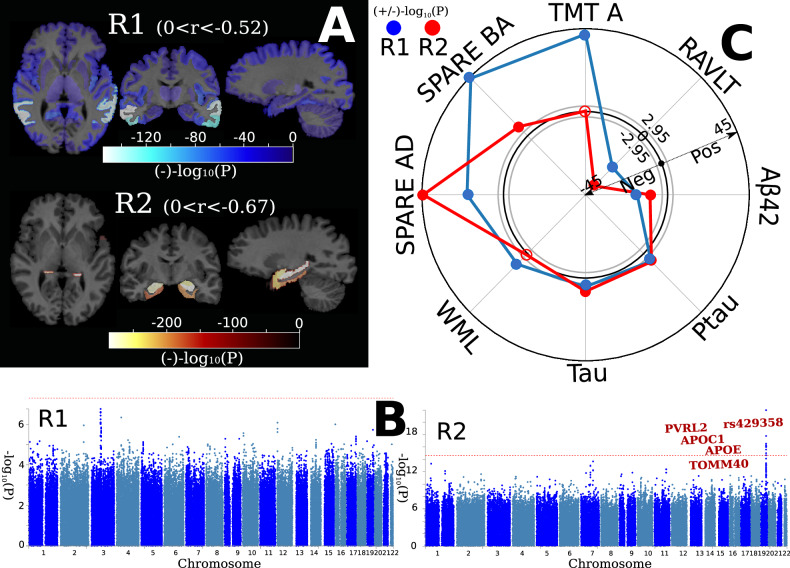
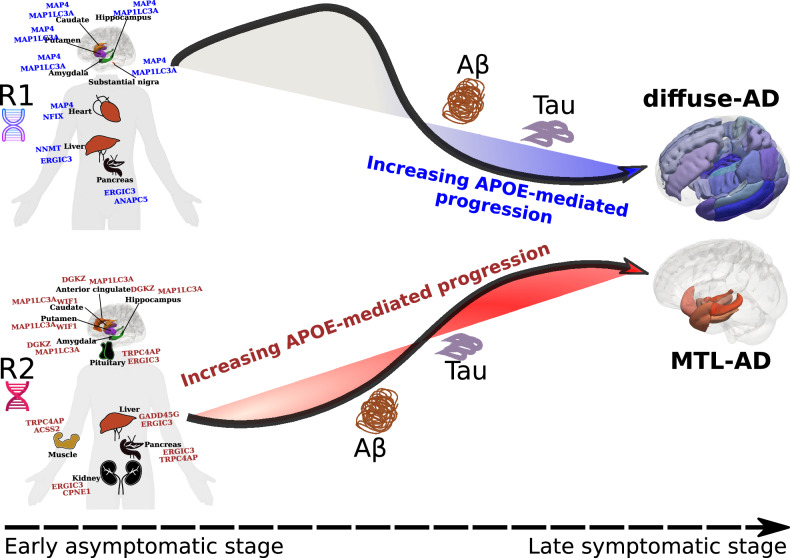
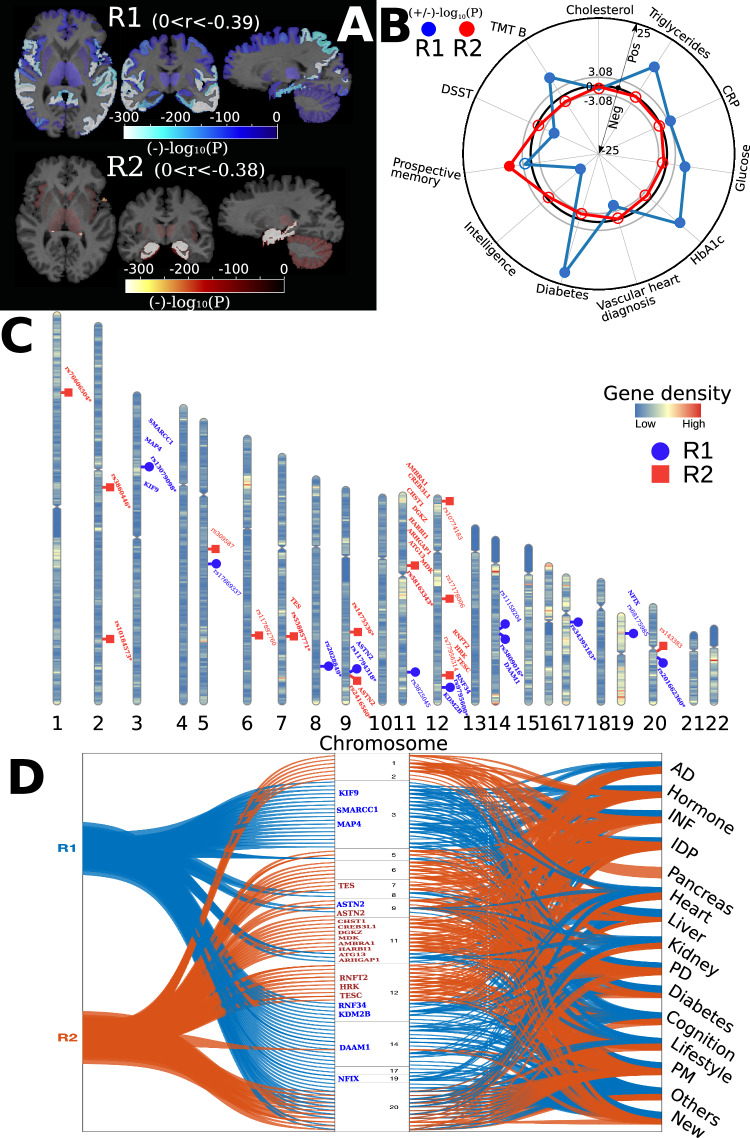
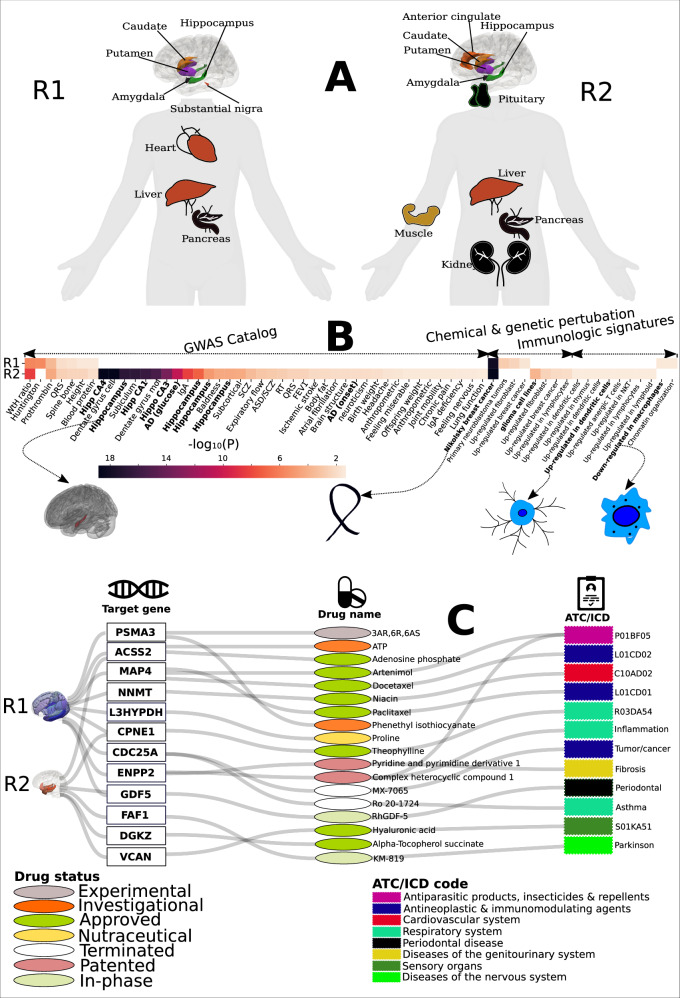
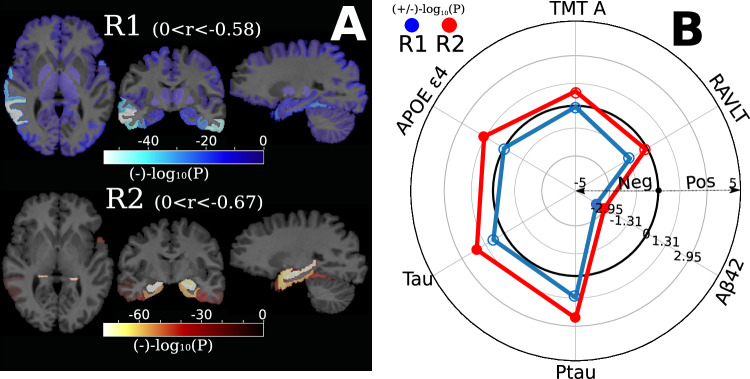
Alzheimer's disease (AD) is associated with heterogeneous atrophy patterns. We employed a semi-supervised representation learning technique known as Surreal-GAN, through which we identified two latent dimensional representations of brain atrophy in symptomatic mild cognitive impairment (MCI) and AD patients: the "diffuse-AD" (R1) dimension shows widespread brain atrophy, and the "MTL-AD" (R2) dimension displays focal medial temporal lobe (MTL) atrophy. Critically, only R2 was associated with widely known sporadic AD genetic risk factors (e.g., APOE ε4) in MCI and AD patients at baseline. We then independently detected the presence of the two dimensions in the early stages by deploying the trained model in the general population and two cognitively unimpaired cohorts of asymptomatic participants. In the general population, genome-wide association studies found 77 genes unrelated to APOE differentially associated with R1 and R2. Functional analyses revealed that these genes were overrepresented in differentially expressed gene sets in organs beyond the brain (R1 and R2), including the heart (R1) and the pituitary gland, muscle, and kidney (R2). These genes were enriched in biological pathways implicated in dendritic cells (R2), macrophage functions (R1), and cancer (R1 and R2). Several of them were "druggable genes" for cancer (R1), inflammation (R1), cardiovascular diseases (R1), and diseases of the nervous system (R2). The longitudinal progression showed that APOE ε4, amyloid, and tau were associated with R2 at early asymptomatic stages, but this longitudinal association occurs only at late symptomatic stages in R1. Our findings deepen our understanding of the multifaceted pathogenesis of AD beyond the brain. In early asymptomatic stages, the two dimensions are associated with diverse pathological mechanisms, including cardiovascular diseases, inflammation, and hormonal dysfunction-driven by genes different from APOE-which may collectively contribute to the early pathogenesis of AD. All results are publicly available at https://labs-laboratory.com/medicine/ .
阿尔茨海默病(AD)与异质萎缩模式有关。我们采用了一种称为 Surreal-GAN 的半监督表示学习技术,通过该技术,我们在有症状的轻度认知障碍(MCI)和 AD 患者中识别了大脑萎缩的两个潜在维度表示:“弥漫性 AD”(R1)维度显示广泛的大脑萎缩,而“MTL-AD”(R2)维度显示局灶性内侧颞叶(MTL)萎缩。关键的是,只有 R2 与 MCI 和 AD 患者基线时众所周知的散发性 AD 遗传风险因素(例如 APOE ε4)相关。然后,我们通过在普通人群和两个认知正常的无症状参与者队列中部署训练好的模型,在早期独立检测到这两个维度的存在。在普通人群中,全基因组关联研究发现了 77 个与 APOE 无关的基因,它们与 R1 和 R2 存在差异关联。功能分析表明,这些基因在大脑以外的器官(R1 和 R2)的差异表达基因集中过度表达,包括心脏(R1)和脑垂体、肌肉和肾脏(R2)。这些基因在与树突细胞(R2)、巨噬细胞功能(R1)和癌症(R1 和 R2)相关的生物途径中富集。其中一些是癌症(R1)、炎症(R1)、心血管疾病(R1)和神经系统疾病(R2)的“可用药基因”。它们中的几个是用于癌症(R1)、炎症(R1)、心血管疾病(R1)和神经系统疾病(R2)的“可用药基因”。纵向进展表明,APOE ε4、淀粉样蛋白和 tau 在早期无症状阶段与 R2 相关,但这种纵向关联仅在 R1 的晚期症状阶段发生。我们的发现加深了我们对 AD 超越大脑的多方面发病机制的理解。在早期无症状阶段,这两个维度与多种病理机制相关,包括心血管疾病、炎症和激素功能障碍,这些机制由与 APOE 不同的基因驱动,这些基因可能共同导致 AD 的早期发病机制。所有结果均可在 https://labs-laboratory.com/medicine/ 上公开获得。