Straight Timothy M, Ottolini Martin G, Prince Gregory A, Eichelberger Maryna C
Department of Clinical Investigation, Brooke Army Medical Center, Fort Sam Houston, TX, USA.
Virol J. 2008 Mar 20;5:44. doi: 10.1186/1743-422X-5-44.
Influenza virus infection or vaccination evokes an antibody response to viral hemagglutinin (HA) and neuraminidase (NA) surface glycoproteins, which results in immunity against influenza A viruses of the same HA and NA subtype. A heterosubtypic immune response that offers some protection against different influenza A subtypes has been suggested from epidemiologic studies in human influenza outbreaks, and has been induced in experimental animal models. Original studies of such cross-protection showed that cytotoxic T lymphocytes (CTL) protect H3N2-immune mice from a lethal H1N1 infection. More recent studies in mice demonstrate that antibodies also contribute to heterosubtypic immunity (HSI). We previously demonstrated that HSI in cotton rats (Sigmodon hispidus) is characterized by protection of H3N2-immune animals from influenza H1N1-induced increase in respiratory rate (tachypnea). Alternatively, H1N1-immune animals are protected from H3N2-induced tachypnea. The experiments described in this report were designed to elucidate the immune mechanism that prevents this very early sign of disease.
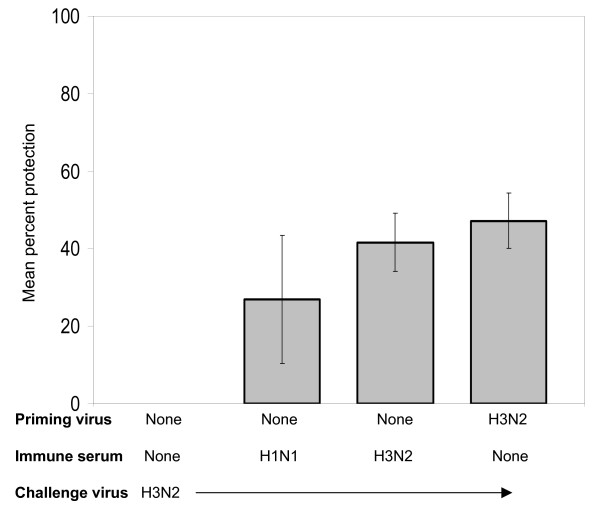
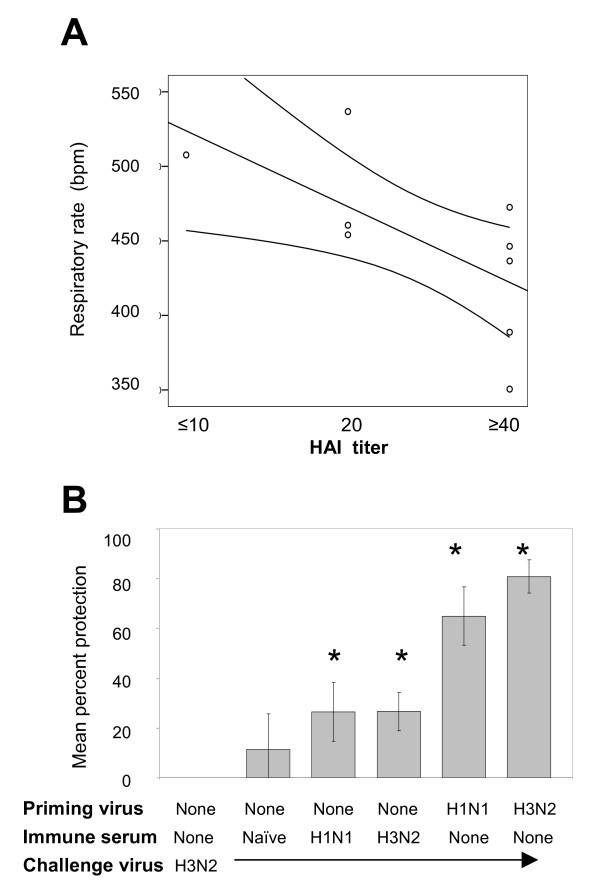
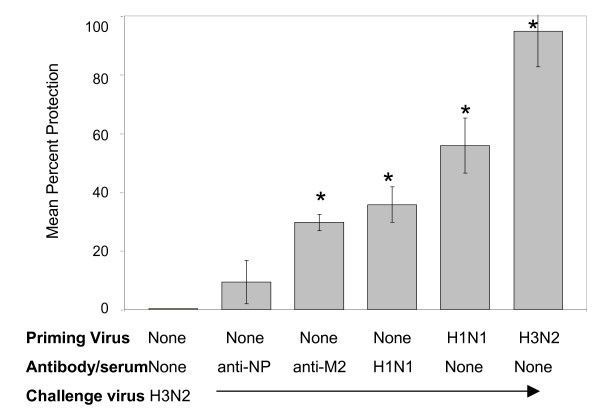
Our results show that cotton rats provided with H1N1-immune serum prior to challenge with an H3N2 virus were protected from influenza-associated tachypnea, with the degree of protection correlating with the antibody titer transferred. Immunization with an inactivated preparation of virus delivered intramuscularly also provided some protection suggesting that CTL and/or mucosal antibody responses are not required for protection. Antibodies specific for conserved epitopes present on the virus exterior are likely to facilitate this protection since prophylactic treatment of cotton rats with anti-M2e (the extracellular domain of M2) but not anti-nucleoprotein (NP) reduced virus-induced tachypnea.
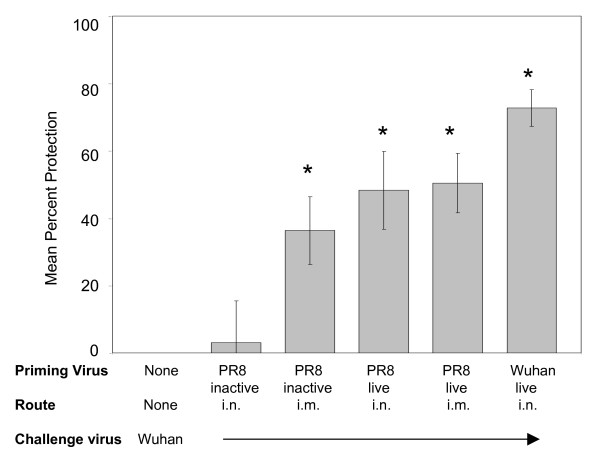
In the cotton rat model of heterosubtypic immunity, humoral immunity plays a role in protecting animals from influenza-induced tachypea. Partial protection against respiratory disease caused by different influenza A subtypes can be attained with either live virus administered intranasally or inactivated virus delivered intramuscularly suggesting that either vaccine regimen may provide some protection against potential pandemic outbreaks in humans.
流感病毒感染或接种疫苗会引发针对病毒血凝素(HA)和神经氨酸酶(NA)表面糖蛋白的抗体反应,从而产生针对相同HA和NA亚型甲型流感病毒的免疫力。从人类流感暴发的流行病学研究中提示了一种对不同甲型流感亚型具有一定保护作用的异源亚型免疫反应,并且在实验动物模型中也已诱导出这种反应。此类交叉保护的最初研究表明,细胞毒性T淋巴细胞(CTL)可保护H3N2免疫的小鼠免受致死性H1N1感染。最近在小鼠中的研究表明,抗体也有助于异源亚型免疫(HSI)。我们之前证明,棉鼠(棉鼠属)中的HSI表现为保护H3N2免疫的动物免受甲型流感H1N1诱导的呼吸频率增加(呼吸急促)。或者,H1N1免疫的动物可免受H3N2诱导的呼吸急促。本报告中描述的实验旨在阐明预防这种非常早期疾病迹象的免疫机制。
我们的结果表明,在受到H3N2病毒攻击之前接受H1N1免疫血清的棉鼠免受流感相关的呼吸急促,保护程度与转移的抗体滴度相关。肌肉注射灭活病毒制剂进行免疫也提供了一定的保护,这表明保护并不需要CTL和/或黏膜抗体反应。针对病毒外部存在的保守表位的特异性抗体可能有助于这种保护,因为用抗M2e(M2的细胞外结构域)而非抗核蛋白(NP)对棉鼠进行预防性治疗可降低病毒诱导的呼吸急促。
在异源亚型免疫的棉鼠模型中,体液免疫在保护动物免受流感诱导的呼吸急促方面发挥作用。通过鼻内接种活病毒或肌肉注射灭活病毒均可获得对不同甲型流感亚型引起的呼吸道疾病的部分保护,这表明任何一种疫苗接种方案都可能对人类潜在的大流行暴发提供一定的保护。