Morgan Josh L, Schubert Timm, Wong Rachel O L
Department of Biological Structure, University of Washington, Seattle, WA 98195, USA.
Neural Dev. 2008 Mar 26;3:8. doi: 10.1186/1749-8104-3-8.
Neurons receive excitatory synaptic inputs that are distributed across their dendritic arbors at densities and with spatial patterns that influence their output. How specific synaptic distributions are attained during development is not well understood. The distribution of glutamatergic inputs across the dendritic arbors of mammalian retinal ganglion cells (RGCs) has long been correlated to the spatial receptive field profiles of these neurons. Thus, determining how glutamatergic inputs are patterned onto RGC dendritic arbors during development could provide insight into the cellular mechanisms that shape their functional receptive fields.
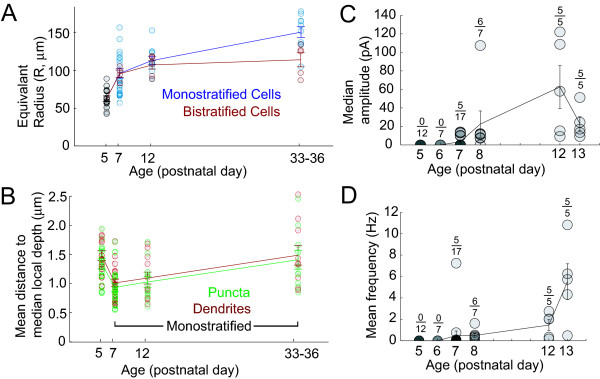
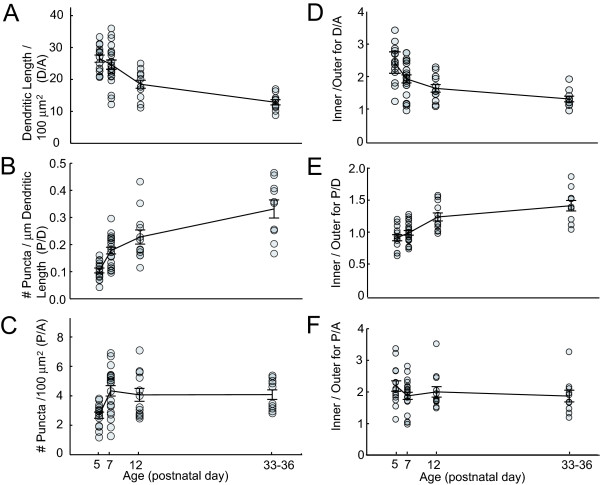
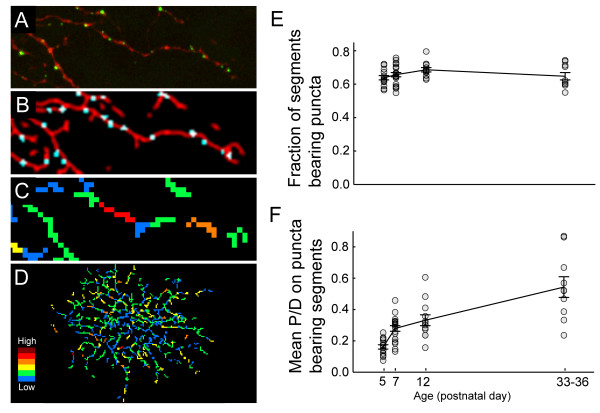
We transfected developing and mature mouse RGCs with plasmids encoding fluorescent proteins that label their dendrites and glutamatergic postsynaptic sites. We found that as dendritic density (dendritic length per unit area of dendritic field) decreases with maturation, the density of synapses along the dendrites increases. These changes appear coordinated such that RGCs attain the mature average density of postsynaptic sites per unit area (areal density) by the time synaptic function emerges. Furthermore, stereotypic centro-peripheral gradients in the areal density of synapses across the arbor of RGCs are established at an early developmental stage.
The spatial pattern of glutamatergic inputs onto RGCs arises early in synaptogenesis despite ensuing reorganization of dendritic structure. We raise the possibility that these early patterns of synaptic distributions may arise from constraints placed on the number of contacts presynaptic neurons are able to make with the RGCs.
神经元接收兴奋性突触输入,这些输入以不同密度并按照影响其输出的空间模式分布在其树突分支上。在发育过程中如何实现特定的突触分布尚不清楚。长期以来,哺乳动物视网膜神经节细胞(RGC)树突分支上谷氨酸能输入的分布与这些神经元的空间感受野轮廓相关。因此,确定发育过程中谷氨酸能输入如何在RGC树突分支上形成模式,有助于深入了解塑造其功能性感受野的细胞机制。
我们用编码荧光蛋白的质粒转染发育中和成熟的小鼠RGC,这些荧光蛋白可标记其树突和谷氨酸能突触后位点。我们发现,随着树突密度(树突野单位面积的树突长度)随着成熟而降低,沿树突的突触密度增加。这些变化似乎是协调的,以至于在突触功能出现时,RGC达到了单位面积突触后位点的成熟平均密度(面密度)。此外,在发育早期阶段,RGC树突分支上突触面密度的刻板的中心-外周梯度就已建立。
尽管随后树突结构会发生重组,但谷氨酸能输入到RGC上的空间模式在突触发生早期就已出现。我们提出这样一种可能性,即这些早期的突触分布模式可能源于对突触前神经元与RGC接触数量的限制。