Hayreh Sohan Singh, Zimmerman M Bridget
Department of Ophthalmology and Visual Sciences, College of Medicine, University of Iowa, Iowa City, IA, USA.
Graefes Arch Clin Exp Ophthalmol. 2008 Jul;246(7):1029-46. doi: 10.1007/s00417-008-0805-8. Epub 2008 Apr 11.
To investigate systematically the role of systemic corticosteroid therapy in non-arteritic anterior ischemic optic neuropathy (NA-AION).
The study consists of a cohort of 613 consecutive patients (696 eyes), first seen in our clinic from 1973 to 2000. Of this cohort, 312 patients (364 eyes) voluntarily opted for systemic steroid therapy, and 301 (332 eyes) for no treatment. At first visit, all patients in both groups had a detailed ophthalmic and medical history, and comprehensive ophthalmic evaluation. Visual evaluation was done by recording Snellen visual acuity, and visual fields with a Goldmann perimeter. The same ophthalmic evaluation was performed at each follow-up visit. Patients in the steroid-treated group were initially given 80 mg Prednisone daily for 2 weeks, and then tapered down to 70 mg for 5 days, 60 mg for 5 days, and then cutting down by 5 mg every 5 days. Visual outcome in the two groups was compared
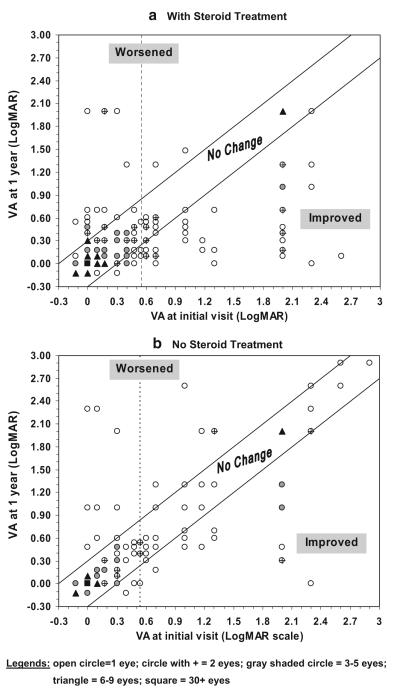
Median follow-up was 3.8 years. At 6 months from onset of NA-AION, of the eyes with initial visual acuity 20/70 or worse and seen within 2 weeks of onset, there was visual acuity improvement in 69.8% (95% confidence interval (CI): 57.3%, 79.9%) in the treated group, compared to 40.5% (95% CI: 29.2%, 52.9%) in the untreated group (odds ratio of improvement: 3.39; 95% CI:1.62, 7.11; p = 0.001). Comparison of visual field defect at 6 months from onset of NA-AION, among those seen within 2 weeks of NA-AION onset with moderate to severe initial visual field defect, there was improvement in 40.1% (95% CI: 33.1%, 47.5%) of the treated group, and 24.5% (95% CI: 17.7%, 32.9%) of the untreated group (odds ratio: 2.06, 95% CI: 1.24, 3.40; p = 0.005). In both treated and untreated groups, the visual acuity and visual fields kept improving up to about 6 months from onset of NA-AION, and very little thereafter.
This study suggested that NA-AION eyes treated during the acute phase with systemic corticosteroids resulted in a significantly higher probability of improvement in visual acuity (p = 0.001) and visual field (p = 0.005) than in the untreated group. Both visual acuity and visual fields improved up to 6 months after onset of NA-AION.
系统研究全身应用皮质类固醇疗法在非动脉炎性前部缺血性视神经病变(NA-AION)中的作用。
该研究纳入了1973年至2000年在我们诊所首诊的613例连续患者(696只眼)。在该队列中,312例患者(364只眼)自愿选择全身应用类固醇疗法,301例患者(332只眼)选择不治疗。初次就诊时,两组所有患者均有详细的眼科和病史,并进行了全面的眼科评估。通过记录Snellen视力和用Goldmann视野计检查视野来进行视力评估。每次随访时均进行相同的眼科评估。接受类固醇治疗的患者最初每天给予80mg泼尼松,持续2周,然后逐渐减至70mg,持续5天,60mg,持续5天,然后每5天减少5mg。比较两组的视力结果。
中位随访时间为3.8年。在NA-AION发病6个月时,对于初始视力为20/70或更差且在发病后2周内就诊的眼,治疗组的视力改善率为69.8%(95%置信区间(CI):57.3%,79.9%),而未治疗组为40.5%(95%CI:29.2%,52.9%)(改善的优势比:3.39;95%CI:1.62,7.11;p = 0.001)。在NA-AION发病6个月时,对那些在NA-AION发病后2周内就诊且初始视野缺损为中度至重度的患者进行视野缺损比较,治疗组有40.1%(95%CI:33.1%,47.5%)得到改善,未治疗组为24.5%(95%CI:17.7%,32.9%)(优势比:2.06,95%CI:1.24,3.40;p = 0.005)。在治疗组和未治疗组中,视力和视野在NA-AION发病后约6个月内持续改善,此后改善甚微。
本研究表明,与未治疗组相比,在急性期接受全身皮质类固醇治疗的NA-AION眼视力(p = 0.001)和视野(p = 0.005)改善的可能性显著更高。NA-AION发病后6个月内视力和视野均有所改善。