Akubio Ltd,, 181 Cambridge Science Park, Cambridge, CB4 0GJ, UK.
J Nanobiotechnology. 2008 Apr 29;6:5. doi: 10.1186/1477-3155-6-5.
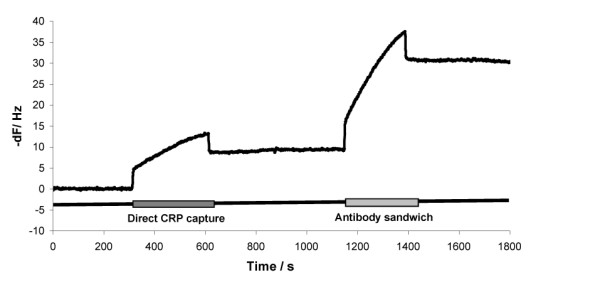
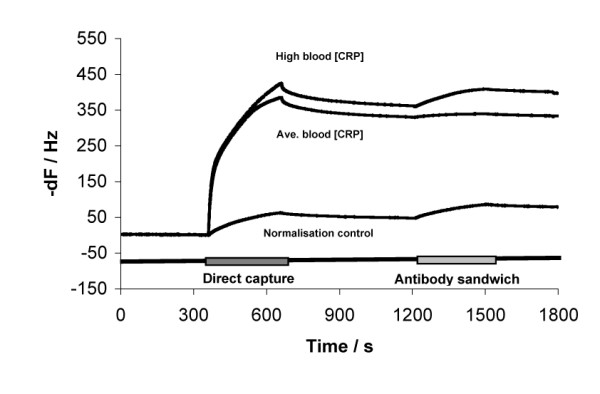
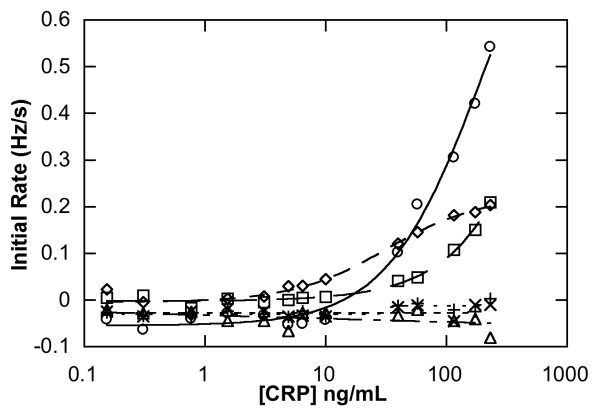
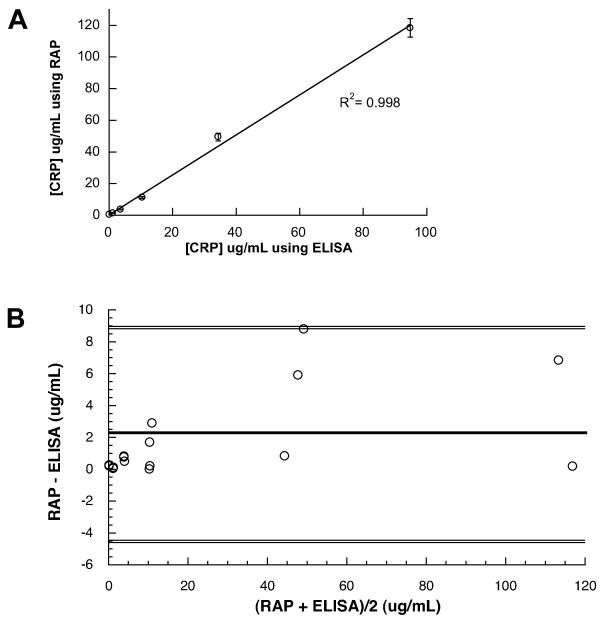
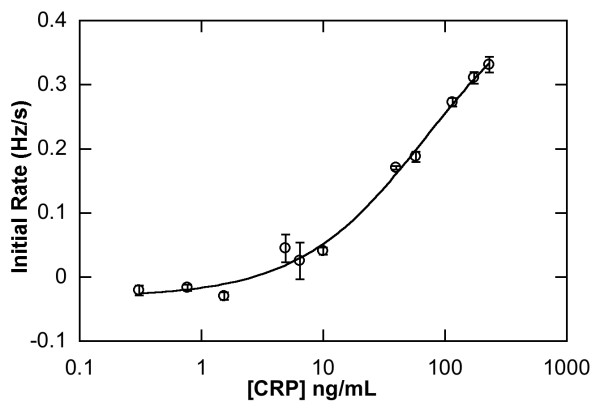
C-Reactive Protein (CRP) is an acute phase reactant routinely used as a biomarker to assess either infection or inflammatory processes such as autoimmune diseases. CRP also has demonstrated utility as a predictive marker of future risk of cardiovascular disease. A new method of immunoassay for the detection of C-Reactive Protein has been developed using Resonant Acoustic Profilingtrade mark (RAPtrade mark) with comparable sensitivity to a high sensitivity CRP ELISA (hsCRP) but with considerable time efficiency (12 minutes turnaround time to result). In one method, standard solutions of CRP (0 to 231 ng/mL) or diluted spiked horse serum sample are injected through two sensor channels of a RAPtrade mark biosensor. One contains a surface with sheep antibody to CRP, the other a control surface containing purified Sheep IgG. At the end of a 5-minute injection the initial rate of change in resonant frequency was proportional to CRP concentration. The initial rates of a second sandwich step of anti-CRP binding were also proportional to the sample CRP concentration and provided a more sensitive method for quantification of CRP. The lower limit of detection for the direct assay and the homogenous sandwich assay were both 20 ng/mL whereas for the direct sandwich assay the lower limit was 3 ng/mL. In a step towards a rapid clinical assay, diluted horse blood spiked with human CRP was passed over one sensor channel whilst a reference standard solution at the borderline cardiovascular risk level was passed over the other. A semi-quantities ratio was thus obtained indicative of sample CRP status. Overall, the present study revealed that CRP concentrations in serum that might be expected in both normal and pathological conditions can be detected in a time-efficient, label-free immunoassay with RAPtrade mark detection technology with determined CRP concentrations in close agreement with those determined using a commercially available high sensitivity ELISA.
C 反应蛋白(CRP)是一种急性相反应物,通常用作评估感染或炎症过程(如自身免疫性疾病)的生物标志物。CRP 也已被证明可作为预测未来心血管疾病风险的标志物。一种新的 C 反应蛋白检测免疫分析方法已经使用共振声学分析(RAP)技术开发,该技术与高灵敏度 CRP ELISA(hsCRP)相比具有相当的灵敏度,但具有相当高的时间效率(12 分钟出结果)。在一种方法中,CRP 的标准溶液(0 至 231ng/mL)或稀释的马血清加标样品通过 RAP 生物传感器的两个传感器通道注入。一个通道包含羊抗 CRP 的表面,另一个通道包含含有纯化羊 IgG 的对照表面。在 5 分钟的注入结束时,共振频率的初始变化率与 CRP 浓度成正比。第二个抗 CRP 结合的三明治步骤的初始速率也与样品 CRP 浓度成正比,为 CRP 的定量提供了更灵敏的方法。直接测定和均相三明治测定的检测下限均为 20ng/mL,而直接三明治测定的检测下限为 3ng/mL。在迈向快速临床测定的过程中,用马血稀释的人 CRP 通过一个传感器通道流过,而边界心血管风险水平的参考标准溶液通过另一个传感器通道流过。因此获得了一个半定量比值,表明样品 CRP 状态。总的来说,本研究表明,在使用 RAP 检测技术的时间高效、无标记免疫分析中,可以检测到在正常和病理条件下可能预期的血清 CRP 浓度,并且确定的 CRP 浓度与使用市售高灵敏度 ELISA 确定的浓度非常一致。