Goldstein Richard A, Soyer Orkun S
Mathematical Biology, National Institute for Medical Research, London, United Kingdom.
PLoS Comput Biol. 2008 May 23;4(5):e1000084. doi: 10.1371/journal.pcbi.1000084.
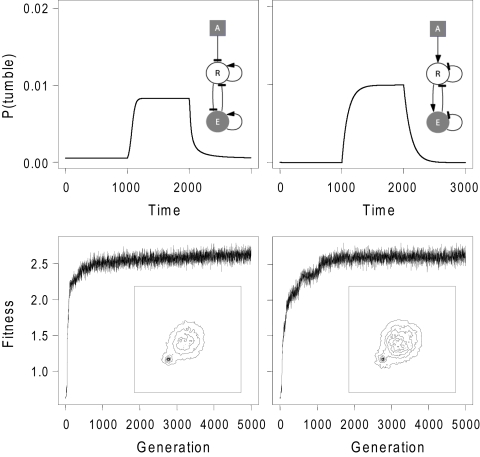
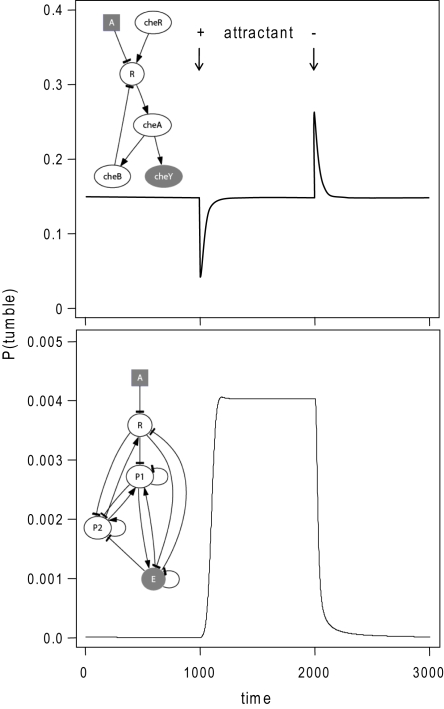
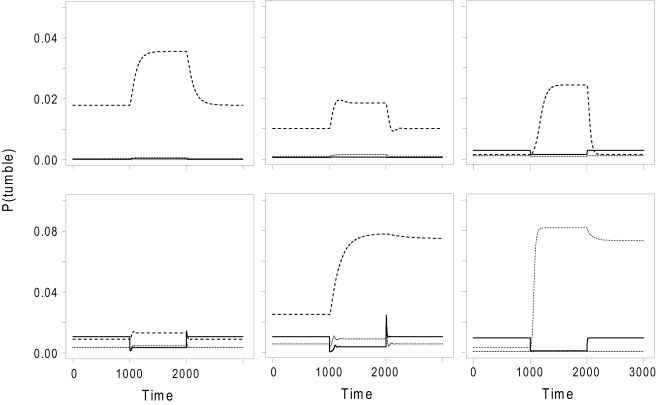
Bacteria are able to sense and respond to a variety of external stimuli, with responses that vary from stimuli to stimuli and from species to species. The best-understood is chemotaxis in the model organism Escherichia coli, where the dynamics and the structure of the underlying pathway are well characterised. It is not clear, however, how well this detailed knowledge applies to mechanisms mediating responses to other stimuli or to pathways in other species. Furthermore, there is increasing experimental evidence that bacteria integrate responses from different stimuli to generate a coherent taxis response. We currently lack a full understanding of the different pathway structures and dynamics and how this integration is achieved. In order to explore different pathway structures and dynamics that can underlie taxis responses in bacteria, we perform a computational simulation of the evolution of taxis. This approach starts with a population of virtual bacteria that move in a virtual environment based on the dynamics of the simple biochemical pathways they harbour. As mutations lead to changes in pathway structure and dynamics, bacteria better able to localise with favourable conditions gain a selective advantage. We find that a certain dynamics evolves consistently under different model assumptions and environments. These dynamics, which we call non-adaptive dynamics, directly couple tumbling probability of the cell to increasing stimuli. Dynamics that are adaptive under a wide range of conditions, as seen in the chemotaxis pathway of E. coli, do not evolve in these evolutionary simulations. However, we find that stimulus scarcity and fluctuations during evolution results in complex pathway dynamics that result both in adaptive and non-adaptive dynamics depending on basal stimuli levels. Further analyses of evolved pathway structures show that effective taxis dynamics can be mediated with as few as two components. The non-adaptive dynamics mediating taxis responses provide an explanation for experimental observations made in mutant strains of E. coli and in wild-type Rhodobacter sphaeroides that could not be explained with standard models. We speculate that such dynamics exist in other bacteria as well and play a role linking the metabolic state of the cell and the taxis response. The simplicity of mechanisms mediating such dynamics makes them a candidate precursor of more complex taxis responses involving adaptation. This study suggests a strong link between stimulus conditions during evolution and evolved pathway dynamics. When evolution was simulated under conditions of scarce and fluctuating stimulus conditions, the evolved pathway contained features of both adaptive and non-adaptive dynamics, suggesting that these two types of dynamics can have different advantages under distinct environmental circumstances.
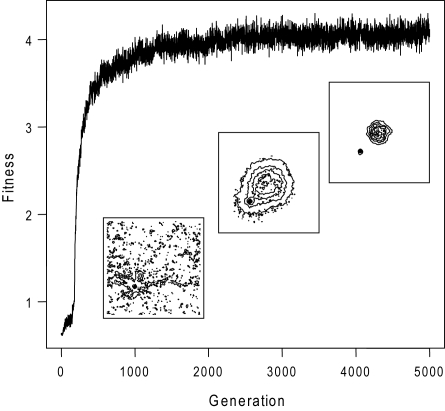
细菌能够感知并对多种外部刺激做出反应,其反应因刺激类型和物种而异。研究最为透彻的是模式生物大肠杆菌中的趋化作用,其潜在途径的动力学和结构已得到充分表征。然而,尚不清楚这些详细知识在多大程度上适用于介导对其他刺激的反应机制或其他物种的途径。此外,越来越多的实验证据表明,细菌会整合来自不同刺激的反应以产生连贯的趋化反应。我们目前对不同的途径结构和动力学以及这种整合是如何实现的还缺乏全面的了解。为了探索细菌趋化反应背后可能存在的不同途径结构和动力学,我们对趋化作用的进化进行了计算模拟。这种方法从一群虚拟细菌开始,它们在虚拟环境中根据所拥有的简单生化途径的动力学进行移动。随着突变导致途径结构和动力学的变化,更能在有利条件下定位的细菌获得了选择优势。我们发现,在不同的模型假设和环境下,某种动力学一致地进化。这些动力学,我们称之为非适应性动力学,直接将细胞的翻滚概率与不断增加的刺激联系起来。在广泛条件下具有适应性的动力学,如在大肠杆菌趋化途径中所见,在这些进化模拟中并未进化出来。然而,我们发现进化过程中的刺激稀缺和波动会导致复杂的途径动力学,根据基础刺激水平,既会产生适应性动力学,也会产生非适应性动力学。对进化后的途径结构的进一步分析表明,仅用两个组件就能介导有效的趋化动力学。介导趋化反应的非适应性动力学为在大肠杆菌突变菌株和野生型球形红杆菌中所做的实验观察提供了解释,而这些观察结果用标准模型无法解释。我们推测这种动力学在其他细菌中也存在,并在连接细胞的代谢状态和趋化反应中发挥作用。介导这种动力学的机制的简单性使其成为涉及适应性的更复杂趋化反应的候选前身。这项研究表明进化过程中的刺激条件与进化后的途径动力学之间存在紧密联系。当在刺激条件稀缺且波动的情况下模拟进化时,进化后的途径包含适应性和非适应性动力学的特征,这表明这两种类型的动力学在不同的环境情况下可能具有不同的优势。