Pendley Chad J, Becker Ericka A, Karl Julie A, Blasky Alex J, Wiseman Roger W, Hughes Austin L, O'Connor Shelby L, O'Connor David H
Wisconsin National Primate Research Center, University of Wisconsin-Madison, Madison, WI 53706, USA.
Immunogenetics. 2008 Jul;60(7):339-51. doi: 10.1007/s00251-008-0292-4. Epub 2008 May 27.
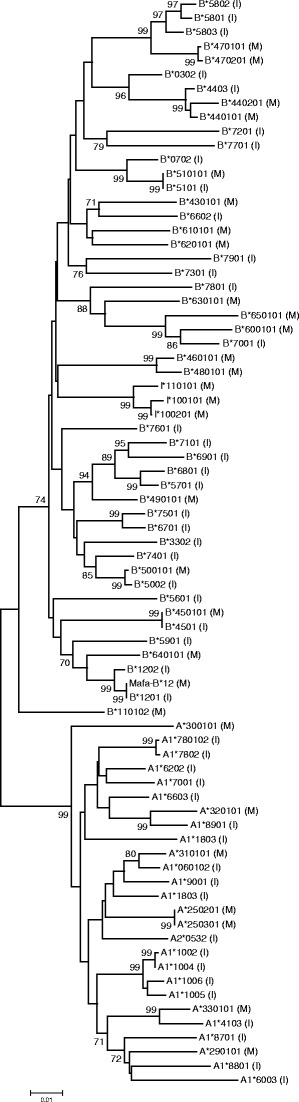
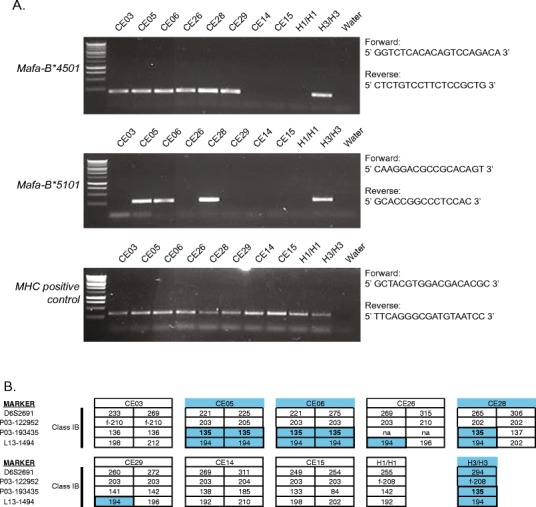
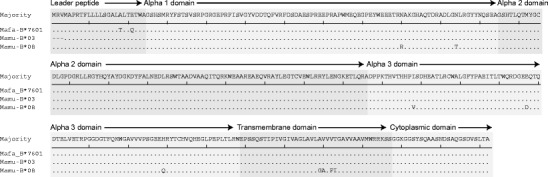
Cynomolgus macaques (Macaca fascicularis) are quickly becoming a useful model for infectious disease and transplantation research. Even though cynomolgus macaques from different geographic regions are used for these studies, there has been limited characterization of full-length major histocompatibility complex (MHC) class I immunogenetics of distinct geographic populations. Here, we identified 48 MHC class I cDNA nucleotide sequences in eleven Indonesian cynomolgus macaques, including 41 novel Mafa-A and Mafa-B sequences. We found seven MHC class I sequences in Indonesian macaques that were identical to MHC class I sequences identified in Malaysian or Mauritian macaques. Sharing of nucleotide sequences between these geographically distinct populations is also consistent with the hypothesis that Indonesia was a source of the Mauritian macaque population. In addition, we found that the Indonesian cDNA sequence Mafa-B7601 is identical throughout its peptide binding domain to Mamu-B03, an allele that has been associated with control of Simian immunodeficiency virus (SIV) viremia in Indian rhesus macaques. Overall, a better understanding of the MHC class I alleles present in Indonesian cynomolgus macaques improves their value as a model for disease research, and it better defines the biogeography of cynomolgus macaques throughout Southeast Asia.
食蟹猴(Macaca fascicularis)正迅速成为传染病和移植研究的有用模型。尽管来自不同地理区域的食蟹猴被用于这些研究,但对于不同地理种群的全长主要组织相容性复合体(MHC)I类免疫遗传学的表征却很有限。在此,我们在11只印度尼西亚食蟹猴中鉴定出48个MHC I类cDNA核苷酸序列,包括41个新的Mafa - A和Mafa - B序列。我们在印度尼西亚食蟹猴中发现了7个MHC I类序列,它们与在马来西亚或毛里求斯食蟹猴中鉴定出的MHC I类序列相同。这些地理上不同种群之间核苷酸序列的共享也与印度尼西亚是毛里求斯食蟹猴种群来源的假设一致。此外,我们发现印度尼西亚cDNA序列Mafa - B7601在其整个肽结合域与Mamu - B03相同,Mamu - B03是一种与印度恒河猴中猿猴免疫缺陷病毒(SIV)病毒血症控制相关的等位基因。总体而言,更好地了解印度尼西亚食蟹猴中存在的MHC I类等位基因提高了它们作为疾病研究模型的价值,并更好地界定了整个东南亚食蟹猴的生物地理学。