Karsai I, Szucs P, Koszegi B, Hayes P M, Casas A, Bedo Z, Veisz O
Agricultural Research Institute of the Hungarian Academy of Sciences, 2462 Martonvásár, Brunszvik u. 2, Hungary.
J Exp Bot. 2008;59(10):2707-15. doi: 10.1093/jxb/ern131. Epub 2008 Jun 11.
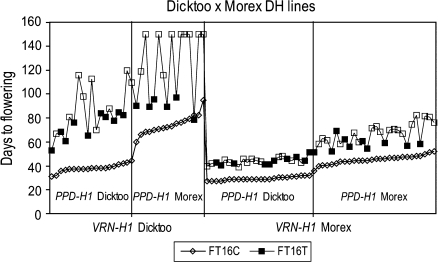
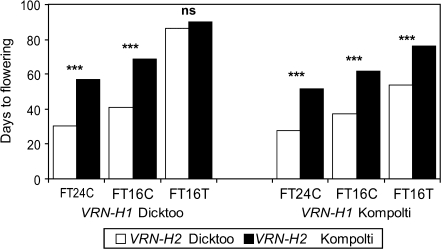
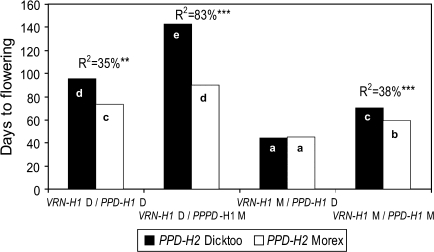
The effects of synchronous photo (16 h daylength) and thermo (2 degrees C daily fluctuation) cycles on flowering time were compared with constant light and temperature treatments using two barley mapping populations derived from the facultative cultivar 'Dicktoo'. The 'Dicktoo'x'Morex' (spring) population (DM) segregates for functional differences in alleles of candidate genes for VRN-H1, VRN-H3, PPD-H1, and PPD-H2. The first two loci are associated with the vernalization response and the latter two with photoperiod sensitivity. The 'Dicktoo'x'Kompolti korai' (winter) population (DK) has a known functional polymorphism only at VRN-H2, a locus associated with vernalization sensitivity. Flowering time in both populations was accelerated when there was no fluctuating factor in the environment and was delayed to the greatest extent with the application of synchronous photo and thermo cycles. Alleles at VRN-H1, VRN-H2, PPD-H1, and PPD-H2--and their interactions--were found to be significant determinants of the increase/decrease in days to flower. Under synchronous photo and thermo cycles, plants with the Dicktoo (recessive) VRN-H1 allele flowered significantly later than those with the Kompolti korai (recessive) or Morex (dominant) VRN-H1 alleles. The Dicktoo VRN-H1 allele, together with the late-flowering allele at PPD-H1 and PPD-H2, led to the greatest delay. The application of synchronous photo and thermo cycles changed the epistatic interaction between VRN-H2 and VRN-H1: plants with Dicktoo type VRN-H1 flowered late, regardless of the allele phase at VRN-H2. Our results are novel in demonstrating the large effects of minor variations in environmental signals on flowering time: for example, a 2 degrees C thermo cycle caused a delay in flowering time of 70 d as compared to a constant temperature.
利用从兼性品种‘Dicktoo’衍生而来的两个大麦作图群体,将同步光周期(16小时日照长度)和热周期(每日2摄氏度波动)对开花时间的影响与恒定光照和温度处理进行了比较。‘Dicktoo’בMorex’(春性)群体(DM)在VRN-H1、VRN-H3、PPD-H1和PPD-H2候选基因的等位基因功能差异上存在分离。前两个位点与春化反应相关,后两个位点与光周期敏感性相关。‘Dicktoo’בKompolti korai’(冬性)群体(DK)仅在VRN-H2(一个与春化敏感性相关的位点)存在已知的功能多态性。当环境中没有波动因素时,两个群体的开花时间都加快了,而应用同步光周期和热周期时,开花时间延迟到最大程度。发现VRN-H1、VRN-H2、PPD-H1和PPD-H2的等位基因及其相互作用是开花天数增加/减少的重要决定因素。在同步光周期和热周期下,具有Dicktoo(隐性)VRN-H1等位基因的植株比具有Kompolti korai(隐性)或Morex(显性)VRN-H1等位基因的植株开花明显更晚。Dicktoo VRN-H1等位基因与PPD-H1和PPD-H2的晚花等位基因一起导致了最大的延迟。同步光周期和热周期的应用改变了VRN-H2和VRN-H1之间的上位性相互作用:具有Dicktoo型VRN-H1的植株开花较晚,而与VRN-H2的等位基因阶段无关。我们的结果新颖之处在于证明了环境信号的微小变化对开花时间有很大影响:例如,与恒温相比