Hofer Christoph K, Senn Alban, Weibel Luc, Zollinger Andreas
Institute of Anaesthesiology and Intensive Care Medicine, Triemli City Hospital, Birmensdorferstrasse, CH-8063 Zurich, Switzerland.
Crit Care. 2008;12(3):R82. doi: 10.1186/cc6933. Epub 2008 Jun 20.
Stroke volume variation (SVV) has repeatedly been shown to be a reliable predictor of fluid responsiveness. Various devices allow automated clinical assessment of SVV. The aim of the present study was to compare prediction of fluid responsiveness using SVV, as determined by the FloTrac/Vigileo system and the PiCCOplus system.
In patients who had undergone elective cardiac surgery, SVVFloTrac was determined via radial FloTrac sensor, and SVVPiCCO and pulse pressure variation were assessed via a femoral PiCCO catheter. Stroke volume was assessed by transpulmonary thermodilution. All variables were recorded before and after a volume shift induced by a change in body positioning (from 30 degrees head-up position to 30 degrees head-down position). Pearson correlation, t-test, and Bland-Altman analysis were performed. Area under the curve was determined by plotting receiver operating characteristic curves for changes in stroke volume in excess of 25%. P < 0.05 was considered statistically significant.
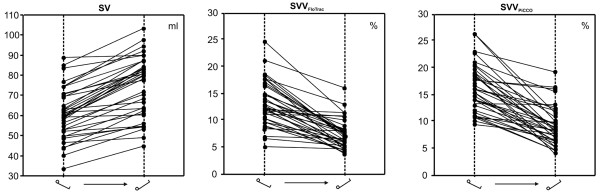
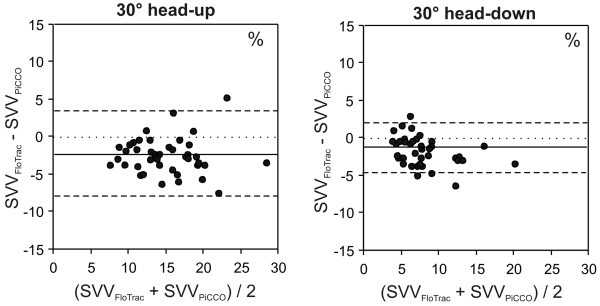
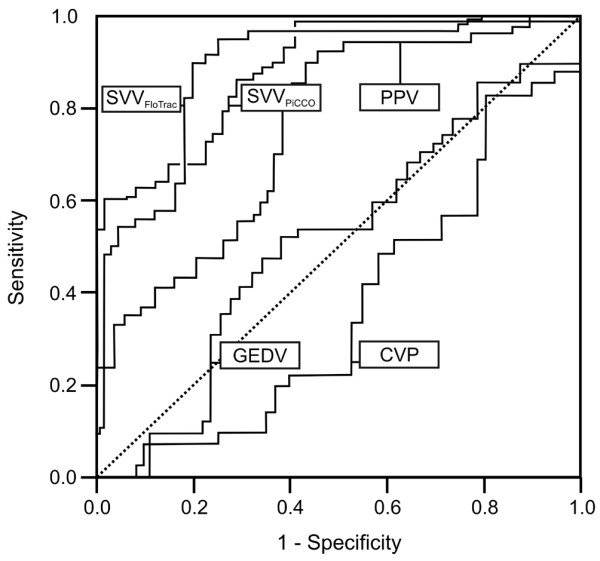
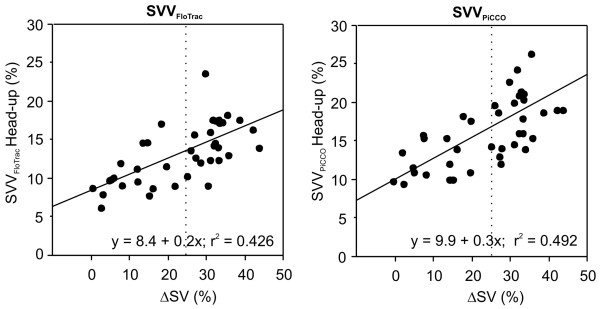
Body positioning resulted in a significant increase in stroke volume; SVVFloTrac and SVVPiCCO decreased significantly. Correlations of SVVFloTrac and SVVPiCCO with change in stroke volume were similar. There was no significant difference between the areas under the curve for SVVFloTrac and SVVPiCCO; the optimal threshold values given by the receiver operating characteristic curves were 9.6% for SVVFloTrac (sensitivity 91% and specificity 83%) and 12.1% for SVVPiCCO (sensitivity 87% and specificity 76%). There was a clinically acceptable agreement and strong correlation between SVVFloTrac and SVVPiCCO.
SVVs assessed using the FloTrac/Vigileo and the PiCCOplus systems exhibited similar performances in terms of predicting fluid responsiveness. In comparison with SVVPiCCO, SVVFloTrac has a lower threshold value.
每搏输出量变异(SVV)已多次被证明是液体反应性的可靠预测指标。各种设备可实现对SVV的自动化临床评估。本研究的目的是比较使用FloTrac/Vigileo系统和PiCCOplus系统测定的SVV对液体反应性的预测。
在接受择期心脏手术的患者中,通过桡动脉FloTrac传感器测定FloTrac每搏输出量变异(SVVFloTrac),通过股动脉PiCCO导管评估PiCCO每搏输出量变异(SVVPiCCO)和脉压变异。通过经肺热稀释法评估每搏输出量。在身体姿势改变(从头部抬高30度位变为头部下垂30度位)引起容量变化前后记录所有变量。进行Pearson相关性分析、t检验和Bland-Altman分析。通过绘制每搏输出量变化超过25%的受试者工作特征曲线来确定曲线下面积。P<0.05被认为具有统计学意义。
身体姿势改变导致每搏输出量显著增加;SVVFloTrac和SVVPiCCO显著降低。SVVFloTrac和SVVPiCCO与每搏输出量变化的相关性相似。SVVFloTrac和SVVPiCCO的曲线下面积无显著差异;受试者工作特征曲线给出的最佳阈值,SVVFloTrac为9.6%(敏感性91%,特异性83%),SVVPiCCO为12.1%(敏感性87%,特异性76%)。SVVFloTrac和SVVPiCCO之间存在临床可接受的一致性和强相关性。
使用FloTrac/Vigileo和PiCCOplus系统评估的SVV在预测液体反应性方面表现相似。与SVVPiCCO相比,SVVFloTrac的阈值更低。