Department of Physical Medicine & Rehabilitation, Institute of Wonkwang Medical Science, Wonkwang University School of Medicine, Iksan, Korea, Department of Physical Medicine & Rehabilitation, Research Institute of Medical Science, Chonnam National University Medical School & Hospital, Gwangju and Center for Integrative Medicine, Institute of Medical Science, Wonkwang University, Iksan, Korea.
Evid Based Complement Alternat Med. 2008 Jun;5(2):231-5. doi: 10.1093/ecam/nem025.
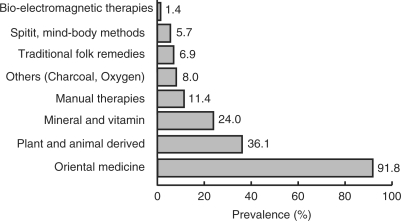
This study measured the prevalence of complementary and alternative medicine (CAM) use among Korean stroke patients. Questionnaire-based 20-min interviews were conducted at the hospitals by a trained nurse after an outpatient visit. It included questions on demographic information, clinical information and the utilization of CAM. Of 304 stroke-patient respondents, 164 (54%) had used CAM, of which 66% had started taking CAM products following suggestions from family members and other relatives. Of the 57% of users who felt that CAM was effective, 84% considered that it improved the symptoms of stroke and 16% felt it was effective in achieving psychological relaxation. Of the eight CAM categories used by respondents, 92% used traditional Oriental medical treatments, 36% used plant- and animal-derived over-the-counter health care products, 24% used minerals and vitamins, and 11% used manual therapies. The majority of stroke patients (68%) were trying a new type of CAM, and half of the respondents (45%) relied on the knowledge of their general practitioner about CAMs when deciding whether to use them. Most of the stroke patients in this study used CAM, and a half of them reported beneficial effects. Despite the presence of adverse side effects, they tended to be used without discussion with chief physicians, and hence physicians should be actively involved in the usage of CAM.
本研究旨在测量韩国中风患者使用补充替代医学(CAM)的流行率。在门诊后,由一名经过培训的护士在医院通过基于问卷的 20 分钟访谈进行。它包括人口统计学信息、临床信息和 CAM 的利用情况。在 304 名中风患者受访者中,有 164 名(54%)使用过 CAM,其中 66%是根据家人和其他亲戚的建议开始服用 CAM 产品的。在感觉 CAM 有效的 57%的使用者中,84%认为它改善了中风症状,16%认为它在实现心理放松方面有效。在受访者使用的八种 CAM 类别中,92%使用传统的东方医学治疗,36%使用植物和动物源性的非处方保健品,24%使用矿物质和维生素,11%使用手动疗法。大多数中风患者(68%)正在尝试一种新型 CAM,而一半的受访者(45%)在决定是否使用 CAM 时依赖他们的全科医生对 CAM 的了解。本研究中的大多数中风患者使用 CAM,其中一半报告有有益的效果。尽管存在不良副作用,但他们倾向于在没有与主治医生讨论的情况下使用 CAM,因此医生应该积极参与 CAM 的使用。