Fulkerson Jayne A, Pasch Keryn E, Perry Cheryl L, Komro Kelli
School of Nursing, University of Minnesota, Minneapolis, MN 55455-0342, USA.
J Community Health. 2008 Dec;33(6):425-33. doi: 10.1007/s10900-008-9117-5.
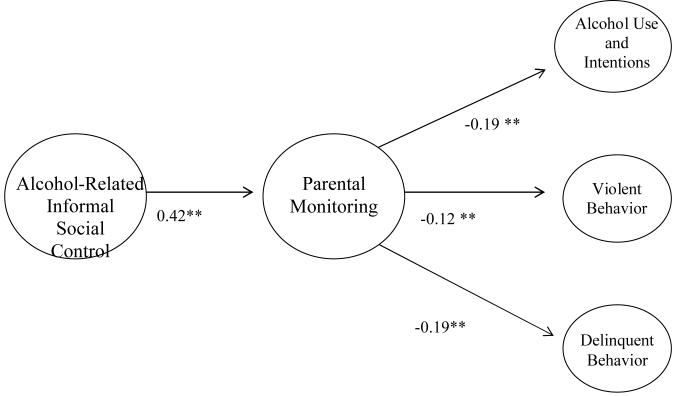
The purpose of the present study is to investigate the relationships between alcohol-related informal social control and parental monitoring on alcohol use, behavior and intentions; violent behavior; and delinquent behavior in a racially diverse population of young urban adolescents. Baseline surveys were administered to 6th grade male and female students in 61 urban Chicago schools as part of Project Northland Chicago, a group randomized trial for the prevention/reduction of substance use. A subset of their parents (n = 3,034) was also surveyed regarding alcohol use, violence, and delinquency and related issues. Structural equation modeling was used to assess relationships between alcohol-related informal social control (as measured by parental perceptions of neighborhood action regarding youth drinking) and parental monitoring (as reported by parents), and three adolescent outcomes (alcohol use, behaviors and intentions; violent behavior; and delinquent behavior; as reported by teens). Associations between alcohol-related informal social control and parental monitoring were positive and significant (P < .001). Direct paths from parental monitoring to all three adolescent outcomes were negative and statistically significant (alcohol use, behaviors and intentions, P < .001; violent behavior, P < .001; and delinquent behavior, P < .001). Alcohol-related informal social control was not significantly associated with adolescent outcomes. Efforts to engage parents to be more active in monitoring adolescents' activities may be related to lower levels of underage drinking, violence and delinquency among both female and male urban youth. Neighborhood norms and action against teenage drinking may be too distal to adolescent outcomes to be directly associated.
本研究的目的是调查在种族多样化的城市青少年群体中,与酒精相关的非正式社会控制和父母对青少年饮酒、行为及意图、暴力行为和犯罪行为的监管之间的关系。作为“北国芝加哥项目”的一部分,对芝加哥61所城市学校的六年级男女学生进行了基线调查,该项目是一项预防/减少物质使用的群组随机试验。还对他们的一部分家长(n = 3,034)进行了关于饮酒、暴力、犯罪及相关问题的调查。采用结构方程模型来评估与酒精相关的非正式社会控制(通过父母对邻里针对青少年饮酒所采取行动的认知来衡量)和父母监管(由父母报告)之间的关系,以及三种青少年结果(饮酒、行为及意图;暴力行为;犯罪行为;由青少年报告)。与酒精相关的非正式社会控制和父母监管之间的关联呈正向且显著(P < .001)。从父母监管到所有三种青少年结果的直接路径呈负向且具有统计学意义(饮酒、行为及意图,P < .001;暴力行为,P < .001;犯罪行为,P < .001)。与酒精相关的非正式社会控制与青少年结果无显著关联。促使父母更积极地监管青少年活动的努力可能与城市青少年(无论男女)中较低水平的未成年饮酒、暴力和犯罪有关。邻里规范及针对青少年饮酒的行动可能离青少年结果太远,以至于无法直接产生关联。