Heaton L M, Komatsu R, Low-Beer D, Fowler T B, Way P O
US Census Bureau, 4600 Silver Hill Road, Washington, USA.
Sex Transm Infect. 2008 Aug;84 Suppl 1(Suppl_1):i92-i96. doi: 10.1136/sti.2008.030247.
To propose a methodology to estimate the number of new HIV infections averted. Knowledge of HIV infection has increased tremendously and modelling tools to project current epidemics into the future have greatly improved. Different types of models can be used to estimate HIV infections averted, although the number of new HIV infections averted cannot be measured directly.
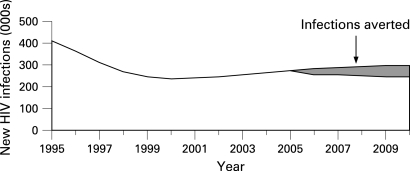
Using cohort-component population projections, a disease modelling-based approach was used to compare the observed epidemiology of a disease after programme initiation with an expected epidemiology from past trends before programme initiation. The concept of modelling infections averted in a disease modelling-based approach involves a comparison between an "expected" or baseline epidemic with an "estimated" one. A hypothetical example was featured in order to demonstrate the proposed methodology. Using both the Estimation and Projection Package (EPP) and the Spectrum demographic modelling program, the underlying annual incidence levels implied by both the baseline and estimated epidemics were examined.
The difference between baseline and estimated incidence levels is interpreted as "infections averted". Strengths and limitations of the approach are discussed.
In this study an expected epidemiological approach was compared to one based on observation. Once sufficient data become available, the validation of various country data including HIV prevalence, mortality, and behaviour must be done. Additional information related to behaviour change may be critical to further support arguments for a change in disease trend. It is therefore important to use all available data, consequently strengthening findings from a disease modelling-based approach on HIV infections averted.
提出一种估算避免的新增艾滋病毒感染病例数的方法。对艾滋病毒感染的认识有了极大提高,预测当前疫情未来发展趋势的建模工具也有了很大改进。虽然无法直接测量避免的新增艾滋病毒感染病例数,但可以使用不同类型的模型来估算。
采用队列成分人口预测法,基于疾病建模的方法将项目启动后观察到的疾病流行病学情况与项目启动前过去趋势的预期流行病学情况进行比较。基于疾病建模的方法中估算避免感染的概念涉及“预期”或基线疫情与“估计”疫情之间的比较。给出了一个假设示例以说明所提出的方法。使用估计与预测软件包(EPP)和人口统计学建模程序Spectrum,研究了基线和估计疫情所隐含的潜在年发病率水平。
基线发病率水平与估计发病率水平之间的差异被解释为“避免的感染病例数”。讨论了该方法的优点和局限性。
在本研究中,将预期流行病学方法与基于观察的方法进行了比较。一旦有足够的数据,就必须对包括艾滋病毒流行率、死亡率和行为等各种国家数据进行验证。与行为改变相关的其他信息对于进一步支持疾病趋势变化的论点可能至关重要。因此,重要的是使用所有可用数据,从而加强基于疾病建模方法对避免的艾滋病毒感染病例数的研究结果。