Loarie Scott R, Carter Benjamin E, Hayhoe Katharine, McMahon Sean, Moe Richard, Knight Charles A, Ackerly David D
Nicholas School of the Environment & Earth Sciences, Duke University, Durham, North Carolina, United States of America.
PLoS One. 2008 Jun 25;3(6):e2502. doi: 10.1371/journal.pone.0002502.
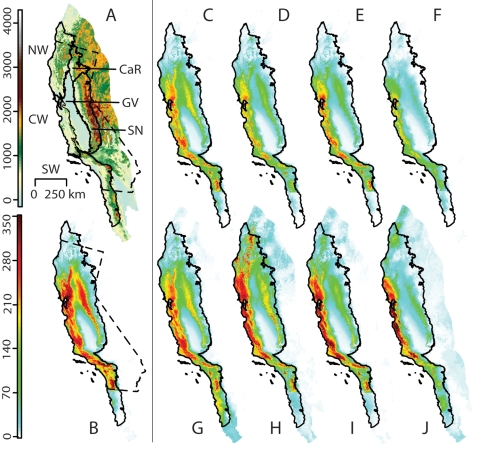
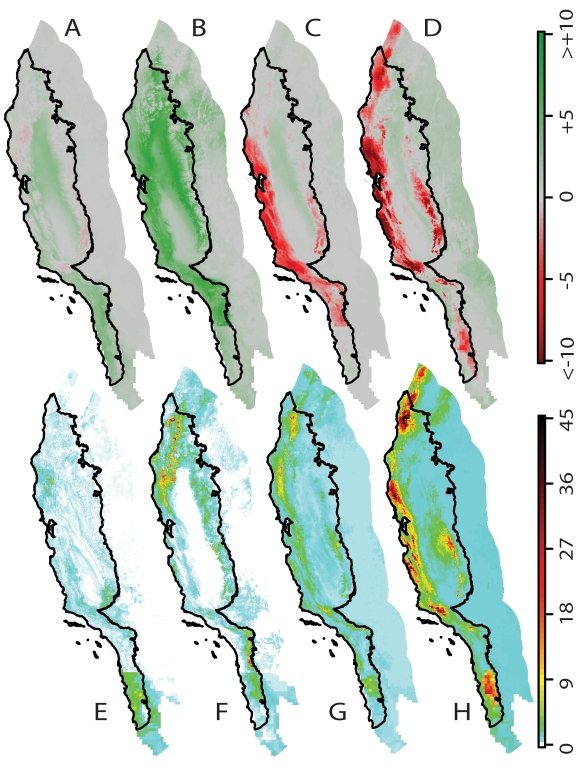
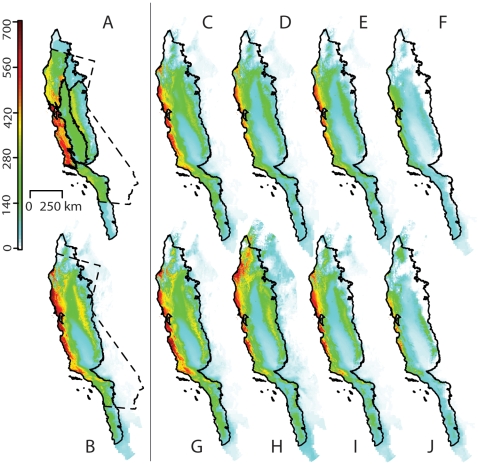
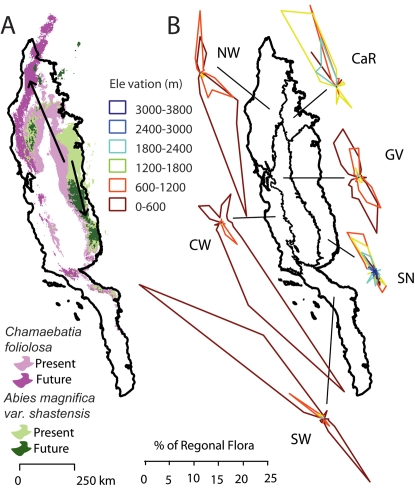
The flora of California, a global biodiversity hotspot, includes 2387 endemic plant taxa. With anticipated climate change, we project that up to 66% will experience >80% reductions in range size within a century. These results are comparable with other studies of fewer species or just samples of a region's endemics. Projected reductions depend on the magnitude of future emissions and on the ability of species to disperse from their current locations. California's varied terrain could cause species to move in very different directions, breaking up present-day floras. However, our projections also identify regions where species undergoing severe range reductions may persist. Protecting these potential future refugia and facilitating species dispersal will be essential to maintain biodiversity in the face of climate change.
加利福尼亚州是全球生物多样性热点地区,其植物区系包含2387个特有植物分类群。随着预期的气候变化,我们预计,在一个世纪内,高达66%的分类群分布范围将缩小80%以上。这些结果与其他针对较少物种或仅对某一地区特有物种样本进行的研究结果相当。预计的分布范围缩小取决于未来排放的规模以及物种从当前位置扩散的能力。加利福尼亚州地形多样,可能导致物种朝非常不同的方向迁移,从而打破当今的植物区系。然而,我们的预测也确定了一些地区,在这些地区,分布范围大幅缩小的物种可能会存续下来。面对气候变化,保护这些潜在的未来避难所并促进物种扩散对于维持生物多样性至关重要。