Buckingham Bruce, Wilson Darrell M, Lecher Todd, Hanas Ragnar, Kaiserman Kevin, Cameron Fergus
Lucile Packard Children's Hospital at Stanford, Pediatric Endocrinology, Stanford, California, USA.
Diabetes Care. 2008 Nov;31(11):2110-2. doi: 10.2337/dc08-0863. Epub 2008 Aug 11.
Despite a high incidence of nocturnal hypoglycemia documented by the use of continuous glucose monitoring (CGM), there are no reports in the literature of nocturnal hypoglycemic seizures while a patient is wearing a CGM device.
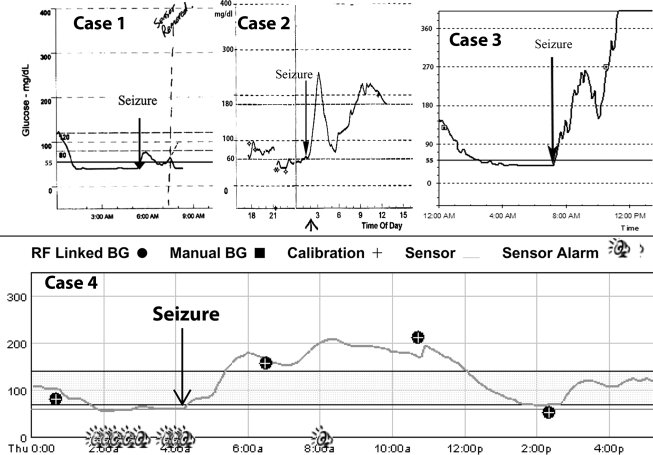
In this article, we describe four such cases and assess the duration of nocturnal hypoglycemia before the seizure.
In the cases where patients had a nocturnal hypoglycemic seizure while wearing a CGM device, sensor hypoglycemia (<60 mg/dl) was documented on the CGM record for 2.25-4 h before seizure activity.
Even with a subcutaneous glucose lag of 18 min when compared with blood glucose measurements, glucose sensors have time to provide clinically meaningful alarms. Current nocturnal hypoglycemic alarms need to be improved, however, since patients can sleep through the current alarm systems.
尽管通过连续血糖监测(CGM)记录显示夜间低血糖发生率很高,但文献中尚无患者佩戴CGM设备时发生夜间低血糖性癫痫发作的报道。
在本文中,我们描述了4例此类病例,并评估了癫痫发作前夜间低血糖的持续时间。
在患者佩戴CGM设备时发生夜间低血糖性癫痫发作的病例中,CGM记录显示在癫痫活动前2.25 - 4小时存在传感器低血糖(<60 mg/dl)。
尽管与血糖测量相比皮下葡萄糖存在18分钟的延迟,但葡萄糖传感器仍有时间提供具有临床意义的警报。然而,目前的夜间低血糖警报需要改进,因为患者可能会在当前警报系统响起时仍在睡眠中。