Santolamazza Federica, Mancini Emiliano, Simard Frédéric, Qi Yumin, Tu Zhijian, della Torre Alessandra
Dipartimento di Scienze di Sanità Pubblica, Istituto Pasteur-Fondazione Cenci-Bolognetti, Sezione di Parassitologia, Università di Roma, La Sapienza, Italy.
Malar J. 2008 Aug 25;7:163. doi: 10.1186/1475-2875-7-163.
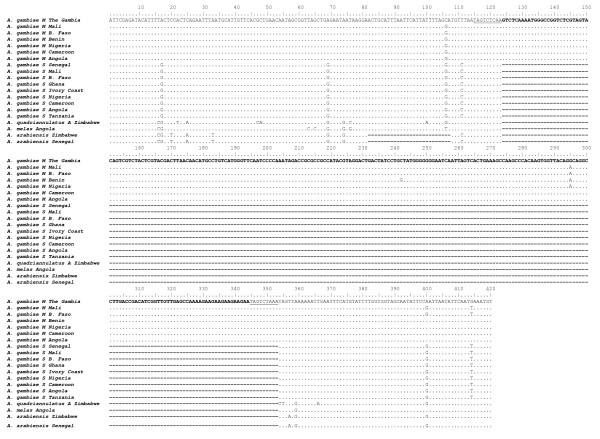
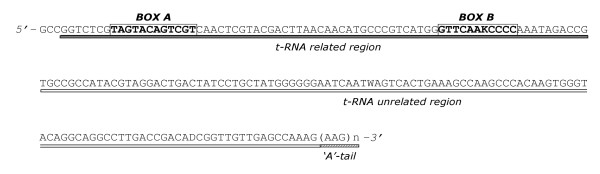
SINEs (Short INterspersed Elements) are homoplasy-free and co-dominant genetic markers which are considered to represent useful tools for population genetic studies, and could help clarifying the speciation processes ongoing within the major malaria vector in Africa, Anopheles gambiae s.s. Here, we report the results of the analysis of the insertion polymorphism of a nearly 200 bp-long SINE (SINE200) within genome areas of high differentiation (i.e. "speciation islands") of M and S A. gambiae molecular forms.
A SINE-PCR approach was carried out on thirteen SINE200 insertions in M and S females collected along the whole range of distribution of A. gambiae s.s. in sub-Saharan Africa. Ten specimens each for Anopheles arabiensis, Anopheles melas, Anopheles quadriannulatus A and 15 M/S hybrids from laboratory crosses were also analysed.
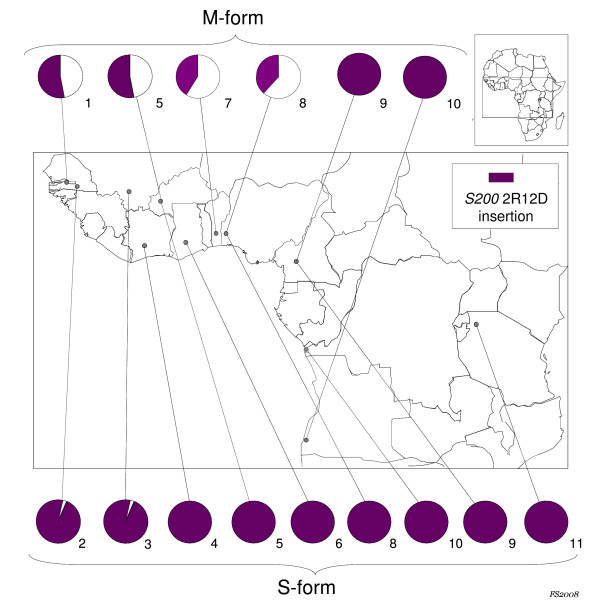
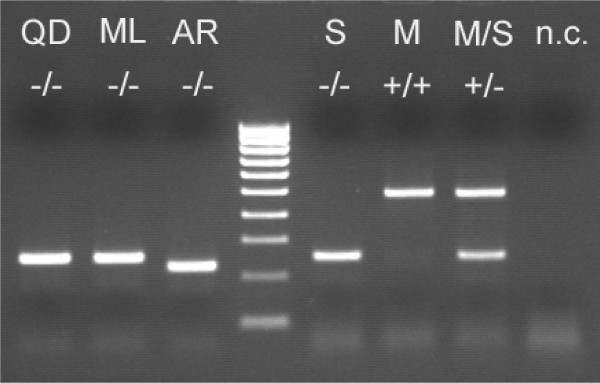
Eight loci were successfully amplified and were found to be specific for A. gambiae s.s.: 5 on 2L chromosome and one on X chromosome resulted monomorphic, while two loci positioned respectively on 2R (i.e. S200 2R12D) and X (i.e. S200 X6.1) chromosomes were found to be polymorphic. S200 2R12D was homozygote for the insertion in most S-form samples, while intermediate levels of polymorphism were shown in M-form, resulting in an overall high degree of genetic differentiation between molecular forms (Fst = 0.46 p < 0.001) and within M-form (Fst = 0.46 p < 0.001). The insertion of S200 X6.1 was found to be fixed in all M- and absent in all S-specimens. This led to develop a novel easy-to-use PCR approach to straightforwardly identify A. gambiae molecular forms. This novel approach allows to overcome the constraints associated with markers on the rDNA region commonly used for M and S identification. In fact, it is based on a single copy and irreversible SINE200 insertion and, thus, is not subjected to peculiar evolutionary patterns affecting rDNA markers, e.g. incomplete homogenization of the arrays through concerted evolution and/or mixtures of M and S IGS-sequences among the arrays of single chromatids.
The approach utilized allowed to develop new easy-to-use co-dominant markers for the analysis of genetic differentiation between M and S-forms and opens new perspectives in the study of the speciation process ongoing within A. gambiae.
短散在重复元件(SINEs)是无趋同进化且共显性的遗传标记,被认为是群体遗传学研究的有用工具,有助于阐明非洲主要疟疾媒介冈比亚按蚊(Anopheles gambiae s.s.)正在进行的物种形成过程。在此,我们报告了对一个近200 bp长的SINE(SINE200)在冈比亚按蚊M和S分子型高分化基因组区域(即“物种形成岛”)内插入多态性的分析结果。
对在撒哈拉以南非洲冈比亚按蚊整个分布范围内采集的M型和S型雌性个体中的十三个SINE200插入位点进行了SINE-PCR分析。还分析了阿拉伯按蚊(Anopheles arabiensis)、梅拉斯按蚊(Anopheles melas)、四斑按蚊A(Anopheles quadriannulatus A)各十个样本以及来自实验室杂交的15个M/S杂交个体。
成功扩增出八个位点,发现它们对冈比亚按蚊s.s.具有特异性:2L染色体上的5个位点和X染色体上的1个位点呈单态性,而分别位于2R(即S200 2R12D)和X(即S200 X6.1)染色体上的两个位点呈多态性。在大多数S型样本中,S200 2R12D插入位点为纯合子,而在M型中显示出中等水平的多态性,导致分子型之间(Fst = 0.46,p < 0.001)以及M型内部(Fst = 0.46,p < 0.001)存在高度的遗传分化。发现S200 X6.1的插入在所有M型样本中是固定的,而在所有S型样本中不存在。这促使开发出一种新颖且易于使用的PCR方法来直接鉴定冈比亚按蚊的分子型。这种新方法能够克服与常用于M型和S型鉴定的松果体DNA区域标记相关的限制。实际上,它基于一个单拷贝且不可逆的SINE200插入,因此不会受到影响核糖体DNA标记的特殊进化模式的影响,例如通过协同进化使阵列不完全同质化和/或单染色体内阵列之间M型和S型间隔基因序列的混合。
所采用的方法有助于开发新的易于使用的共显性标记,用于分析M型和S型之间的遗传分化,并为冈比亚按蚊正在进行的物种形成过程的研究开辟了新的视角。