
在感染牛海绵状脑病(BSE)的牛尿液中鉴定疾病诱导的生物标志物。
The identification of disease-induced biomarkers in the urine of BSE infected cattle.
作者信息
Simon Sharon L R, Lamoureux Lise, Plews Margot, Stobart Michael, LeMaistre Jillian, Ziegler Ute, Graham Catherine, Czub Stefanie, Groschup Martin, Knox J David
机构信息
Public Health Agency of Canada, Winnipeg, Canada.
出版信息
Proteome Sci. 2008 Sep 5;6:23. doi: 10.1186/1477-5956-6-23.
BACKGROUND
The bovine spongiform encephalopathy (BSE) epidemic and the emergence of a new human variant of Creutzfeldt-Jakob Disease (vCJD) have led to profound changes in the production and trade of agricultural goods. The rapid tests currently approved for BSE monitoring in slaughtered cattle are all based on the detection of the disease related isoform of the prion protein, PrPd, in brain tissue and consequently are only suitable for post-mortem diagnosis.
OBJECTIVES
In instances such as assessing the health of breeding stock for export purposes where post-mortem testing is not an option, there is a demand for an ante-mortem test based on a matrix or body fluid that would permit easy access and repeated sampling. Urine and urine based analyses would meet these requirements.
RESULTS
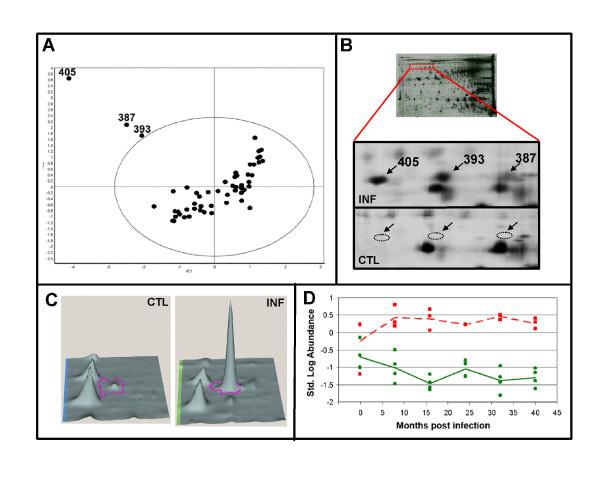
Two dimensional differential gel eletrophoresis (2D-DIGE) and mass spectrometry analyses were used to identify proteins exhibiting differential abundance in the urine of BSE infected cattle and age matched controls over the course of the disease. Multivariate analyses of protein expression data identified a single protein able to discriminate, with 100% accuracy, control from infected samples. In addition, a subset of proteins were able to predict with 85% +/- 13.2 accuracy the time post infection that the samples were collected.
CONCLUSION
These results suggest that in principle it is possible to identify biomarkers in urine useful in the diagnosis, prognosis and monitoring of disease progression of transmissible spongiform encephalopathy diseases (TSEs).
背景
牛海绵状脑病(BSE)疫情以及新型人类变异型克雅氏病(vCJD)的出现,导致了农产品生产和贸易的深刻变革。目前批准用于屠宰牛BSE监测的快速检测方法均基于检测脑组织中与疾病相关的朊病毒蛋白异构体PrPd,因此仅适用于死后诊断。
目的
在诸如评估用于出口的种畜健康状况等无法进行死后检测的情况下,需要一种基于基质或体液的生前检测方法,以便于采样和重复采样。尿液及基于尿液的分析能够满足这些要求。
结果
采用二维差异凝胶电泳(2D-DIGE)和质谱分析,以确定在疾病过程中BSE感染牛尿液和年龄匹配对照中丰度有差异的蛋白质。对蛋白质表达数据进行多变量分析,确定了一种能以100%的准确率区分对照样本和感染样本的单一蛋白质。此外,一部分蛋白质能够以85%±13.2%的准确率预测样本采集时的感染后时间。
结论
这些结果表明,原则上有可能在尿液中鉴定出可用于诊断、预后评估及监测传染性海绵状脑病(TSE)疾病进展的生物标志物。


 Zotero 插件