Deilkås Ellen T, Hofoss Dag
Health Services Research Unit, Akershus University Hospital, Lorenskog, Norway.
BMC Health Serv Res. 2008 Sep 22;8:191. doi: 10.1186/1472-6963-8-191.
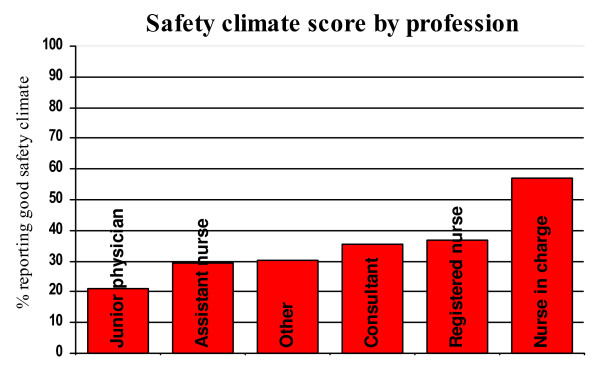
How to protect patients from harm is a question of universal interest. Measuring and improving safety culture in care giving units is an important strategy for promoting a safe environment for patients. The Safety Attitudes Questionnaire (SAQ) is the only instrument that measures safety culture in a way which correlates with patient outcome. We have translated the SAQ to Norwegian and validated the translated version. The psychometric properties of the translated questionnaire are presented in this article.
The questionnaire was translated with the back translation technique and tested in 47 clinical units in a Norwegian university hospital. SAQ's (the Generic version (Short Form 2006) the version with the two sets of questions on perceptions of management: on unit management and on hospital management) were distributed to 1911 frontline staff. 762 were distributed during unit meetings and 1149 through the postal system. Cronbach alphas, item-to-own correlations, and test-retest correlations were calculated, and response distribution analysis and confirmatory factor analysis were performed, as well as early validity tests.
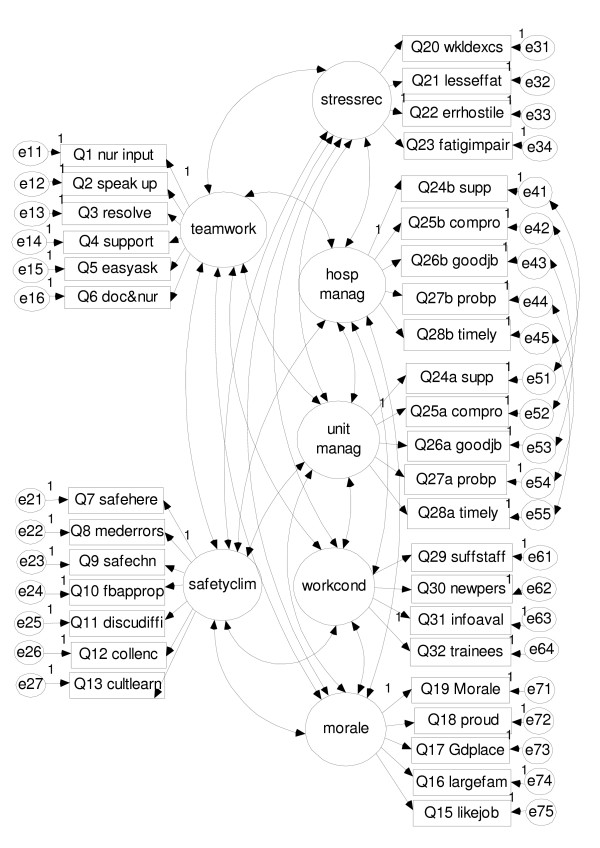
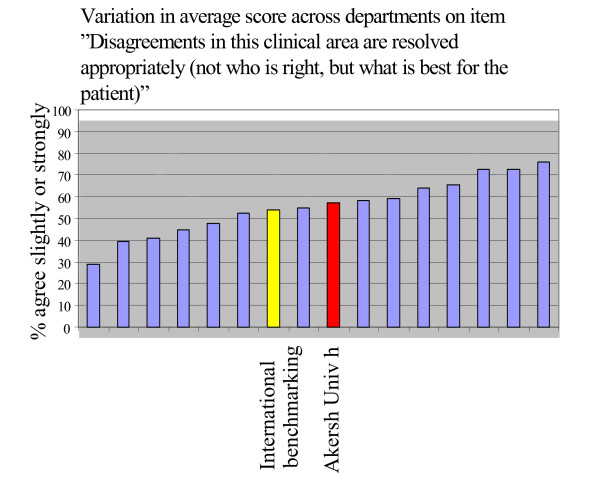
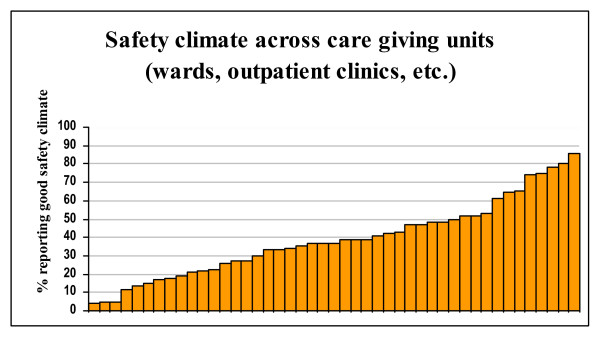
1306 staff members completed and returned the questionnaire: a response rate of 68%. Questionnaire acceptability was good. The reliability measures were acceptable. The factor structure of the responses was tested by confirmatory factor analysis. 36 items were ascribed to seven underlying factors: Teamwork Climate, Safety Climate, Stress Recognition, Perceptions of Hospital Management, Perceptions of Unit Management, Working conditions, and Job satisfaction. Goodness-of-Fit Indices showed reasonable, but not indisputable, model fit. External validity indicators - recognizability of results, correlations with "trigger tool"-identified adverse events, with patient satisfaction with hospitalization, patient reports of possible maltreatment, and patient evaluation of organization of hospital work - provided preliminary validation.
Based on the data from Akershus University Hospital, we conclude that the Norwegian translation of the SAQ showed satisfactory internal psychometric properties. With data from one hospital only, we cannot draw strong conclusions on its external validity. Further validation studies linking the SAQ-scores to patient outcome data should be performed.
如何保护患者免受伤害是一个广受关注的问题。衡量并改善护理单元的安全文化是为患者营造安全环境的一项重要策略。安全态度问卷(SAQ)是唯一一种以与患者预后相关的方式来衡量安全文化的工具。我们已将SAQ翻译成挪威语并对翻译版本进行了验证。本文介绍了翻译后问卷的心理测量特性。
采用回译技术对问卷进行翻译,并在挪威一家大学医院的47个临床单元进行测试。向1911名一线工作人员发放了SAQ(通用版(2006年简版)以及包含两组关于管理认知问题的版本:关于单元管理和医院管理)。762份通过单元会议发放,1149份通过邮政系统发放。计算了克朗巴哈系数、项目与自身的相关性以及重测相关性,并进行了反应分布分析、验证性因素分析以及早期效度测试。
1306名工作人员完成并返还了问卷,回复率为68%。问卷的可接受性良好。可靠性测量结果可以接受。通过验证性因素分析对回复的因素结构进行了测试。36个项目被归为七个潜在因素:团队合作氛围、安全氛围、压力认知、对医院管理的认知、对单元管理的认知、工作条件和工作满意度。拟合优度指标显示模型拟合合理但并非无可争议。外部效度指标——结果的可识别性、与“触发工具法”确定的不良事件的相关性、与患者住院满意度的相关性、患者对可能虐待行为的报告以及患者对医院工作组织的评价——提供了初步验证。
基于阿克什胡斯大学医院的数据,我们得出结论,SAQ的挪威语翻译版本显示出令人满意的内部心理测量特性。由于仅来自一家医院的数据,我们无法就其外部效度得出有力结论。应开展进一步的验证研究,将SAQ分数与患者预后数据联系起来。