• 文献检索
  • 文档翻译
  • 深度研究
  • 学术资讯
  • Suppr Zotero 插件Zotero 插件
  • 邀请有礼
  • 套餐&价格
  • 历史记录
应用&插件
Suppr Zotero 插件Zotero 插件浏览器插件Mac 客户端Windows 客户端微信小程序
定价
高级版会员购买积分包购买API积分包
服务
文献检索文档翻译深度研究API 文档MCP 服务
关于我们
关于 Suppr公司介绍联系我们用户协议隐私条款
关注我们

Suppr 超能文献

核心技术专利:CN118964589B侵权必究
粤ICP备2023148730 号-1Suppr @ 2026

文献检索

告别复杂PubMed语法,用中文像聊天一样搜索,搜遍4000万医学文献。AI智能推荐,让科研检索更轻松。

立即免费搜索

文件翻译

保留排版,准确专业,支持PDF/Word/PPT等文件格式,支持 12+语言互译。

免费翻译文档

深度研究

AI帮你快速写综述,25分钟生成高质量综述,智能提取关键信息,辅助科研写作。

立即免费体验

安全态度问卷:心理测量特性、基准数据及新兴研究

The Safety Attitudes Questionnaire: psychometric properties, benchmarking data, and emerging research.

作者信息

Sexton John B, Helmreich Robert L, Neilands Torsten B, Rowan Kathy, Vella Keryn, Boyden James, Roberts Peter R, Thomas Eric J

机构信息

The University of Texas Center of Excellence for Patient Safety Research and Practice, The University of Texas--Houston Medical School, Houston, USA.

出版信息

BMC Health Serv Res. 2006 Apr 3;6:44. doi: 10.1186/1472-6963-6-44.

DOI:10.1186/1472-6963-6-44
PMID:16584553
原文链接:https://pmc.ncbi.nlm.nih.gov/articles/PMC1481614/
Abstract

BACKGROUND

There is widespread interest in measuring healthcare provider attitudes about issues relevant to patient safety (often called safety climate or safety culture). Here we report the psychometric properties, establish benchmarking data, and discuss emerging areas of research with the University of Texas Safety Attitudes Questionnaire.

METHODS

Six cross-sectional surveys of health care providers (n = 10,843) in 203 clinical areas (including critical care units, operating rooms, inpatient settings, and ambulatory clinics) in three countries (USA, UK, New Zealand). Multilevel factor analyses yielded results at the clinical area level and the respondent nested within clinical area level. We report scale reliability, floor/ceiling effects, item factor loadings, inter-factor correlations, and percentage of respondents who agree with each item and scale.

RESULTS

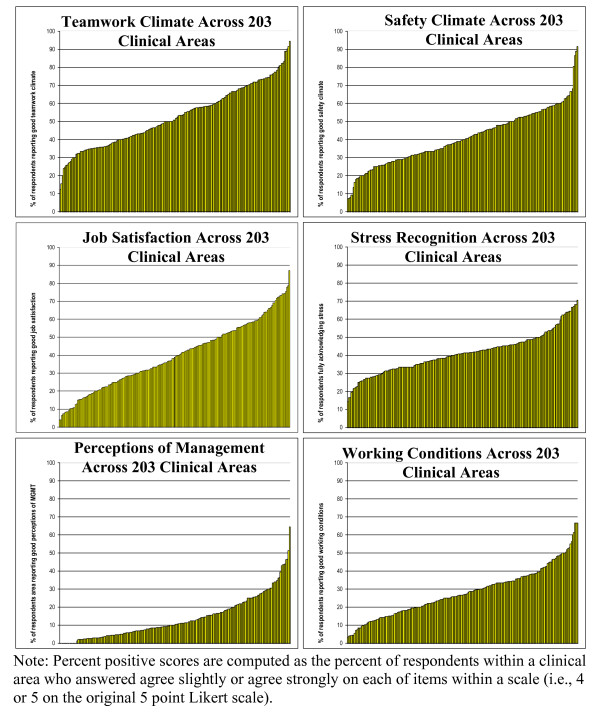
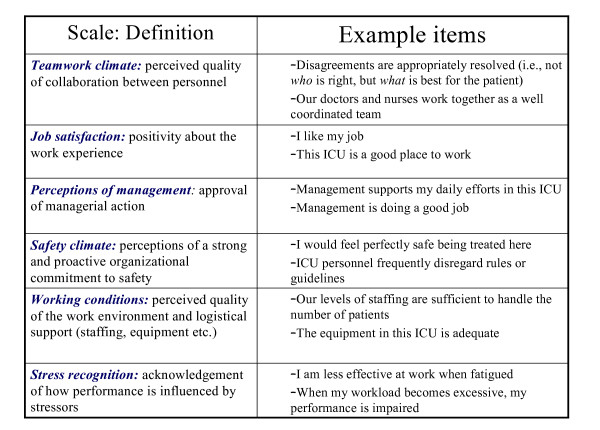
A six factor model of provider attitudes fit to the data at both the clinical area and respondent nested within clinical area levels. The factors were: Teamwork Climate, Safety Climate, Perceptions of Management, Job Satisfaction, Working Conditions, and Stress Recognition. Scale reliability was 0.9. Provider attitudes varied greatly both within and among organizations. Results are presented to allow benchmarking among organizations and emerging research is discussed.

CONCLUSION

The Safety Attitudes Questionnaire demonstrated good psychometric properties. Healthcare organizations can use the survey to measure caregiver attitudes about six patient safety-related domains, to compare themselves with other organizations, to prompt interventions to improve safety attitudes and to measure the effectiveness of these interventions.

摘要

背景

人们广泛关注衡量医疗服务提供者对与患者安全相关问题的态度(通常称为安全氛围或安全文化)。在此,我们报告德克萨斯大学安全态度问卷的心理测量特性,建立基准数据,并讨论新兴的研究领域。

方法

对三个国家(美国、英国、新西兰)203个临床区域(包括重症监护病房、手术室、住院部和门诊诊所)的医疗服务提供者(n = 10843)进行了六项横断面调查。多级因素分析得出了临床区域层面以及嵌套在临床区域层面内的受访者层面的结果。我们报告了量表信度、地板效应/天花板效应、项目因素负荷、因素间相关性以及同意每个项目和量表的受访者百分比。

结果

一个六因素的提供者态度模型适用于临床区域层面和嵌套在临床区域层面内的受访者层面的数据。这些因素包括:团队合作氛围、安全氛围、对管理的认知、工作满意度、工作条件和压力认知。量表信度为0.9。组织内部和组织之间提供者的态度差异很大。呈现结果以便进行组织间的基准比较,并讨论新兴研究。

结论

安全态度问卷显示出良好的心理测量特性。医疗保健组织可以使用该调查来衡量护理人员对六个与患者安全相关领域的态度,将自己与其他组织进行比较,促使采取干预措施以改善安全态度,并衡量这些干预措施的有效性。
https://cdn.ncbi.nlm.nih.gov/pmc/blobs/fa77/1481614/5f2ca47e30d0/1472-6963-6-44-2.jpg
https://cdn.ncbi.nlm.nih.gov/pmc/blobs/fa77/1481614/5c799d1c006b/1472-6963-6-44-1.jpg
https://cdn.ncbi.nlm.nih.gov/pmc/blobs/fa77/1481614/5f2ca47e30d0/1472-6963-6-44-2.jpg
https://cdn.ncbi.nlm.nih.gov/pmc/blobs/fa77/1481614/5c799d1c006b/1472-6963-6-44-1.jpg
https://cdn.ncbi.nlm.nih.gov/pmc/blobs/fa77/1481614/5f2ca47e30d0/1472-6963-6-44-2.jpg

相似文献

1
The Safety Attitudes Questionnaire: psychometric properties, benchmarking data, and emerging research.安全态度问卷:心理测量特性、基准数据及新兴研究
BMC Health Serv Res. 2006 Apr 3;6:44. doi: 10.1186/1472-6963-6-44.
2
Validation of the Dutch language version of the Safety Attitudes Questionnaire (SAQ-NL).荷兰语版安全态度问卷(SAQ-NL)的验证
BMC Health Serv Res. 2016 Aug 15;16(a):385. doi: 10.1186/s12913-016-1648-3.
3
Measuring safety culture in the ambulatory setting: the safety attitudes questionnaire--ambulatory version.测量门诊环境中的安全文化:安全态度问卷——门诊版
J Gen Intern Med. 2007 Jan;22(1):1-5. doi: 10.1007/s11606-007-0114-7.
4
Perceptions of safety culture vary across the intensive care units of a single institution.在同一机构的重症监护病房中,对安全文化的认知存在差异。
Crit Care Med. 2007 Jan;35(1):165-76. doi: 10.1097/01.CCM.0000251505.76026.CF.
5
The safety attitudes questionnaire - ambulatory version: psychometric properties of the Norwegian translated version for the primary care setting.安全态度问卷 - 门诊版:初级保健环境中挪威语翻译版的心理测量特性。
BMC Health Serv Res. 2014 Mar 29;14:139. doi: 10.1186/1472-6963-14-139.
6
The Safety Attitudes Questionnaire as a tool for benchmarking safety culture in the NICU.《安全态度问卷》作为新生儿重症监护病房安全文化基准工具。
Arch Dis Child Fetal Neonatal Ed. 2012 Mar;97(2):F127-32. doi: 10.1136/archdischild-2011-300612.
7
The safety attitudes questionnaire in Chinese: psychometric properties and benchmarking data of the safety culture in Beijing hospitals.中文版安全态度问卷:北京医院安全文化的心理测量特性及基准数据
BMC Health Serv Res. 2017 Aug 23;17(1):590. doi: 10.1186/s12913-017-2543-2.
8
The associations between work-life balance behaviours, teamwork climate and safety climate: cross-sectional survey introducing the work-life climate scale, psychometric properties, benchmarking data and future directions.工作-生活平衡行为、团队合作氛围和安全氛围之间的关系:引入工作-生活氛围量表的横断面调查、心理测量学特性、基准数据和未来方向。
BMJ Qual Saf. 2017 Aug;26(8):632-640. doi: 10.1136/bmjqs-2016-006032. Epub 2016 Dec 22.
9
Patient safety culture in a Dutch pediatric surgical intensive care unit: an evaluation using the Safety Attitudes Questionnaire.荷兰儿科外科重症监护病房的患者安全文化:使用安全态度问卷进行评估。
Pediatr Crit Care Med. 2011 Nov;12(6):e310-6. doi: 10.1097/PCC.0b013e318220afca.
10
Work-life balance behaviours cluster in work settings and relate to burnout and safety culture: a cross-sectional survey analysis.工作-生活平衡行为在工作环境中聚集,并与倦怠和安全文化有关:一项横断面调查分析。
BMJ Qual Saf. 2019 Feb;28(2):142-150. doi: 10.1136/bmjqs-2018-007933. Epub 2018 Oct 11.

引用本文的文献

1
Safety Culture Evaluation in Sarawak General Hospital: A Cross-Sectional Study Using Safety Attitude Questionnaire (SAQ).砂拉越总医院的安全文化评估:一项使用安全态度问卷(SAQ)的横断面研究。
Risk Manag Healthc Policy. 2025 Aug 27;18:2799-2811. doi: 10.2147/RMHP.S530072. eCollection 2025.
2
Teamwork effectiveness in intensive care units: development and validation of a brief and reliable assessment tool (TES-ICU).重症监护病房中的团队协作效能:一种简短且可靠的评估工具(TES-ICU)的开发与验证
BMC Health Serv Res. 2025 Aug 30;25(1):1157. doi: 10.1186/s12913-025-13432-y.
3
Artificial Intelligence Anxiety and Patient Safety Attitudes Among Operating Room Professionals: A Descriptive Cross-Sectional Study.

本文引用的文献

1
Preoperative Safety Briefing Project.术前安全简报项目
Perm J. 2004 Spring;8(2):21-7. doi: 10.7812/TPP/04.968.
2
Measuring patient safety climate: a review of surveys.衡量患者安全氛围:调查综述
Qual Saf Health Care. 2005 Oct;14(5):364-6. doi: 10.1136/qshc.2005.014217.
3
Assessing safety culture: guidelines and recommendations.评估安全文化:指南与建议
手术室专业人员的人工智能焦虑与患者安全态度:一项描述性横断面研究。
Healthcare (Basel). 2025 Aug 16;13(16):2021. doi: 10.3390/healthcare13162021.
4
Assessing Stress and Shift Quality in Nursing Students: A Pre- and Post-Shift Survey Approach.评估护生的压力与轮班质量:一种轮班前和轮班后的调查方法。
Healthcare (Basel). 2025 Jul 18;13(14):1741. doi: 10.3390/healthcare13141741.
5
Work Environment and Work Context Factors Associated With Homecare Workers' Intention to Leave: An Analysis of a National, Multicenter Cross-Sectional Study.与家庭护理人员离职意愿相关的工作环境和工作背景因素:一项全国性多中心横断面研究的分析
J Nurs Manag. 2025 Jul 9;2025:1554741. doi: 10.1155/jonm/1554741. eCollection 2025.
6
Assessment of Emergency Medicine Residents' Situational Awareness and Perception of Patient Safety Culture in the Emergency Department.急诊科急诊医学住院医师的情境意识及对患者安全文化认知的评估
AEM Educ Train. 2025 Jun 12;9(3):e70060. doi: 10.1002/aet2.70060. eCollection 2025 Jun.
7
Healthcare workers' perceptions of patient safety culture in emergency departments: a scoping review.医护人员对急诊科患者安全文化的认知:一项范围综述
BMJ Open. 2025 Jun 4;15(6):e097086. doi: 10.1136/bmjopen-2024-097086.
8
Emergency department's patient safety culture perceived by healthcare workers: A scoping review protocol.医护人员对急诊科患者安全文化的认知:一项范围综述方案
PLoS One. 2025 May 27;20(5):e0325049. doi: 10.1371/journal.pone.0325049. eCollection 2025.
9
Patient safety attitude among intensive care unit physicians and nurses: a multi-center study in Egypt.埃及重症监护病房医生和护士的患者安全态度:一项多中心研究
J Egypt Public Health Assoc. 2025 May 14;100(1):11. doi: 10.1186/s42506-025-00190-2.
10
Leadership dynamics in health care crises: The impact of initiating structure and consideration behaviors on safety climate in public hospitals.医疗保健危机中的领导动态:创始结构和关怀行为对公立医院安全氛围的影响。
Health Care Manage Rev. 2025;50(3):221-231. doi: 10.1097/HMR.0000000000000444. Epub 2025 May 12.
Qual Saf Health Care. 2005 Aug;14(4):231-3. doi: 10.1136/qshc.2005.015180.
4
The effect of executive walk rounds on nurse safety climate attitudes: a randomized trial of clinical units[ISRCTN85147255] [corrected].行政巡查对护士安全氛围态度的影响:临床科室的一项随机试验[ISRCTN85147255] [已校正]
BMC Health Serv Res. 2005 Apr 11;5(1):28. doi: 10.1186/1472-6963-5-28.
5
Using a multihospital survey to examine the safety culture.利用多医院调查来审视安全文化。
Jt Comm J Qual Saf. 2004 Mar;30(3):125-32. doi: 10.1016/s1549-3741(04)30014-6.
6
Safety culture assessment: a tool for improving patient safety in healthcare organizations.患者安全文化评估:一种改善医疗机构患者安全的工具。
Qual Saf Health Care. 2003 Dec;12 Suppl 2(Suppl 2):ii17-23. doi: 10.1136/qhc.12.suppl_2.ii17.
7
The culture of safety: results of an organization-wide survey in 15 California hospitals.安全文化:加利福尼亚州15家医院全组织范围调查的结果
Qual Saf Health Care. 2003 Apr;12(2):112-8. doi: 10.1136/qhc.12.2.112.
8
Discrepant attitudes about teamwork among critical care nurses and physicians.重症监护护士和医生对团队合作的态度存在差异。
Crit Care Med. 2003 Mar;31(3):956-9. doi: 10.1097/01.CCM.0000056183.89175.76.
9
Error, stress, and teamwork in medicine and aviation: cross sectional surveys.医学与航空领域中的失误、压力及团队协作:横断面调查
BMJ. 2000 Mar 18;320(7237):745-9. doi: 10.1136/bmj.320.7237.745.
10
Framework for analysing risk and safety in clinical medicine.临床医学风险与安全分析框架
BMJ. 1998 Apr 11;316(7138):1154-7. doi: 10.1136/bmj.316.7138.1154.