Brodersen Kay H, Penny Will D, Harrison Lee M, Daunizeau Jean, Ruff Christian C, Duzel Emrah, Friston Karl J, Stephan Klaas E
Wellcome Trust Centre for Neuroimaging, Institute of Neurology, University College London, 12 Queen Square, London WC1N 3BG, UK.
Neural Netw. 2008 Nov;21(9):1247-60. doi: 10.1016/j.neunet.2008.08.007. Epub 2008 Sep 7.
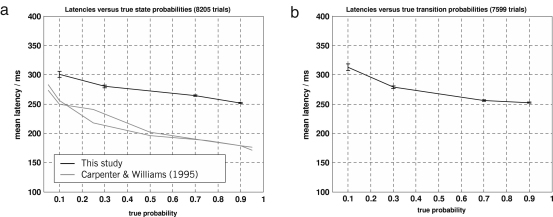
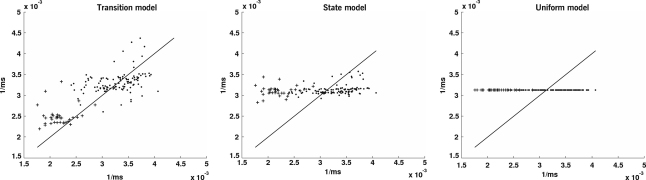
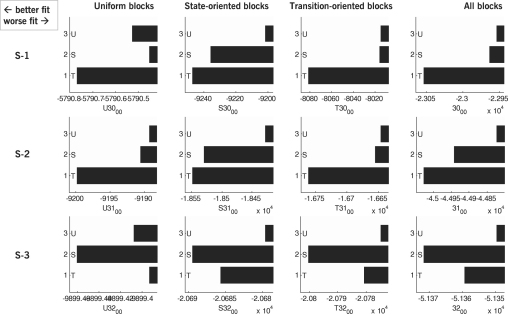
The neurophysiology of eye movements has been studied extensively, and several computational models have been proposed for decision-making processes that underlie the generation of eye movements towards a visual stimulus in a situation of uncertainty. One class of models, known as linear rise-to-threshold models, provides an economical, yet broadly applicable, explanation for the observed variability in the latency between the onset of a peripheral visual target and the saccade towards it. So far, however, these models do not account for the dynamics of learning across a sequence of stimuli, and they do not apply to situations in which subjects are exposed to events with conditional probabilities. In this methodological paper, we extend the class of linear rise-to-threshold models to address these limitations. Specifically, we reformulate previous models in terms of a generative, hierarchical model, by combining two separate sub-models that account for the interplay between learning of target locations across trials and the decision-making process within trials. We derive a maximum-likelihood scheme for parameter estimation as well as model comparison on the basis of log likelihood ratios. The utility of the integrated model is demonstrated by applying it to empirical saccade data acquired from three healthy subjects. Model comparison is used (i) to show that eye movements do not only reflect marginal but also conditional probabilities of target locations, and (ii) to reveal subject-specific learning profiles over trials. These individual learning profiles are sufficiently distinct that test samples can be successfully mapped onto the correct subject by a naïve Bayes classifier. Altogether, our approach extends the class of linear rise-to-threshold models of saccadic decision making, overcomes some of their previous limitations, and enables statistical inference both about learning of target locations across trials and the decision-making process within trials.
眼动的神经生理学已得到广泛研究,针对在不确定情况下朝向视觉刺激产生眼动的决策过程,已提出了几种计算模型。一类被称为线性上升至阈值模型的模型,为观察到的外周视觉目标出现与朝向该目标的扫视之间潜伏期的变异性提供了一种经济但广泛适用的解释。然而,到目前为止,这些模型没有考虑跨一系列刺激的学习动态,并且不适用于受试者接触具有条件概率事件的情况。在这篇方法学论文中,我们扩展了线性上升至阈值模型类别以解决这些局限性。具体而言,我们通过结合两个单独的子模型,将先前的模型重新表述为一个生成式分层模型,这两个子模型分别解释了跨试验的目标位置学习与试验内决策过程之间的相互作用。我们推导了一种基于对数似然比的最大似然参数估计方案以及模型比较方法。通过将其应用于从三名健康受试者获取的经验性扫视数据,证明了该集成模型的实用性。模型比较用于:(i)表明眼动不仅反映目标位置的边际概率,还反映条件概率;(ii)揭示受试者在多次试验中的特定学习概况。这些个体学习概况足够独特,以至于朴素贝叶斯分类器可以成功地将测试样本映射到正确的受试者上。总之,我们的方法扩展了扫视决策的线性上升至阈值模型类别,克服了它们先前的一些局限性,并能够对跨试验的目标位置学习和试验内的决策过程进行统计推断。