McDowell Jennifer E, Dyckman Kara A, Austin Benjamin P, Clementz Brett A
Departments of Psychology & Neuroscience, Bio-Imaging Research Center, Psychology Building, University of Georgia, Athens, GA 30602, USA.
Brain Cogn. 2008 Dec;68(3):255-70. doi: 10.1016/j.bandc.2008.08.016. Epub 2008 Oct 5.
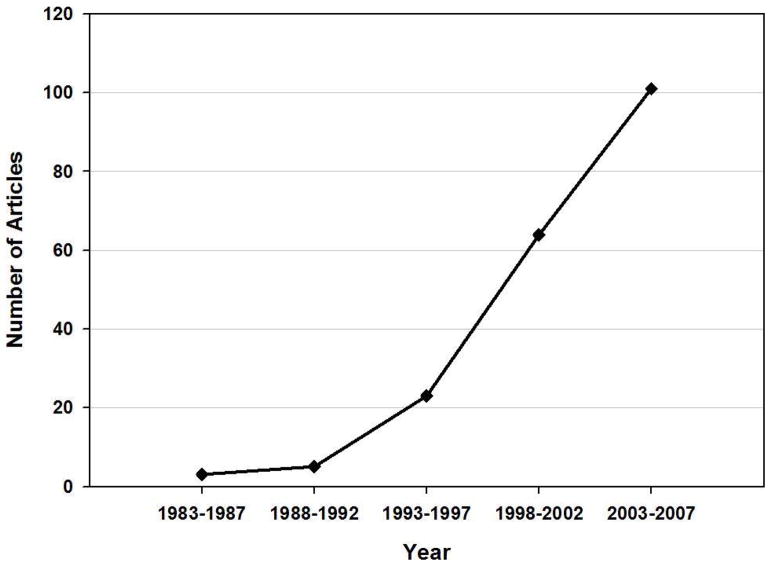
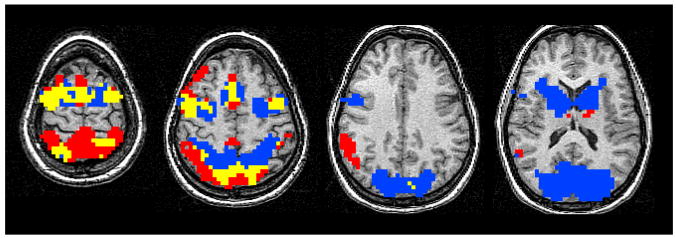
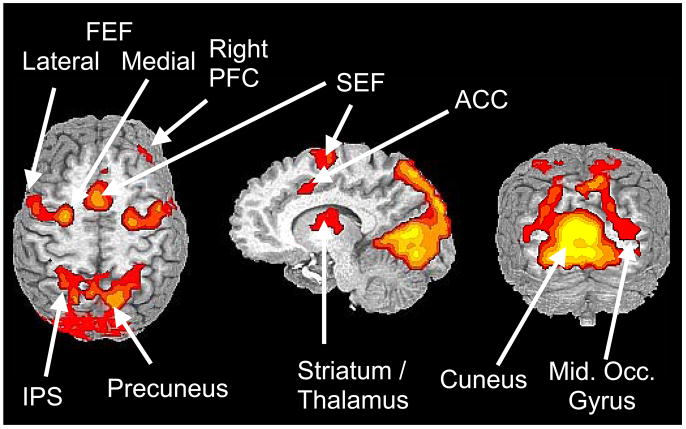
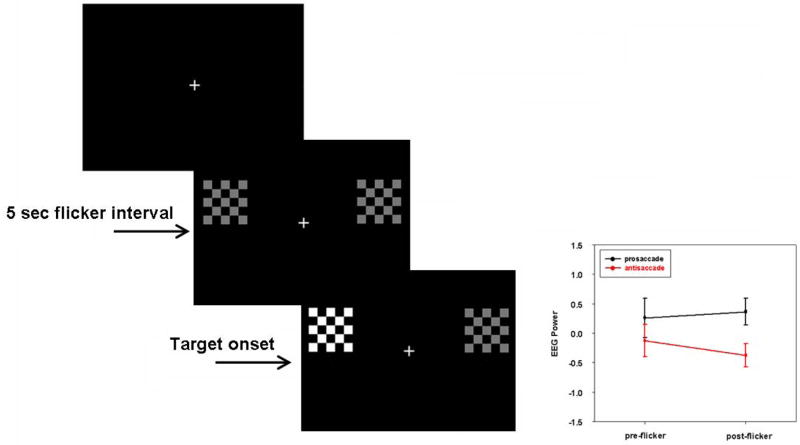
This review provides a summary of the contributions made by human functional neuroimaging studies to the understanding of neural correlates of saccadic control. The generation of simple visually guided saccades (redirections of gaze to a visual stimulus or pro-saccades) and more complex volitional saccades require similar basic neural circuitry with additional neural regions supporting requisite higher level processes. The saccadic system has been studied extensively in non-human (e.g., single-unit recordings) and human (e.g., lesions and neuroimaging) primates. Considerable knowledge of this system's functional neuroanatomy makes it useful for investigating models of cognitive control. The network involved in pro-saccade generation (by definition largely exogenously-driven) includes subcortical (striatum, thalamus, superior colliculus, and cerebellar vermis) and cortical (primary visual, extrastriate, and parietal cortices, and frontal and supplementary eye fields) structures. Activation in these regions is also observed during endogenously-driven voluntary saccades (e.g., anti-saccades, ocular motor delayed response or memory saccades, predictive tracking tasks and anticipatory saccades, and saccade sequencing), all of which require complex cognitive processes like inhibition and working memory. These additional requirements are supported by changes in neural activity in basic saccade circuitry and by recruitment of additional neural regions (such as prefrontal and anterior cingulate cortices). Activity in visual cortex is modulated as a function of task demands and may predict the type of saccade to be generated, perhaps via top-down control mechanisms. Neuroimaging studies suggest two foci of activation within FEF - medial and lateral - which may correspond to volitional and reflexive demands, respectively. Future research on saccade control could usefully (i) delineate important anatomical subdivisions that underlie functional differences, (ii) evaluate functional connectivity of anatomical regions supporting saccade generation using methods such as ICA and structural equation modeling, (iii) investigate how context affects behavior and brain activity, and (iv) use multi-modal neuroimaging to maximize spatial and temporal resolution.
本综述总结了人类功能性神经影像学研究对理解扫视控制的神经相关性所做的贡献。简单视觉引导扫视(将目光重定向至视觉刺激或前向扫视)和更复杂的随意扫视的产生需要相似的基本神经回路,以及支持必要高级过程的额外神经区域。扫视系统已在非人灵长类动物(如单细胞记录)和人类灵长类动物(如损伤和神经影像学研究)中得到广泛研究。对该系统功能性神经解剖学的大量了解使其有助于研究认知控制模型。参与前向扫视产生(从定义上讲主要是外源性驱动)的网络包括皮层下结构(纹状体、丘脑、上丘和小脑蚓部)和皮层结构(初级视觉皮层、纹外皮层、顶叶皮层以及额叶和辅助眼区)。在由内源性驱动的随意扫视(如反扫视、眼动延迟反应或记忆扫视、预测性跟踪任务和预期扫视以及扫视序列)过程中也观察到这些区域的激活,所有这些都需要诸如抑制和工作记忆等复杂认知过程。基本扫视回路中神经活动的变化以及额外神经区域(如前额叶和前扣带回皮层)的募集支持了这些额外需求。视觉皮层的活动根据任务需求进行调节,并且可能通过自上而下的控制机制预测即将产生的扫视类型。神经影像学研究表明,额眼区存在两个激活焦点——内侧和外侧——可能分别对应于随意和反射性需求。未来关于扫视控制的研究可以有效地(i)描绘构成功能差异基础的重要解剖细分,(ii)使用独立成分分析(ICA)和结构方程建模等方法评估支持扫视产生的解剖区域的功能连接,(iii)研究情境如何影响行为和大脑活动,以及(iv)使用多模态神经影像学来最大化空间和时间分辨率。