Valentine J L, Arthur R R, Mobley H L, Dick J D
Department of Immunology and Infectious Diseases. Johns Hopkins School of Public Health and Hygiene, Baltimore, Maryland.
J Clin Microbiol. 1991 Apr;29(4):689-95. doi: 10.1128/jcm.29.4.689-695.1991.
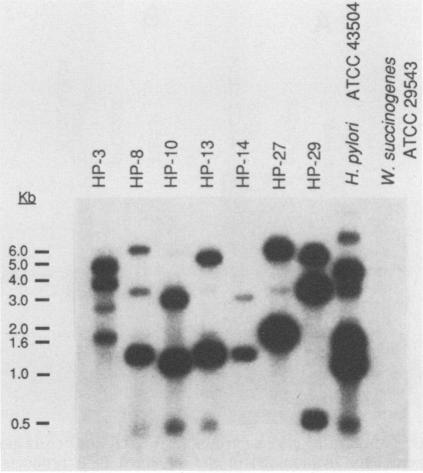
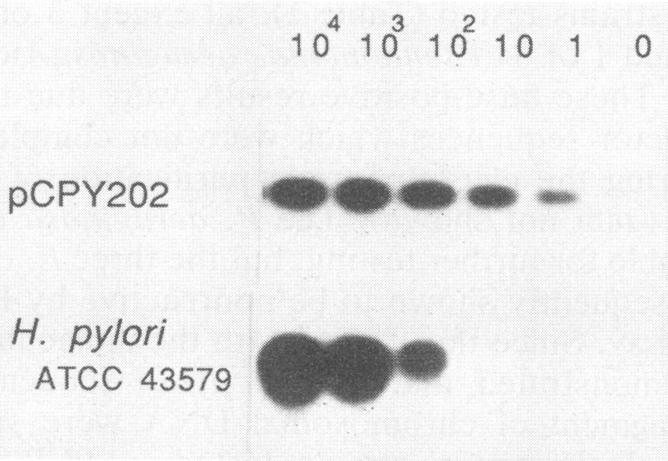
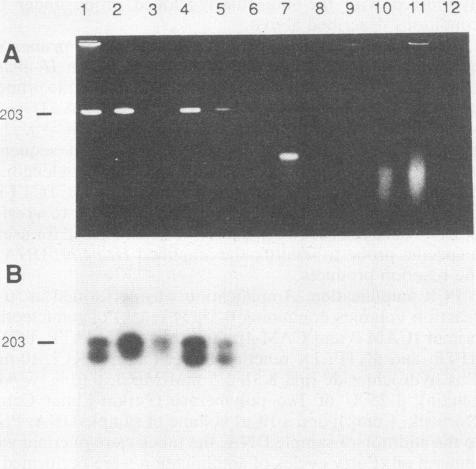
A 1.9-kb cloned fragment of chromosomal DNA randomly selected from a Helicobacter pylori cloned library was evaluated as a potential probe. The probe detected 19 of 19 H. pylori strains and yielded a specificity of 98.7% when tested against 306 other bacterial strains representing 32 different species. False-positive results with non-H. pylori strains were due to the presence of contaminating vector sequences. A polymerase chain reaction (PCR) assay was developed by using 20-base oligonucleotide primers homologous to a portion of the 1.9-kb fragment. The PCR assay amplified a 203-nucleotide-pair product which was analyzed by agarose gel electrophoresis and Southern hybridization by using a third 20-base 32P-labeled oligonucleotide complementary to a region of DNA between the primers. The PCR assay was 100% sensitive, detecting all 35 H. pylori strains tested, and did not amplify sequences in several closely related species. The assay was sensitive for as little as one copy of the cloned plasmid DNA or 100 H. pylori bacterial cells. To evaluate the PCR assay for clinical samples, gastric biopsy and aspirate specimens were tested by PCR, and the results were compared with those of microbiologic culture and histologic examination. In fresh biopsy specimens, H. pylori sequences were detected by PCR in 13 of 14 (93%) positive tissues and 0 of 19 negative tissues. In gastric aspirate specimens, 11 of 13 (85%) positive tissues were positive by PCR. H. pylori DNA was detected in 1 of 14 aspirate specimens negative by culture, histology, and PCR of the accompanying biopsy tissue. PCR is a rapid, accurate, and sensitive method for the detection of H. pylori.
从幽门螺杆菌克隆文库中随机选取的一段1.9kb染色体DNA克隆片段被评估为一种潜在探针。该探针在检测19株幽门螺杆菌菌株时全部检测到,在针对代表32个不同物种的306株其他细菌菌株进行测试时,特异性为98.7%。非幽门螺杆菌菌株出现假阳性结果是由于存在污染的载体序列。利用与1.9kb片段一部分同源的20碱基寡核苷酸引物开发了一种聚合酶链反应(PCR)检测方法。该PCR检测方法扩增出一个203核苷酸对的产物,通过琼脂糖凝胶电泳进行分析,并使用与引物之间DNA区域互补的第三条20碱基32P标记寡核苷酸进行Southern杂交。该PCR检测方法灵敏度为100%,检测了所有35株测试的幽门螺杆菌菌株,并且未扩增几种密切相关物种的序列。该检测方法对低至一份克隆质粒DNA或100个幽门螺杆菌细菌细胞都很敏感。为了评估该PCR检测方法在临床样本中的应用,对胃活检和抽吸标本进行了PCR检测,并将结果与微生物培养和组织学检查结果进行比较。在新鲜活检标本中,14份阳性组织中的13份(93%)通过PCR检测到幽门螺杆菌序列,19份阴性组织中未检测到。在胃抽吸标本中,13份阳性组织中的11份(85%)通过PCR检测为阳性。在一份培养、组织学及伴随活检组织PCR均为阴性的14份抽吸标本中,有1份检测到幽门螺杆菌DNA。PCR是一种检测幽门螺杆菌的快速、准确且灵敏的方法。