Goletti Delia, Carrara Stefania, Butera Ornella, Amicosante Massimo, Ernst Martin, Sauzullo Ilaria, Vullo Vincenzo, Cirillo Daniela, Borroni Emanuele, Markova Roumiana, Drenska Roumiana, Dominguez José, Latorre Irene, Angeletti Claudio, Navarra Assunta, Petrosillo Nicola, Lauria Francesco Nicola, Ippolito Giuseppe, Migliori Giovanni Battista, Lange Christoph, Girardi Enrico
Translational Research Unit, Department of Epidemiology and Preclinical Research, National Institute for Infectious Diseases (INMI) L Spallanzani, IRCCS, Rome, Italy.
PLoS One. 2008;3(10):e3417. doi: 10.1371/journal.pone.0003417. Epub 2008 Oct 15.
The clinical application of IFN-gamma release assays (IGRAs) has recently improved the diagnosis of latent tuberculosis infection. In a multicenter study of the Tuberculosis Network European Trialsgroup (TBNET) we aimed to ascertain in routine clinical practice the accuracy of a novel assay using selected peptides encoded in the mycobacterial genomic region of difference (RD) 1 for the diagnosis of active tuberculosis in comparison with tuberculin skin test (TST), QuantiFERON-TB GOLD In-Tube (Cellestis Ltd., Carnegie, Australia) and T-SPOT.TB (Oxfordimmunotec, Abingdon, UK).
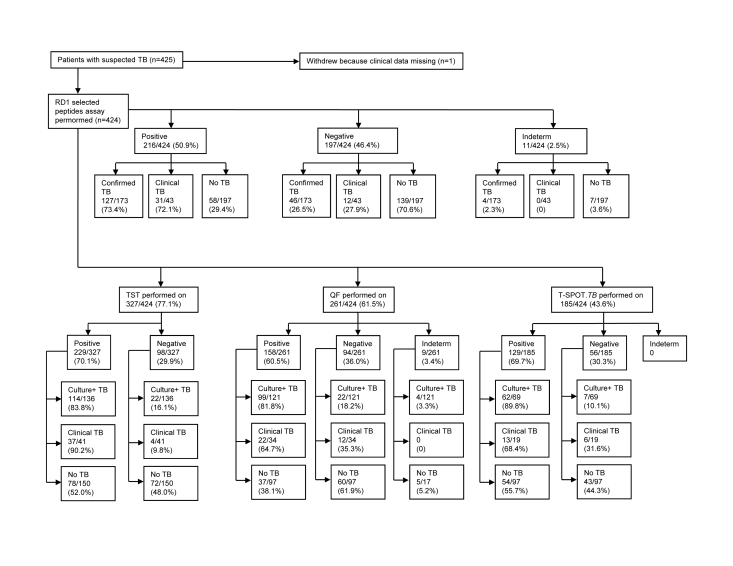
425 individuals from 6 different European centres were prospectively enrolled. We found that sensitivity of the novel test, TST, QuantiFERON-TB GOLD In-Tube and T-SPOT.TB was respectively 73.1%, 85.3%, 78.1%, and 85.2%; specificity was respectively 70.6%, 48.0%, 61.9% and 44.3%; positive likelihood ratios were respectively 2.48, 1.64, 2.05, and 1.53; negative likelihood ratios were respectively 0.38, 0.31, 0.35, 0.33. Sensitivity of TST combined with the novel test, QuantiFERON-TB GOLD In-Tube and T-SPOT.TB increased up to 92.4%, 97.7% and 97.1%, respectively. The likelihood ratios of combined negative results of TST with, respectively, the novel test, QuantiFERON-TB GOLD In-Tube and T-SPOT.TB were 0.19, 0.07 and 0.10.
The assay based on RD1 selected peptides has similar accuracy for active tuberculosis compared with TST and commercial IGRAs. Then, independently of the spectrum of antigens used in the assays to elicit mycobacterial specific immune responses, the novel test, IGRAs, and the TST do not allow an accurate identification of active tuberculosis in clinical practice. However, the combined use of the novel assay or commercial IGRAs with TST may allow exclusion of tuberculosis.
γ-干扰素释放检测(IGRAs)的临床应用最近改善了潜伏性结核感染的诊断。在欧洲结核网络试验组(TBNET)的一项多中心研究中,我们旨在确定在常规临床实践中,一种使用分枝杆菌差异基因组区域(RD)1中编码的选定肽段的新型检测方法与结核菌素皮肤试验(TST)、全血γ-干扰素释放试验(QuantiFERON-TB GOLD In-Tube,澳大利亚卡内基市Cellestis有限公司)和T-SPOT.TB(英国阿宾顿市Oxfordimmunotec公司)相比,对活动性结核病诊断的准确性。
前瞻性纳入了来自6个不同欧洲中心的425名个体。我们发现,新型检测方法、TST、全血γ-干扰素释放试验和T-SPOT.TB的敏感性分别为73.1%、85.3%、78.1%和85.2%;特异性分别为70.6%、48.0%、61.9%和44.3%;阳性似然比分别为2.48、1.64、2.05和1.53;阴性似然比分别为0.38、0.31、0.35和0.33。TST与新型检测方法、全血γ-干扰素释放试验和T-SPOT.TB联合使用时,敏感性分别提高到92.4%、97.7%和97.1%。TST与新型检测方法、全血γ-干扰素释放试验和T-SPOT.TB联合检测结果为阴性时的似然比分别为0.19、0.07和0.10。
基于RD1选定肽段的检测方法与TST和商业IGRAs相比,对活动性结核病的诊断准确性相似。因此,无论用于引发分枝杆菌特异性免疫反应的检测方法中使用何种抗原谱,新型检测方法、IGRAs和TST在临床实践中都无法准确识别活动性结核病。然而,新型检测方法或商业IGRAs与TST联合使用可能有助于排除结核病。