Bousquet Marina, Quelen Cathy, Rosati Roberto, Mansat-De Mas Véronique, La Starza Roberta, Bastard Christian, Lippert Eric, Talmant Pascaline, Lafage-Pochitaloff Marina, Leroux Dominique, Gervais Carine, Viguié Franck, Lai Jean-Luc, Terre Christine, Beverlo Berna, Sambani Costantina, Hagemeijer Anne, Marynen Peter, Delsol Georges, Dastugue Nicole, Mecucci Cristina, Brousset Pierre
Institut National de Santé et de Recherche Médicale, U563, Centre de Physiopathologie de Toulouse-Purpan, 31300 Toulouse, France.
J Exp Med. 2008 Oct 27;205(11):2499-506. doi: 10.1084/jem.20080285. Epub 2008 Oct 20.
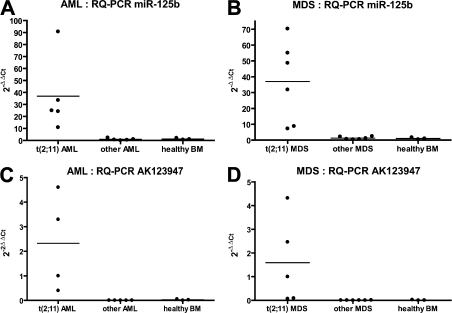
Most chromosomal translocations in myelodysplastic syndromes (MDS) and acute myeloid leukemia (AML) involve oncogenes that are either up-regulated or form part of new chimeric genes. The t(2;11)(p21;q23) translocation has been cloned in 19 cases of MDS and AML. In addition to this, we have shown that this translocation is associated with a strong up-regulation of miR-125b (from 6- to 90-fold). In vitro experiments revealed that miR-125b was able to interfere with primary human CD34(+) cell differentiation, and also inhibited terminal (monocytic and granulocytic) differentiation in HL60 and NB4 leukemic cell lines. Therefore, miR-125b up-regulation may represent a new mechanism of myeloid cell transformation, and myeloid neoplasms carrying the t(2;11) translocation define a new clinicopathological entity.
骨髓增生异常综合征(MDS)和急性髓系白血病(AML)中的大多数染色体易位涉及上调的致癌基因或构成新嵌合基因的一部分。t(2;11)(p21;q23)易位已在19例MDS和AML中被克隆。除此之外,我们还表明这种易位与miR-125b的强烈上调(6至90倍)相关。体外实验表明,miR-125b能够干扰原代人CD34(+)细胞分化,并且还抑制HL60和NB4白血病细胞系中的终末(单核细胞和粒细胞)分化。因此,miR-125b上调可能代表骨髓细胞转化的一种新机制,携带t(2;11)易位的骨髓肿瘤定义了一种新的临床病理实体。