Department of Applied Microbiology, Lund University, PO Box 124, SE-22100 Lund, Sweden.
Biotechnol Biofuels. 2008 Oct 23;1(1):16. doi: 10.1186/1754-6834-1-16.
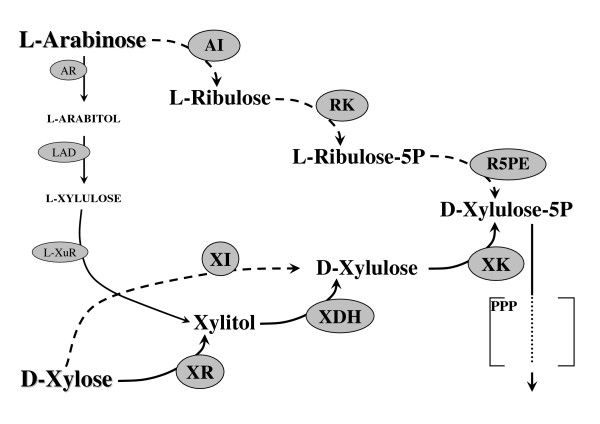
Ethanolic fermentation of lignocellulosic biomass is a sustainable option for the production of bioethanol. This process would greatly benefit from recombinant Saccharomyces cerevisiae strains also able to ferment, besides the hexose sugar fraction, the pentose sugars, arabinose and xylose. Different pathways can be introduced in S. cerevisiae to provide arabinose and xylose utilisation. In this study, the bacterial arabinose isomerase pathway was combined with two different xylose utilisation pathways: the xylose reductase/xylitol dehydrogenase and xylose isomerase pathways, respectively, in genetically identical strains. The strains were compared with respect to aerobic growth in arabinose and xylose batch culture and in anaerobic batch fermentation of a mixture of glucose, arabinose and xylose.
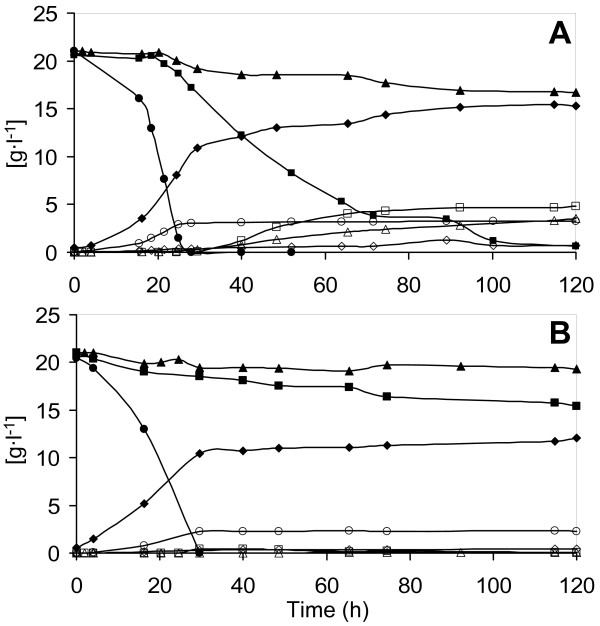
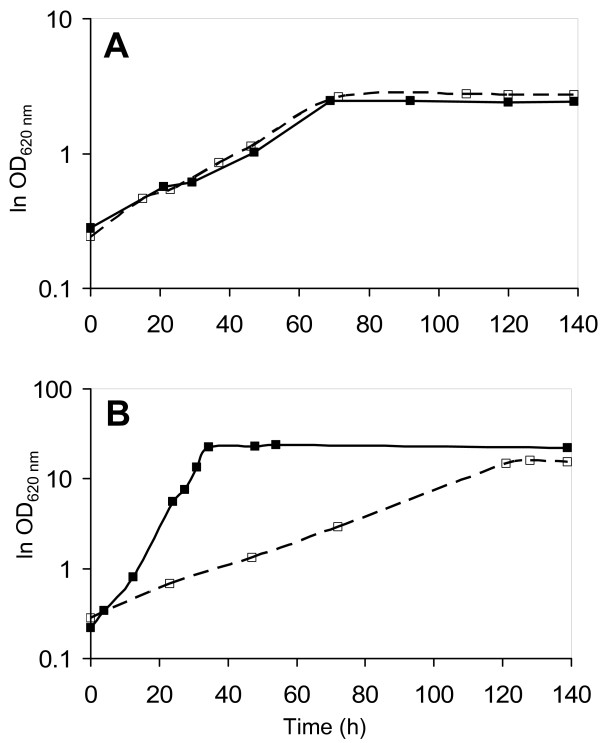
The specific aerobic arabinose growth rate was identical, 0.03 h-1, for the xylose reductase/xylitol dehydrogenase and xylose isomerase strain. The xylose reductase/xylitol dehydrogenase strain displayed higher aerobic growth rate on xylose, 0.14 h-1, and higher specific xylose consumption rate in anaerobic batch fermentation, 0.09 g (g cells)-1 h-1 than the xylose isomerase strain, which only reached 0.03 h-1 and 0.02 g (g cells)-1h-1, respectively. Whereas the xylose reductase/xylitol dehydrogenase strain produced higher ethanol yield on total sugars, 0.23 g g-1 compared with 0.18 g g-1 for the xylose isomerase strain, the xylose isomerase strain achieved higher ethanol yield on consumed sugars, 0.41 g g-1 compared with 0.32 g g-1 for the xylose reductase/xylitol dehydrogenase strain. Anaerobic fermentation of a mixture of glucose, arabinose and xylose resulted in higher final ethanol concentration, 14.7 g l-1 for the xylose reductase/xylitol dehydrogenase strain compared with 11.8 g l-1 for the xylose isomerase strain, and in higher specific ethanol productivity, 0.024 g (g cells)-1 h-1 compared with 0.01 g (g cells)-1 h-1 for the xylose reductase/xylitol dehydrogenase strain and the xylose isomerase strain, respectively.
The combination of the xylose reductase/xylitol dehydrogenase pathway and the bacterial arabinose isomerase pathway resulted in both higher pentose sugar uptake and higher overall ethanol production than the combination of the xylose isomerase pathway and the bacterial arabinose isomerase pathway. Moreover, the flux through the bacterial arabinose pathway did not increase when combined with the xylose isomerase pathway. This suggests that the low activity of the bacterial arabinose pathway cannot be ascribed to arabitol formation via the xylose reductase enzyme.
木质纤维素生物质的乙醇发酵是生产生物乙醇的可持续选择。如果重组酿酒酵母菌株不仅能够发酵己糖部分,还能够发酵戊糖、阿拉伯糖和木糖,那么这个过程将大大受益。可以引入不同的途径使酿酒酵母能够利用阿拉伯糖和木糖。在这项研究中,细菌阿拉伯糖异构酶途径与两种不同的木糖利用途径相结合:木糖还原酶/木糖醇脱氢酶和木糖异构酶途径,分别在遗传上相同的菌株中。比较了这些菌株在有氧条件下以阿拉伯糖和木糖分批培养以及在混合葡萄糖、阿拉伯糖和木糖的厌氧分批发酵中的生长情况。
木糖还原酶/木糖醇脱氢酶和木糖异构酶菌株的有氧阿拉伯糖比生长速率相同,为 0.03 h-1。木糖还原酶/木糖醇脱氢酶菌株在有氧条件下以木糖为底物时的生长速率更高,为 0.14 h-1,在厌氧分批发酵中以木糖为底物时的比消耗速率更高,为 0.09 g(g 细胞)-1 h-1,而木糖异构酶菌株仅达到 0.03 h-1 和 0.02 g(g 细胞)-1 h-1。虽然木糖还原酶/木糖醇脱氢酶菌株在总糖上的乙醇产率较高,为 0.23 g g-1,而木糖异构酶菌株为 0.18 g g-1,但木糖异构酶菌株在消耗糖上的乙醇产率较高,为 0.41 g g-1,而木糖还原酶/木糖醇脱氢酶菌株为 0.32 g g-1。葡萄糖、阿拉伯糖和木糖混合物的厌氧发酵导致最终乙醇浓度更高,木糖还原酶/木糖醇脱氢酶菌株为 14.7 g l-1,而木糖异构酶菌株为 11.8 g l-1,且木糖还原酶/木糖醇脱氢酶菌株和木糖异构酶菌株的比乙醇生产率更高,分别为 0.024 g(g 细胞)-1 h-1和 0.01 g(g 细胞)-1 h-1。
与木糖异构酶途径和细菌阿拉伯糖异构酶途径的组合相比,木糖还原酶/木糖醇脱氢酶途径和细菌阿拉伯糖异构酶途径的组合不仅提高了戊糖的摄取,而且提高了整体乙醇产量。此外,当与木糖异构酶途径结合时,细菌阿拉伯糖途径的通量并没有增加。这表明,通过木糖还原酶酶产生阿拉伯糖醇不能归因于细菌阿拉伯糖途径的低活性。