Mc Manus Vicki, Corcoran Paul, Perry Ivan J
School of Nursing and Midwifery, UCC, Cork, Republic of Ireland.
BMC Pediatr. 2008 Oct 31;8:50. doi: 10.1186/1471-2431-8-50.
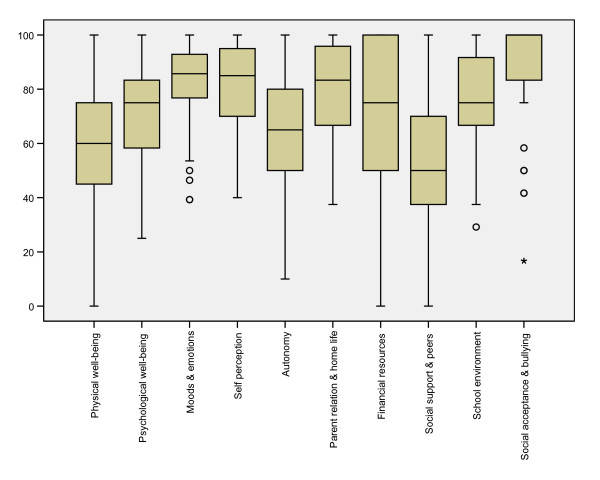
Cerebral palsy (CP) is the most common cause of physical disability in children but its impact on quality of life is not well understood. This study examined participation in everyday activities among children without CP and children with mild, moderate and severe impairment due to CP. We then examined ten domains of quality of life in children with CP and investigated whether participation in everyday activities was associated with improved quality of life independent of gender, age and level of impairment.
This was a cross-sectional study of children aged 8-12 years based on two questionnaires, frequency of participation (FPQ) and KIDSCREEN, completed by parents of 98 children on the South of Ireland Cerebral Palsy Register (response rate = 82%) and parents of 448 children attending two Cork city schools (response rate = 69%) who completed one questionnaire (FPQ). Multiple linear regression was used: firstly to estimate the effect of severity of CP on participation in everyday activities independent of age and gender and secondly we estimated the effect of participation on quality of life independent of age gender and level of impairment.
Participation in 11 of the 14 everyday activities examined varied across the children without CP and the children with varying severity of CP. In general, increased impairment decreased participation. Independent of age and gender, there was a highly significant decrease in overall participation with a fall of -6.0 (95% CI = -6.9 to -5.2) with each increasing level of impairment. The children with CP generally had high quality of life. Increased impairment was associated with diminished quality of life in just two domains - Physical well-being and Social support and peers. Overall participation in everyday activities was significantly associated with quality of life in 3 of the 10 domains (Physical well-being, Social support and peers & Moods and emotions) in analysis adjusted for gender age and level of impairment.
While increased impairment due to CP restricts participation in the majority of everyday activities, the level of participation has a limited effect on the quality of life of the children with CP in age 8-12 years.
脑瘫(CP)是儿童身体残疾的最常见原因,但其对生活质量的影响尚未得到充分了解。本研究调查了无脑瘫儿童以及因脑瘫导致轻度、中度和重度损伤儿童的日常活动参与情况。然后,我们研究了脑瘫儿童生活质量的十个领域,并调查了日常活动参与情况是否与生活质量的改善相关,且不受性别、年龄和损伤程度的影响。
这是一项针对8至12岁儿童的横断面研究,基于两份问卷,即参与频率问卷(FPQ)和儿童生活质量量表(KIDSCREEN),由爱尔兰南部脑瘫登记处的98名儿童的家长(回复率 = 82%)以及科克市两所学校的448名儿童的家长(回复率 = 69%)填写,后者只填写了一份问卷(FPQ)。采用多元线性回归:首先评估脑瘫严重程度对日常活动参与情况的影响,且不受年龄和性别的影响;其次评估参与情况对生活质量的影响,且不受年龄、性别和损伤程度的影响。
在14项被调查的日常活动中,11项活动的参与情况在无脑瘫儿童和不同严重程度的脑瘫儿童之间存在差异。一般来说,损伤程度增加会导致参与度降低。不受年龄和性别的影响,随着损伤程度每增加一级,总体参与度显著下降,降幅为-6.0(95%置信区间 = -6.9至-5.2)。脑瘫儿童的生活质量总体较高。损伤程度增加仅在两个领域与生活质量下降相关——身体健康和社会支持与同伴关系。在对性别、年龄和损伤程度进行调整的分析中,日常活动的总体参与度与10个领域中的3个领域(身体健康、社会支持与同伴关系以及情绪和情感)的生活质量显著相关。
虽然脑瘫导致的损伤程度增加会限制大多数日常活动的参与,但参与程度对8至12岁脑瘫儿童的生活质量影响有限。