Song Hyun-Joo, Onishi Kristine H, Baillargeon Renée, Fisher Cynthia
Department of Psychology, Yonsei University, 134 Shinchon-dong Seodaemun-gu, Seoul 120-749, South Korea.
Cognition. 2008 Dec;109(3):295-315. doi: 10.1016/j.cognition.2008.08.008. Epub 2008 Oct 30.
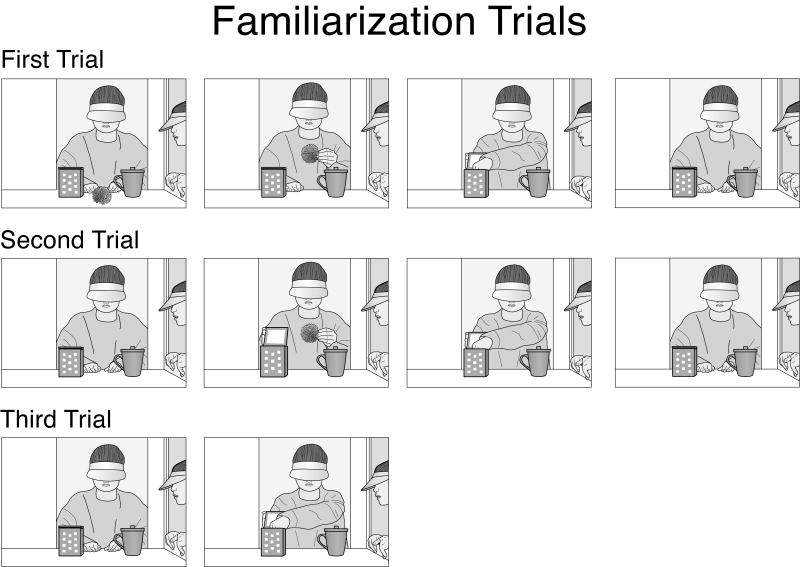
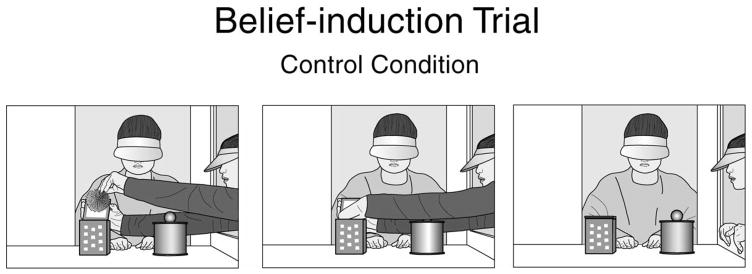
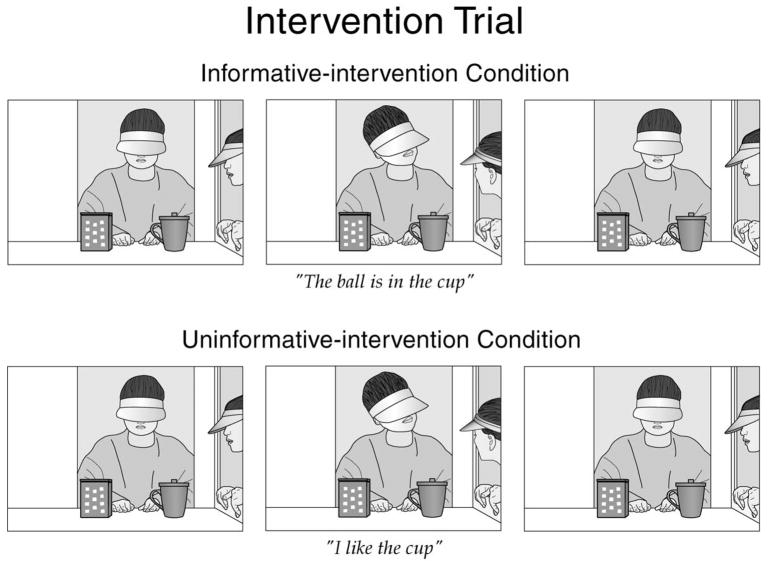
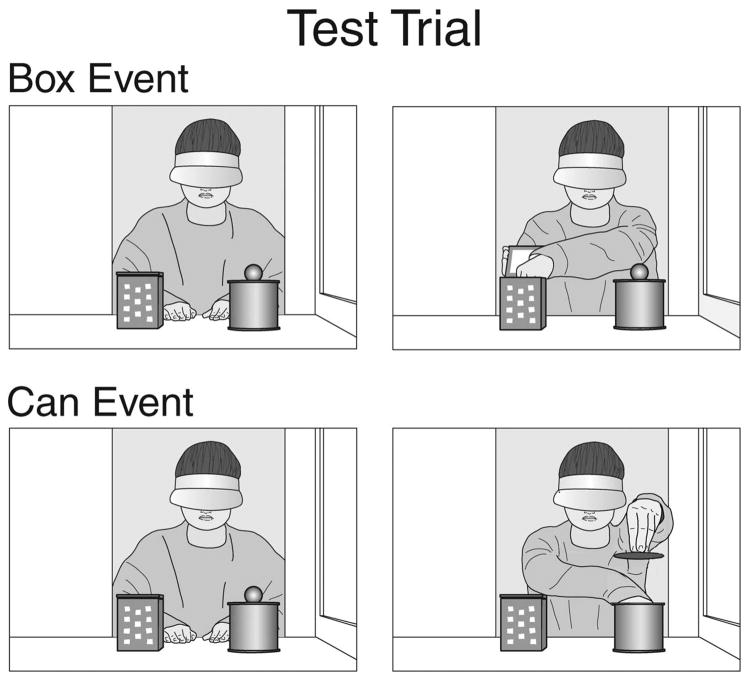
Do 18-month-olds understand that an agent's false belief can be corrected by an appropriate, though not an inappropriate, communication? In Experiment 1, infants watched a series of events involving two agents, a ball, and two containers: a box and a cup. To start, agent1 played with the ball and then hid it in the box, while agent2 looked on. Next, in agent1's absence, agent2 moved the ball from the box to the cup. When agent1 returned, agent2 told her "The ball is in the cup!" (informative-intervention condition) or "I like the cup!" (uninformative-intervention condition). During test, agent1 reached for either the box (box event) or the cup (cup event). In the informative-intervention condition, infants who saw the box event looked reliably longer than those who saw the cup event; in the uninformative-intervention condition, the reverse pattern was found. These results suggest that infants expected agent1's false belief about the ball's location to be corrected when she was told "The ball is in the cup!", but not "I like the cup!". In Experiment 2, agent2 simply pointed to the ball's new location, and infants again expected agent1's false belief to be corrected. These and control results provide additional evidence that infants in the second year of life can attribute false beliefs to agents. In addition, the results suggest that by 18 months of age infants expect agents' false beliefs to be corrected by relevant communications involving words or gestures.
18个月大的婴儿是否明白,一个主体的错误信念可以通过恰当而非不恰当的交流来纠正?在实验1中,婴儿观看了一系列事件,涉及两个主体、一个球和两个容器:一个盒子和一个杯子。开始时,主体1玩球,然后把球藏在盒子里,而主体2在一旁观看。接下来,在主体1不在场时,主体2把球从盒子移到杯子里。当主体1回来时,主体2告诉她“球在杯子里!”(信息性干预条件)或“我喜欢杯子!”(非信息性干预条件)。在测试过程中,主体1伸手去拿盒子(盒子事件)或杯子(杯子事件)。在信息性干预条件下,看到盒子事件的婴儿注视时间明显长于看到杯子事件的婴儿;在非信息性干预条件下,发现了相反的模式。这些结果表明,当被告知“球在杯子里!”而不是“我喜欢杯子!”时,婴儿预期主体1关于球的位置的错误信念会得到纠正。在实验2中,主体2只是指向球的新位置,婴儿再次预期主体1的错误信念会得到纠正。这些结果以及对照结果提供了额外的证据,证明1岁半的婴儿能够将错误信念归因于主体。此外,结果表明,到18个月大时,婴儿预期主体的错误信念会通过涉及言语或手势的相关交流得到纠正。