de Kleine Elian, Verwey Willem B
Cognitive Psychology and Ergonomics, Faculty of Behavioral Sciences, University of Twente, Enschede, The Netherlands.
Psychol Res. 2009 Sep;73(5):685-94. doi: 10.1007/s00426-008-0174-2. Epub 2008 Nov 5.
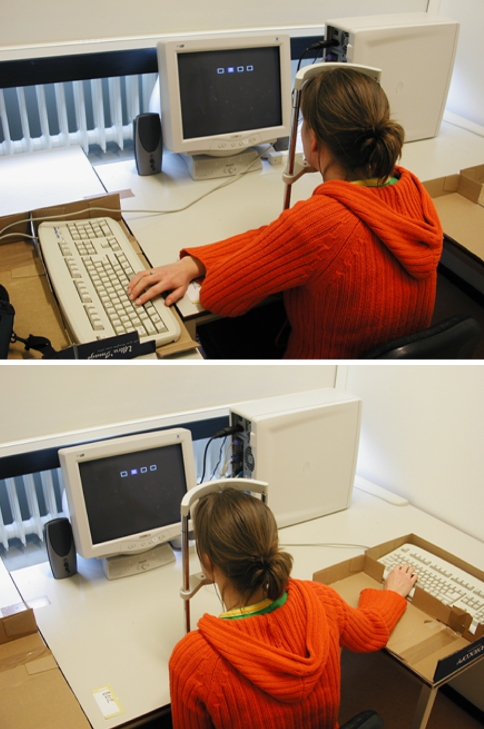
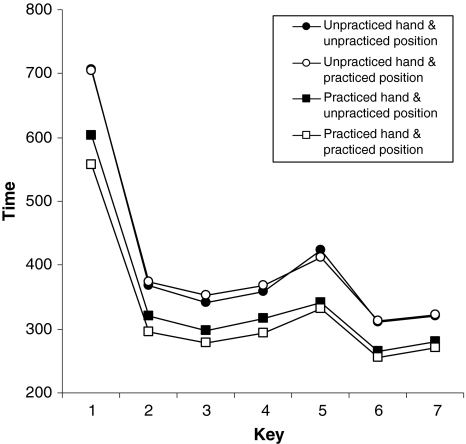
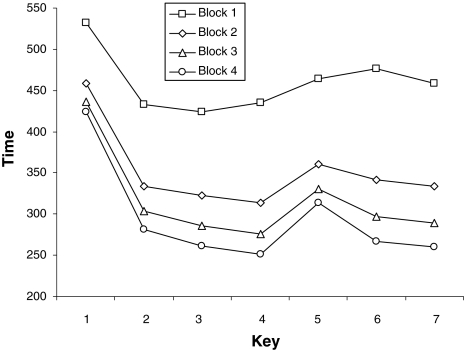
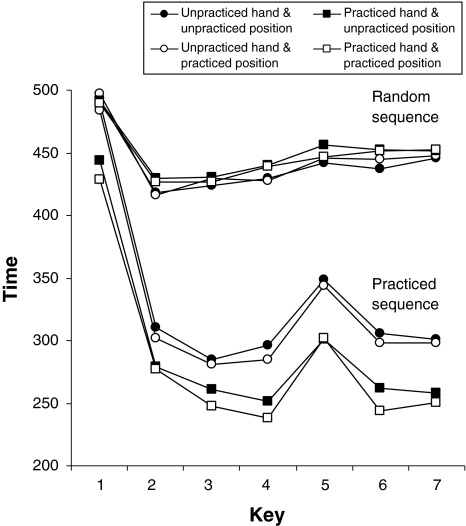
Various studies suggest that movement sequences are initially learned predominantly in effector-independent spatial coordinates and only after extended practice in effector-dependent coordinates. The present study examined this notion for the discrete sequence production (DSP) task by manipulating the hand used and the position of the hand relative to the body. During sequence learning in Experiment 1, in which sequences were executed by reacting to key-specific cues, hand position appeared important for execution with the practiced but not with the unpracticed hand. In Experiment 2 entire sequences were executed by reacting to one cue. This produced similar results as in Experiment 1. These experiments support the notion that robustness of sequencing skill is based on several codes, one being a representation that is both effector and position dependent.
多项研究表明,运动序列最初主要是在与效应器无关的空间坐标中学习的,并且只有在经过长时间的依赖效应器坐标的练习之后才会改变。本研究通过操纵使用的手以及手相对于身体的位置,对离散序列生成(DSP)任务的这一概念进行了检验。在实验1的序列学习过程中,序列是通过对特定按键提示做出反应来执行的,手的位置对于使用熟练的手执行序列似乎很重要,而对于不熟练的手则不然。在实验2中,整个序列是通过对一个提示做出反应来执行的。这产生了与实验1类似的结果。这些实验支持了这样一种观点,即序列技能的稳健性基于多种编码,其中一种是既依赖效应器又依赖位置的表征。