Verwey Willem B, Dronkers Wouter J
Department of Cognitive Psychology and Ergonomics, University of Twente, PO Box 217, 7500 AE, Enschede, The Netherlands.
Human Performance Laboratories, Department of Health and Kinesiology, Texas A&M University, College Station, TX, USA.
Psychol Res. 2019 Mar;83(2):235-246. doi: 10.1007/s00426-017-0967-2. Epub 2018 Jan 3.
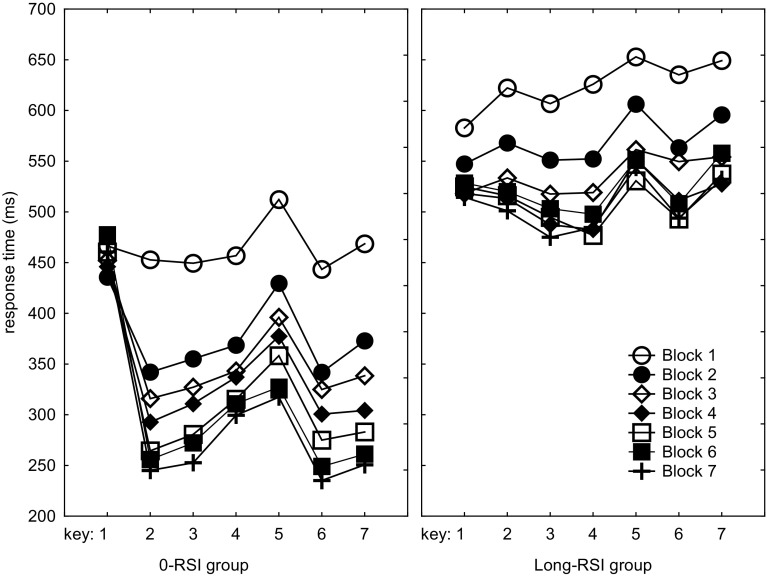
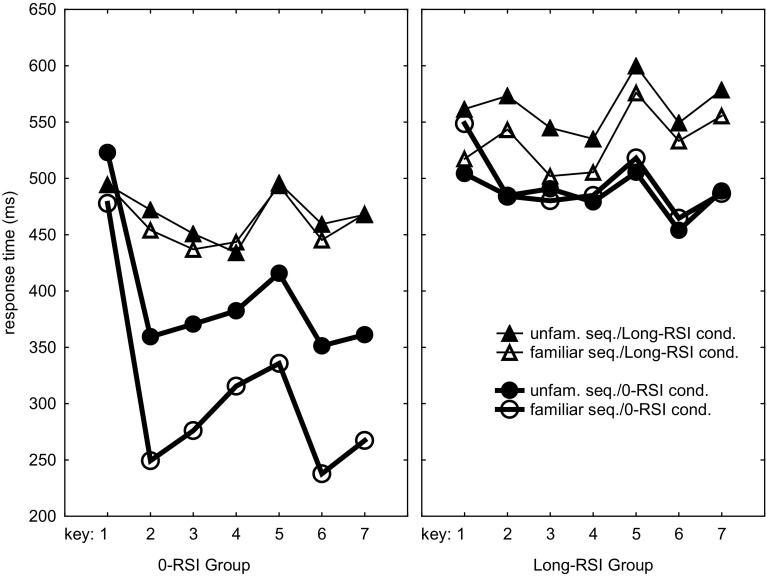
The present study tested the hypothesis that in motor sequences, the interval between successive movements is critical for the type of representation that develops. Participants practiced two 7-key sequences in the context of a discrete sequence production (DSP) task. The 0-RSI group practiced these sequences with response stimulus intervals (RSIs) of 0, which is typical for the DSP task, while the long-RSI group practiced the same sequences with unpredictable RSIs between 500 and 2000 ms. The ensuing test phase examined performance of these familiar and of unfamiliar sequences for both groups under both RSI regimes. The results support our hypothesis that the motor chunks that 0-RSI participants developed could not be used with long RSIs, whereas the long-RSI participants developed sequence representations that cannot be used with 0 RSIs. A new, computerized, sequence awareness task showed that long-RSI participants had limited sequence knowledge. The sequencing skill developed by long-RSI participants can, therefore, not have been based on explicit knowledge.
在运动序列中,连续动作之间的间隔对于所形成的表征类型至关重要。参与者在离散序列生成(DSP)任务的背景下练习了两个7键序列。0-RSI组以0的反应刺激间隔(RSI)练习这些序列,这是DSP任务的典型间隔,而长-RSI组以500至2000毫秒之间不可预测的RSI练习相同的序列。随后的测试阶段考察了两组在两种RSI条件下对这些熟悉和不熟悉序列的表现。结果支持了我们的假设,即0-RSI参与者形成的运动组块不能用于长RSI,而长-RSI参与者形成的序列表征不能用于0 RSI。一项新的计算机化序列意识任务表明,长-RSI参与者的序列知识有限。因此,长-RSI参与者所发展的排序技能不可能基于明确的知识。