Escamilla-Nuñez Maria-Consuelo, Barraza-Villarreal Albino, Hernandez-Cadena Leticia, Moreno-Macias Hortensia, Ramirez-Aguilar Matiana, Sienra-Monge Juan-Jose, Cortez-Lugo Marlene, Texcalac Jose-Luis, del Rio-Navarro Blanca, Romieu Isabelle
Instituto Nacional de Salud Pública, Mexico.
Respir Res. 2008 Nov 16;9(1):74. doi: 10.1186/1465-9921-9-74.
Taffic-related air pollution has been related to adverse respiratory outcomes; however, there is still uncertainty concerning the type of vehicle emission causing most deleterious effects.
A panel study was conducted among 147 asthmatic and 50 healthy children, who were followed up for an average of 22 weeks. Incidence density of coughing, wheezing and breathing difficulty was assessed by referring to daily records of symptoms and child's medication. The association between exposure to pollutants and occurrence of symptoms was evaluated using mixed-effect models with binary response and poisson regression.
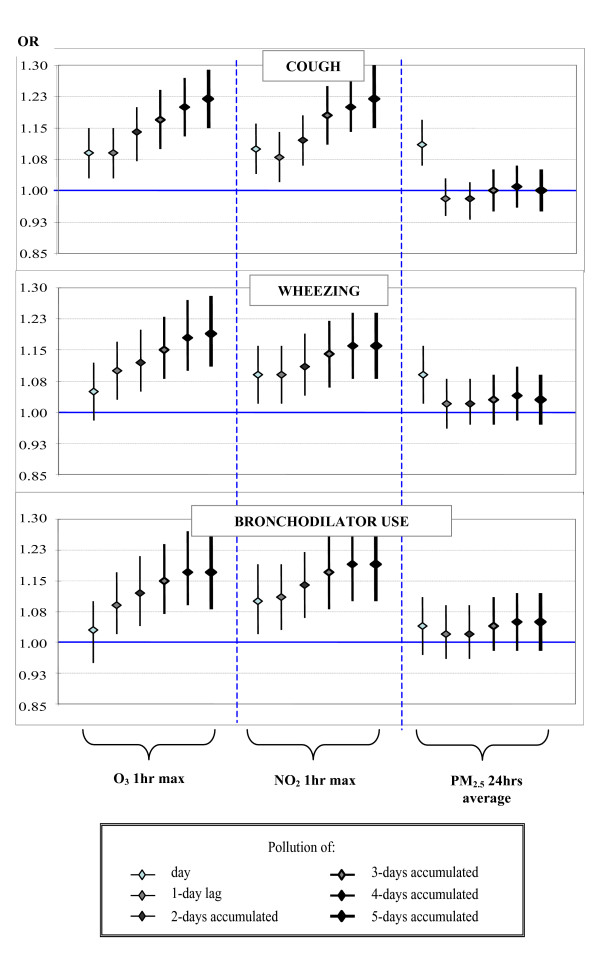
Wheezing was found to relate significantly to air pollutants: an increase of 17.4 microg/m3 (IQR) of PM2.5 (24-h average) was associated with an 8.8% increase (95% CI: 2.4% to 15.5%); an increase of 34 ppb (IQR) of NO2 (1-h maximum) was associated with an 9.1% increase (95% CI: 2.3% to 16.4%) and an increase of 48 ppb (IQR) in O3 levels (1 hr maximum) to an increase of 10% (95% CI: 3.2% to 17.3%). Diesel-fueled motor vehicles were significantly associated with wheezing and bronchodilator use (IRR = 1.29; 95% CI: 1.03 to 1.62, and IRR = 1.32; 95% CI: 0.99 to 1.77, respectively, for an increase of 130 vehicles hourly, above the 24-hour average).
Respiratory symptoms in asthmatic children were significantly associated with exposure to traffic exhaust, especially from natural gas and diesel-fueled vehicles.
交通相关空气污染与不良呼吸结局有关;然而,关于造成最有害影响的车辆排放类型仍存在不确定性。
对147名哮喘儿童和50名健康儿童进行了一项队列研究,平均随访22周。通过参考症状和儿童用药的每日记录来评估咳嗽、喘息和呼吸困难的发病密度。使用具有二元反应和泊松回归的混合效应模型评估污染物暴露与症状发生之间的关联。
发现喘息与空气污染物显著相关:PM2.5(24小时平均值)每增加17.4微克/立方米(四分位距),喘息增加8.8%(95%置信区间:2.4%至15.5%);二氧化氮(1小时最大值)每增加34 ppb(四分位距),喘息增加9.1%(95%置信区间:2.3%至16.4%),臭氧水平(1小时最大值)每增加48 ppb(四分位距),喘息增加10%(95%置信区间:3.2%至17.3%)。柴油机动车与喘息和支气管扩张剂使用显著相关(每小时增加130辆车,高于24小时平均值,相对危险度分别为1.29;95%置信区间:1.03至1.62,以及1.32;95%置信区间:0.99至1.77)。
哮喘儿童的呼吸道症状与交通尾气暴露显著相关,尤其是来自天然气和柴油车辆的尾气。