Ben-Tabou de-Leon Smadar, Davidson Eric H
Division of Biology 156-29, California Institute of Technology, Pasadena, CA 91125, USA.
Dev Biol. 2009 Jan 15;325(2):317-28. doi: 10.1016/j.ydbio.2008.10.043. Epub 2008 Nov 12.
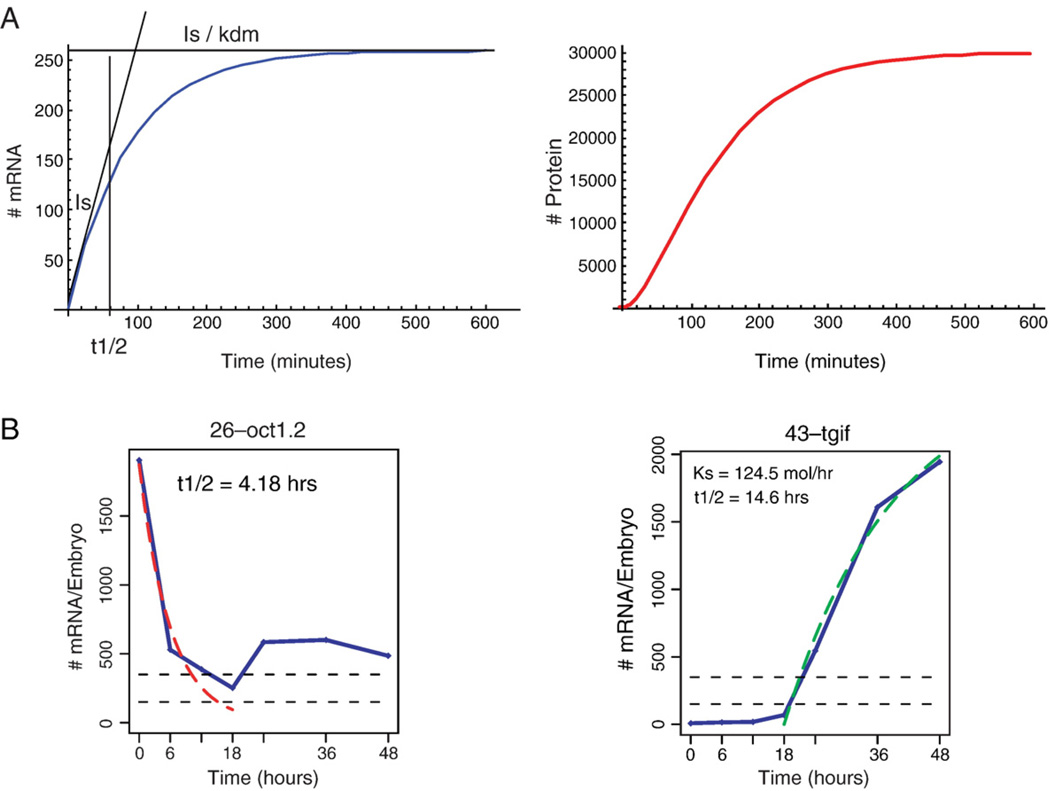
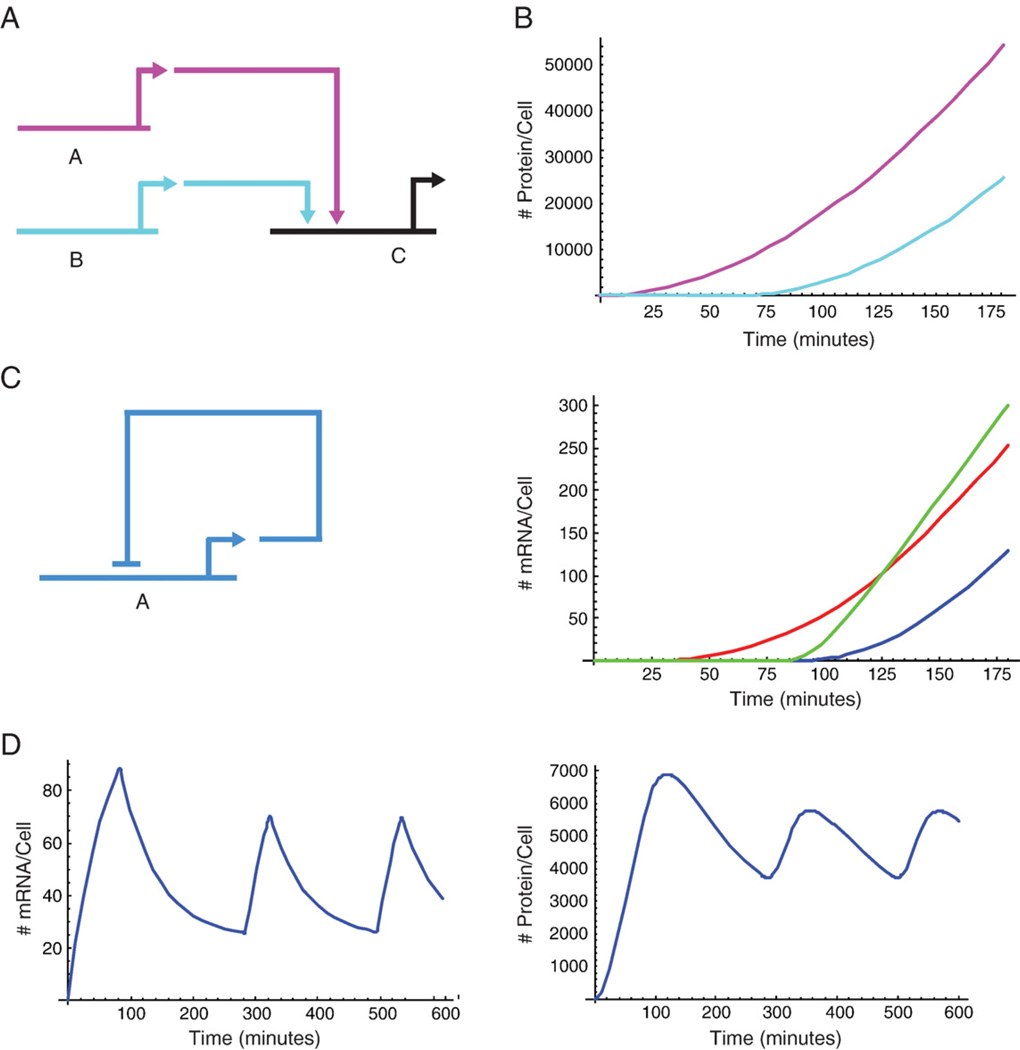
The dynamic process of cell fate specification is regulated by networks of regulatory genes. The architecture of the network defines the temporal order of specification events. To understand the dynamic control of the developmental process, the kinetics of mRNA and protein synthesis and the response of the cis-regulatory modules to transcription factor concentration must be considered. Here we review mathematical models for mRNA and protein synthesis kinetics which are based on experimental measurements of the rates of the relevant processes. The model comprises the response functions of cis-regulatory modules to their transcription factor inputs, by incorporating binding site occupancy and its dependence on biologically measurable quantities. We use this model to simulate gene expression, to distinguish between cis-regulatory execution of "AND" and "OR" logic functions, rationalize the oscillatory behavior of certain transcriptional auto-repressors and to show how linked subcircuits can be dealt with. Model simulations display the effects of mutation of binding sites, or perturbation of upstream gene expression. The model is a generally useful tool for understanding gene regulation and the dynamics of cell fate specification.
细胞命运特化的动态过程受调控基因网络的调节。网络结构定义了特化事件的时间顺序。为了理解发育过程的动态控制,必须考虑mRNA和蛋白质合成的动力学以及顺式调控模块对转录因子浓度的响应。在此,我们综述基于相关过程速率实验测量的mRNA和蛋白质合成动力学的数学模型。该模型通过纳入结合位点占有率及其对生物学可测量量的依赖性,包含了顺式调控模块对其转录因子输入的响应函数。我们使用这个模型来模拟基因表达,区分“与”和“或”逻辑功能的顺式调控执行,合理化某些转录自抑制因子的振荡行为,并展示如何处理相连的子电路。模型模拟展示了结合位点突变或上游基因表达扰动的影响。该模型是理解基因调控和细胞命运特化动态的普遍有用工具。