Kennedy M W, Wassom D L, McIntosh A E, Thomas J C
Wellcome Laboratories for Experimental Parasitology, University of Glasgow, Bearsden, U.K.
Immunology. 1991 May;73(1):36-43.
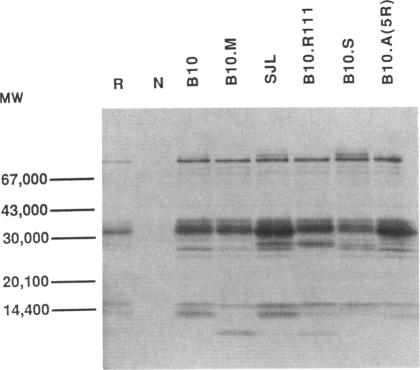
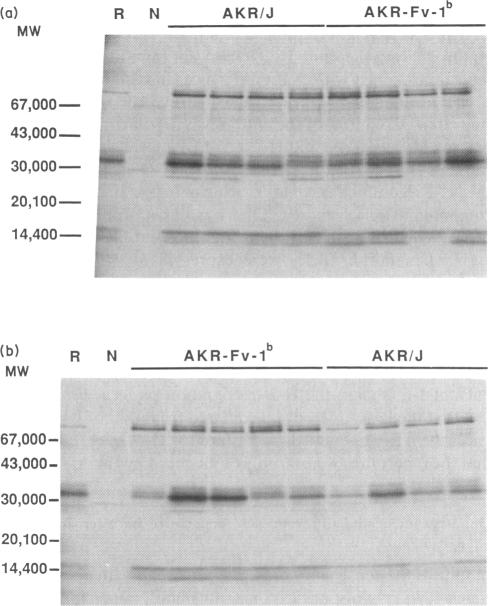
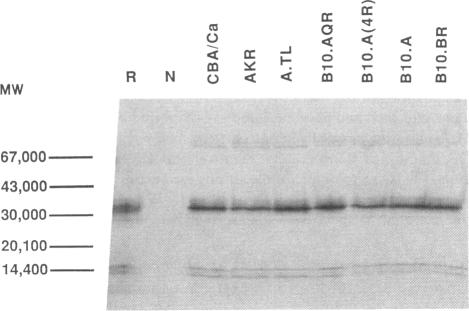
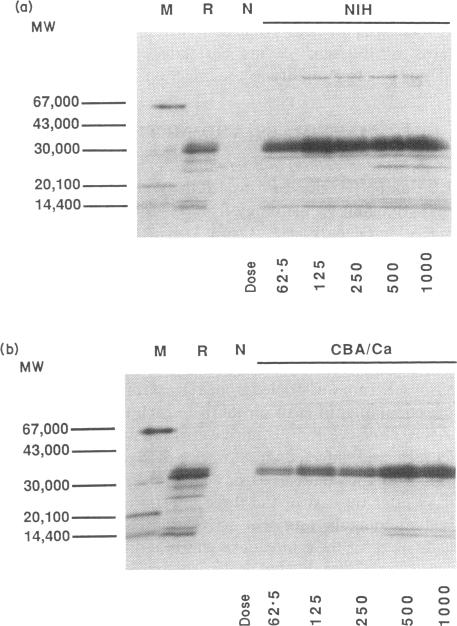
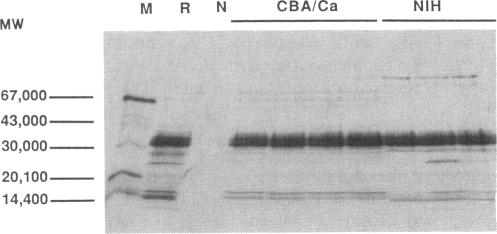
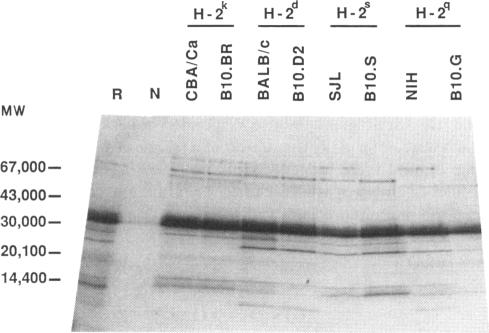
Humans infected with the parasitic nematode Trichinella spiralis vary in the specificity of their antibody responses to the antigens of the parasite. The possibility that such host variation in antigen recognition has a genetic basis was examined in infected inbred mice whose antigen recognition profiles were characterized by immunoprecipitation of biosynthetically labelled secreted materials of adult parasites and SDS-PAGE. The strains varied considerably in repertoire and none produced detectable antibody to all the potential antigens. Using a panel of H-2 congenic and recombinant strains it was established that the repertoire was determined by the major histocompatibility complex (MHC), the I-A region in particular. Other factors, such as level of infection and variation between individuals, affected antigen recognition profiles, but this was always within limits imposed by the MHC. Lastly, an attempt to correlate antibody repertoire with relative susceptibility or resistance to T. spiralis failed to reveal any clear association. This also applied to the AKR/J and AKR-Fv-1b strains, which are H-2-identical but differ in a non-MHC susceptibility locus. These findings would argue, therefore, that the I-A region controls the antibody repertoire in this nematode infection but that the repertoire overall has little influence on the efficiency with which the infections are controlled by the immune system. Should this also apply for other nematode infections, then antigen recognition profiles of infected individual humans and domestic animals might not, therefore, be useful indicators of relative resistance or susceptibility to infection.
感染寄生线虫旋毛虫的人类,其针对该寄生虫抗原的抗体反应特异性存在差异。在感染的近交系小鼠中研究了这种抗原识别方面的宿主差异是否具有遗传基础,这些小鼠的抗原识别谱通过对成年寄生虫生物合成标记的分泌物质进行免疫沉淀和SDS - PAGE来表征。各品系在抗体谱方面差异很大,没有一个品系能产生针对所有潜在抗原的可检测抗体。使用一组H - 2同源和重组品系确定,抗体谱由主要组织相容性复合体(MHC)决定,特别是I - A区域。其他因素,如感染水平和个体间差异,会影响抗原识别谱,但这始终在MHC所设定的范围内。最后,试图将抗体谱与对旋毛虫的相对易感性或抗性相关联,但未发现任何明显关联。这也适用于AKR/J和AKR - Fv - 1b品系,它们H - 2相同,但在一个非MHC易感性位点存在差异。因此,这些发现表明,I - A区域控制这种线虫感染中的抗体谱,但总体而言,抗体谱对免疫系统控制感染的效率影响不大。如果这也适用于其他线虫感染,那么感染个体人类和家畜的抗原识别谱可能因此不是相对抗感染性或易感性的有用指标。