Leitch A E, Duffin R, Haslett C, Rossi A G
MRC Centre for Inflammation Research, The Queen's Medical Research Institute, University of Edinburgh Medical School, Edinburgh, Scotland, UK.
Mucosal Immunol. 2008 Sep;1(5):350-63. doi: 10.1038/mi.2008.31. Epub 2008 Jul 2.
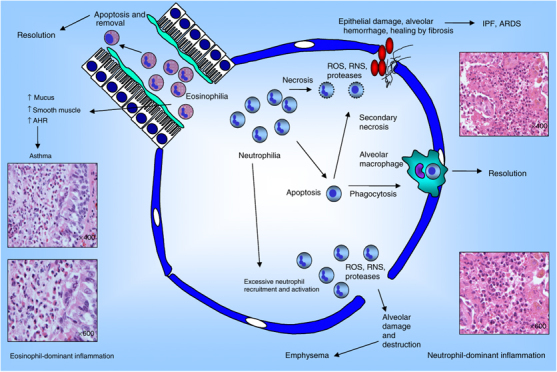
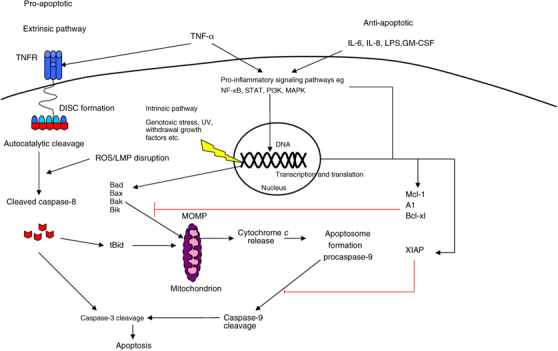
The respiratory mucosa is responsible for gas exchange and is therefore, of necessity, exposed to airborne pathogens, allergens, and foreign particles. It has evolved a multi-faceted, physical and immune defense system to ensure that in the majority of instances, potentially injurious invaders are repelled. Inflammation, predominantly mediated by effector cells of the granulocyte lineage including neutrophils and eosinophils, is a form of immune defense. Where inflammation proves unable to remove an inciting stimulus, chronic inflammatory disease may supervene because of the potential for tissue damage conferred by the presence of large numbers of frustrated, activated granulocytes. Successful recovery from inflammatory disease and resolution of inflammation rely on the clearance of these cells. Ideally, they should undergo apoptosis prior to phagocytosis by macrophage, dendritic, or epithelial cells. The outcome of inflammation can have serious sequelae for the integrity of the respiratory mucosa leading to disease. Therapeutic strategies to drive resolution of inflammation may be directed at the induction of granulocyte apoptosis and the enhancement of granulocyte clearance.
呼吸道黏膜负责气体交换,因此必然会接触到空气传播的病原体、过敏原和外来颗粒。它进化出了一个多方面的物理和免疫防御系统,以确保在大多数情况下,潜在的有害入侵者被击退。炎症主要由粒细胞系的效应细胞(包括中性粒细胞和嗜酸性粒细胞)介导,是一种免疫防御形式。当炎症证明无法消除激发刺激时,由于大量受挫的活化粒细胞的存在可能导致组织损伤,慢性炎症性疾病可能会接踵而至。炎症性疾病的成功康复和炎症的消退依赖于这些细胞的清除。理想情况下,它们应该在被巨噬细胞、树突状细胞或上皮细胞吞噬之前经历凋亡。炎症的结果可能会对呼吸道黏膜的完整性产生严重的后遗症,从而导致疾病。促进炎症消退的治疗策略可能针对诱导粒细胞凋亡和增强粒细胞清除。