Habuchi Satoshi, Tsutsui Hidekazu, Kochaniak Anna B, Miyawaki Atsushi, van Oijen Antoine M
Department of Biological Chemistry and Molecular Pharmacology, Harvard Medical School, Boston, Massachusetts, United States of America.
PLoS One. 2008;3(12):e3944. doi: 10.1371/journal.pone.0003944. Epub 2008 Dec 15.
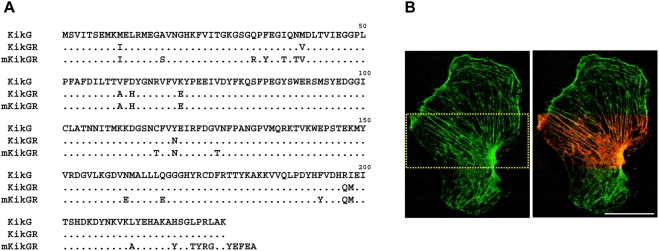
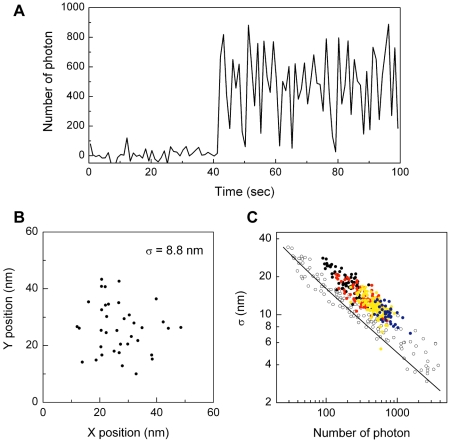
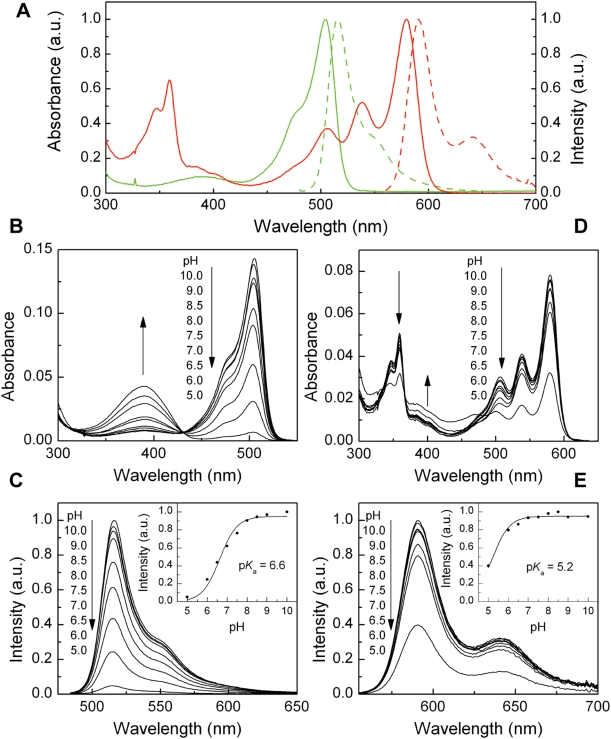
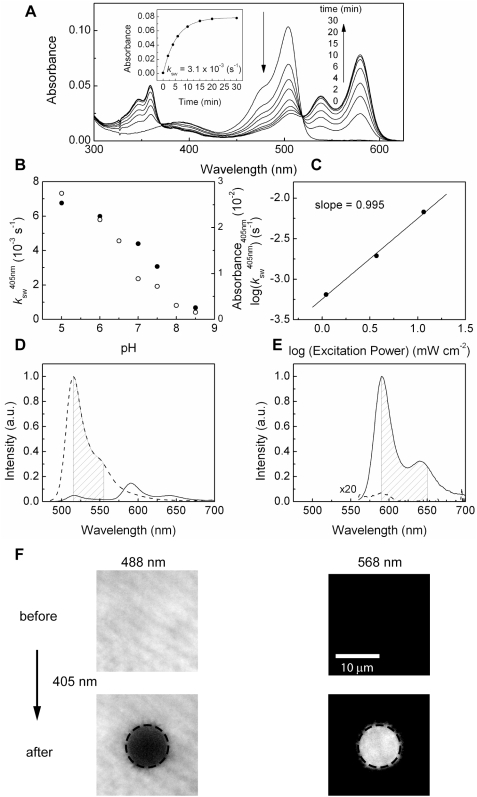
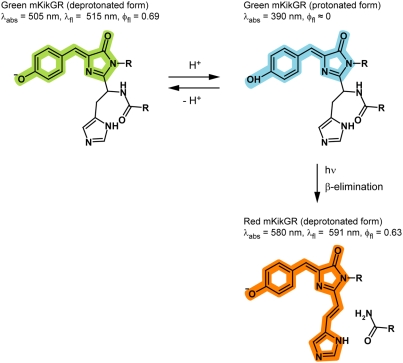
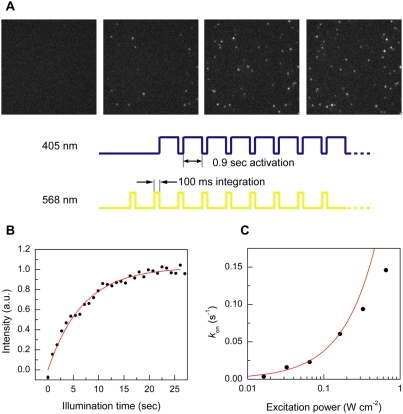
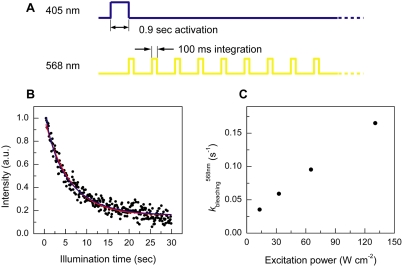
The recent demonstration and utilization of fluorescent proteins whose fluorescence can be switched on and off has greatly expanded the toolkit of molecular and cell biology. These photoswitchable proteins have facilitated the characterization of specifically tagged molecular species in the cell and have enabled fluorescence imaging of intracellular structures with a resolution far below the classical diffraction limit of light. Applications are limited, however, by the fast photobleaching, slow photoswitching, and oligomerization typical for photoswitchable proteins currently available. Here, we report the molecular cloning and spectroscopic characterization of mKikGR, a monomeric version of the previously reported KikGR that displays high photostability and switching rates. Furthermore, we present single-molecule imaging experiments that demonstrate that individual mKikGR proteins can be localized with a precision of better than 10 nanometers, suggesting their suitability for super-resolution imaging.
近期,荧光可开关的荧光蛋白得以展示和应用,这极大地扩展了分子与细胞生物学的工具集。这些光开关蛋白有助于对细胞中特定标记的分子种类进行表征,并能对细胞内结构进行荧光成像,其分辨率远低于光的经典衍射极限。然而,目前可用的光开关蛋白存在快速光漂白、光开关速度慢以及寡聚化等问题,限制了其应用。在此,我们报告了mKikGR的分子克隆和光谱表征,mKikGR是先前报道的KikGR的单体形式,具有高光稳定性和开关速率。此外,我们展示了单分子成像实验,结果表明单个mKikGR蛋白的定位精度优于10纳米,这表明它们适用于超分辨率成像。