Scherer Alison C, Tsuchiya Ami, Younglove Lisa R, Burbacher Thomas M, Faustman Elaine M
Department of Environmental and Occupational Health Sciences, School of Public Health and Community Medicine, University of Washington, Seattle, WA 98105, USA.
Environ Health Perspect. 2008 Dec;116(12):1598-606. doi: 10.1289/ehp.11372. Epub 2008 Aug 1.
Fish consumption advisories are issued to warn the public of possible toxicological threats from consuming certain fish species. Although developing fetuses and children are particularly susceptible to toxicants in fish, fish also contain valuable nutrients. Hence, formulating advice for sensitive populations poses challenges. We conducted a comparative analysis of advisory Web sites issued by states to assess health messages that sensitive populations might access.
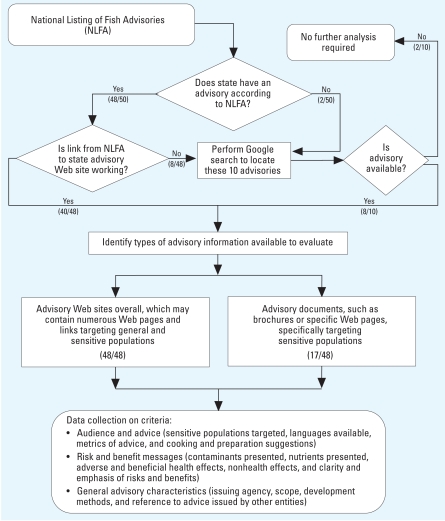
We evaluated state advisories accessed via the National Listing of Fish Advisories issued by the U.S. Environmental Protection Agency.
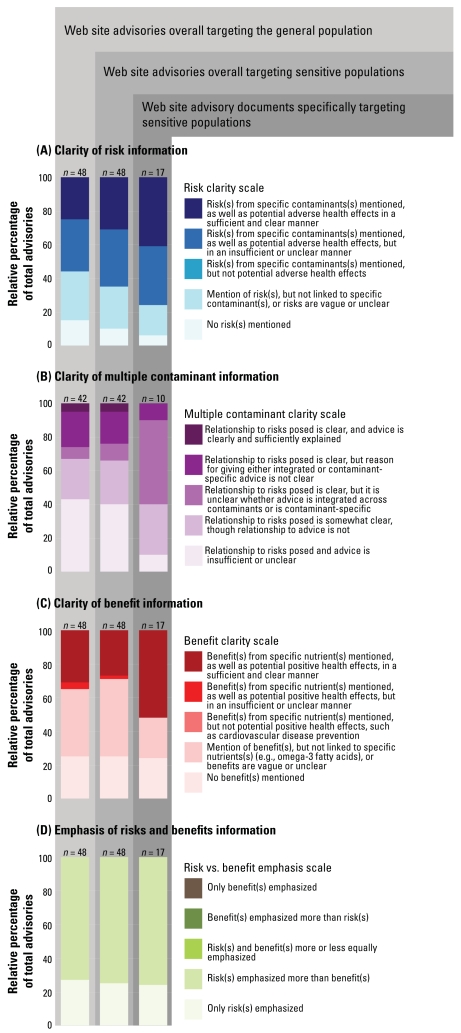
We created criteria to evaluate advisory attributes such as risk and benefit message clarity.
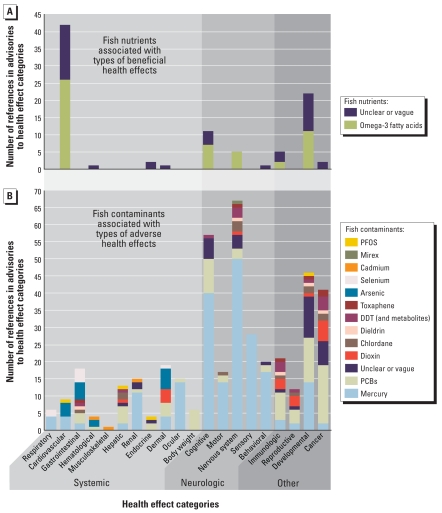
All 48 state advisories issued at the time of this analysis targeted children, 90% (43) targeted pregnant women, and 58% (28) targeted women of childbearing age. Only six advisories addressed single contaminants, while the remainder based advice on 2-12 contaminants. Results revealed that advisories associated a dozen contaminants with specific adverse health effects. Beneficial health effects of any kind were specifically associated only with omega-3 fatty acids found in fish.
These findings highlight the complexity of assessing and communicating information about multiple contaminant exposure from fish consumption. Communication regarding potential health benefits conferred by specific fish nutrients was minimal and focused primarily on omega-3 fatty acids. This overview suggests some lessons learned and highlights a lack of both clarity and consistency in providing the breadth of information that sensitive populations such as pregnant women need to make public health decisions about fish consumption during pregnancy.
发布鱼类消费建议是为了警告公众食用某些鱼类可能带来的毒理学威胁。尽管发育中的胎儿和儿童特别容易受到鱼类中有毒物质的影响,但鱼类也含有宝贵的营养成分。因此,为敏感人群制定建议具有挑战性。我们对各州发布的建议网站进行了比较分析,以评估敏感人群可能获取的健康信息。
我们评估了通过美国环境保护局发布的《鱼类消费建议国家清单》获取的各州建议。
我们制定了评估建议属性的标准,如风险和益处信息的清晰度。
本次分析时发布的所有48份州级建议都针对儿童,90%(43份)针对孕妇,58%(28份)针对育龄妇女。只有6份建议涉及单一污染物,其余建议则基于2至12种污染物。结果显示,这些建议将十几种污染物与特定的不良健康影响联系起来。任何有益的健康影响仅与鱼类中发现的ω-3脂肪酸有明确关联。
这些发现凸显了评估和传达食用鱼类导致多种污染物暴露相关信息的复杂性。关于特定鱼类营养成分潜在健康益处的交流很少,且主要集中在ω-3脂肪酸上。这一概述表明了一些经验教训,并凸显了在提供孕妇等敏感人群在孕期就鱼类消费做出公共卫生决策所需的广泛信息方面,既缺乏清晰度又缺乏一致性。