Division of Epidemiology and Biostatistics, School of Public Health, University of Illinois at Chicago, 1603 W. Taylor St., Chicago, IL 60612, USA.
Environ Health Perspect. 2012 Jan;120(1):11-8. doi: 10.1289/ehp.1003396. Epub 2011 Sep 23.
Beneficial effects of fish consumption on early cognitive development and cardiovascular health have been attributed to the omega-3 fatty acids in fish and fish oils, but toxic chemicals in fish may adversely affect these health outcomes. Risk-benefit assessments of fish consumption have frequently focused on methylmercury and omega-3 fatty acids, not persistent pollutants such as polychlorinated biphenyls, and none have evaluated Great Lakes fish consumption.
The risks and benefits of fish consumption have been established primarily for marine fish. Here, we examine whether sufficient data are available to evaluate the risks and benefits of eating freshwater fish from the Great Lakes.
We used a scoping review to integrate information from multiple state, provincial, and federal agency sources regarding the contaminants and omega-3 fatty acids in Great Lakes fish and fish consumers, consumption rates and fish consumption advisories, and health effects of contaminants and omega-3 fatty acids.
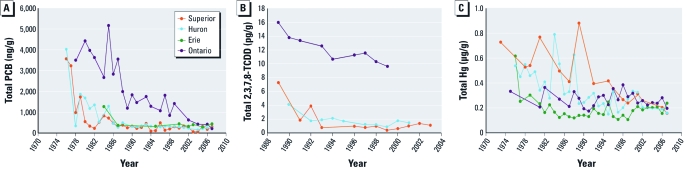
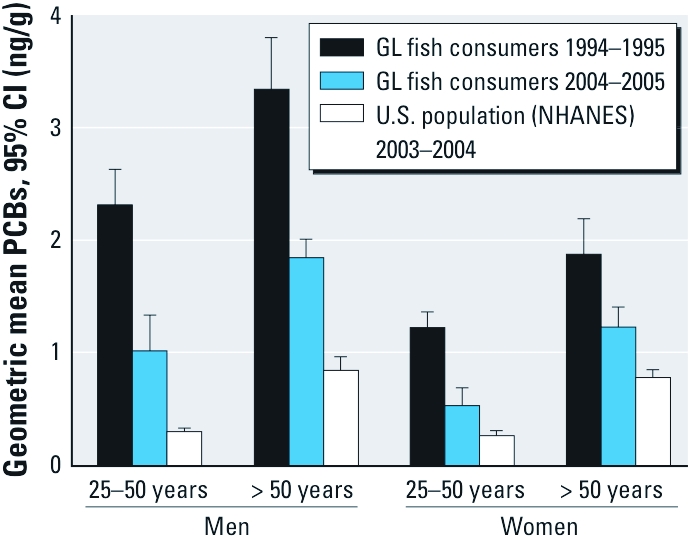
Great Lakes fish contain persistent contaminants--many of which have documented adverse health effects--that accumulate in humans consuming them. In contrast, data are sparse on omega-3 fatty acids in the fish and their consumers. Moreover, few studies have documented the social and cultural benefits of Great Lakes fish consumption, particularly for subsistence fishers and native communities. At this time, federal and state/provincial governments provide fish consumption advisories based solely on risk.
Our knowledge of Great Lakes fish has critical gaps, particularly regarding the benefits of consumption. A risk-benefit analysis requires more information than is currently available on the concentration of omega-3 fatty acids in Great Lakes fish and their absorption by fish eaters in addition to more information on the social, cultural, and health consequences of changes in the amount of fish consumed.
鱼类消费对早期认知发展和心血管健康的有益影响归因于鱼类和鱼油中的 omega-3 脂肪酸,但鱼类中的有毒化学物质可能会对这些健康结果产生不利影响。鱼类消费的风险-效益评估经常集中在甲基汞和 omega-3 脂肪酸上,而不是持久性污染物如多氯联苯,并且没有评估五大湖鱼类的消费。
鱼类消费的风险和益处主要是针对海洋鱼类建立的。在这里,我们研究了是否有足够的数据来评估食用五大湖淡水鱼的风险和益处。
我们使用范围综述来整合来自多个州、省和联邦机构的信息,这些信息涉及五大湖鱼类和鱼类消费者中的污染物和 omega-3 脂肪酸、消费率和鱼类消费建议以及污染物和 omega-3 脂肪酸的健康影响。
五大湖鱼类含有持久性污染物——其中许多具有已记录的不良健康影响——这些污染物在食用它们的人类中积累。相比之下,关于鱼类及其消费者的 omega-3 脂肪酸的数据很少。此外,很少有研究记录了五大湖鱼类消费的社会和文化益处,特别是对于自给渔民和土著社区。目前,联邦和州/省政府仅根据风险提供鱼类消费建议。
我们对五大湖鱼类的了解存在重大差距,特别是关于消费益处的知识。风险-效益分析需要比目前关于五大湖鱼类中 omega-3 脂肪酸的浓度及其被鱼类食用者吸收的信息更多,以及更多关于食用鱼类量变化的社会、文化和健康后果的信息。