McGarvey Stephen T, Buszin Justin, Reed Holly, Smith David C, Rahman Zarah, Andrzejewski Catherine, Awusabo-Asare Kofi, White Michael J
International Health Institute, Brown University, Box G-3121, 121 South Main Street, Room 220, Providence, BI 02912, USA.
J Water Health. 2008 Sep;6(3):339-49. doi: 10.2166/wh.2008.057.
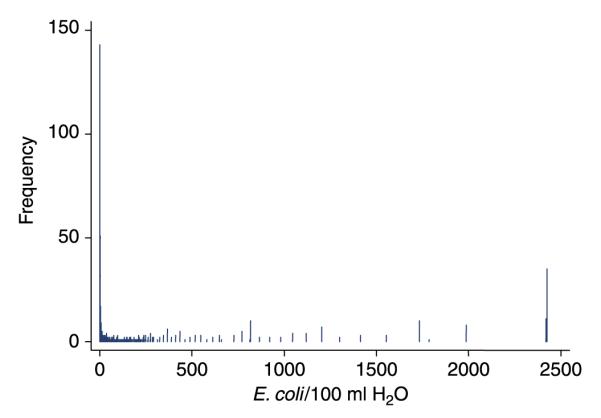
Associations between water sources, socio-demographic characteristics and household drinking water quality are described in a representative sample of six coastal districts of Ghana's Central Region. Thirty-six enumeration areas (EAs) were randomly chosen from a representative survey of 90 EAs in rural, semi-urban and urban residence strata. In each EA, 24 households were randomly chosen for water quality sampling and socio-demographic interview. Escherichia coli per 100 ml H2O was quantified using the IDEXX Colilert system and multi-stage regression models estimated cross-sectional associations between water sources, sanitation and socio-demographic factors. Almost three quarters, 74%, of the households have > 2 E. coli /100 ml H2O. Tap water has significantly lower E. coli levels compared with surface or rainwater and well water had the highest levels. Households with a water closet toilet have significantly lower E. coli compared with those using pit latrines or no toilets. Household size is positively associated, and a possessions index is negatively associated, with E. coli. Variations in community and household socio-demographic and behavioural factors are key determinants of drinking water quality. These factors should be included in planning health education associated with investments in water systems.
加纳中部地区六个沿海区的代表性样本描述了水源、社会人口特征与家庭饮用水质量之间的关联。从农村、半城市和城市居住层的90个枚举区的代表性调查中随机选取36个枚举区。在每个枚举区,随机选取24户家庭进行水质采样和社会人口访谈。使用IDEXX Colilert系统对每100毫升水中的大肠杆菌进行定量,并采用多阶段回归模型估计水源、卫生设施和社会人口因素之间的横断面关联。近四分之三(74%)的家庭每100毫升水中大肠杆菌含量超过2个。与地表水、雨水相比,自来水的大肠杆菌含量显著较低,井水的含量最高。使用抽水马桶的家庭大肠杆菌含量明显低于使用坑式厕所或无厕所的家庭。家庭规模与大肠杆菌呈正相关,财产指数与大肠杆菌呈负相关。社区和家庭社会人口及行为因素的差异是饮用水质量的关键决定因素。在规划与水系统投资相关的健康教育时应纳入这些因素。