Hultman Jenni, Ritari Jarmo, Romantschuk Martin, Paulin Lars, Auvinen Petri
Institute of Biotechnology, University of Helsinki, Helsinki, Finland.
BMC Microbiol. 2008 Dec 30;8:237. doi: 10.1186/1471-2180-8-237.
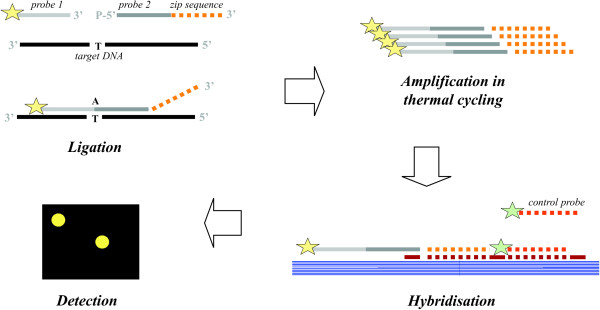
Composting is one of the methods utilised in recycling organic communal waste. The composting process is dependent on aerobic microbial activity and proceeds through a succession of different phases each dominated by certain microorganisms. In this study, a ligation-detection-reaction (LDR) based microarray method was adapted for species-level detection of compost microbes characteristic of each stage of the composting process. LDR utilises the specificity of the ligase enzyme to covalently join two adjacently hybridised probes. A zip-oligo is attached to the 3'-end of one probe and fluorescent label to the 5'-end of the other probe. Upon ligation, the probes are combined in the same molecule and can be detected in a specific location on a universal microarray with complementary zip-oligos enabling equivalent hybridisation conditions for all probes. The method was applied to samples from Nordic composting facilities after testing and optimisation with fungal pure cultures and environmental clones.
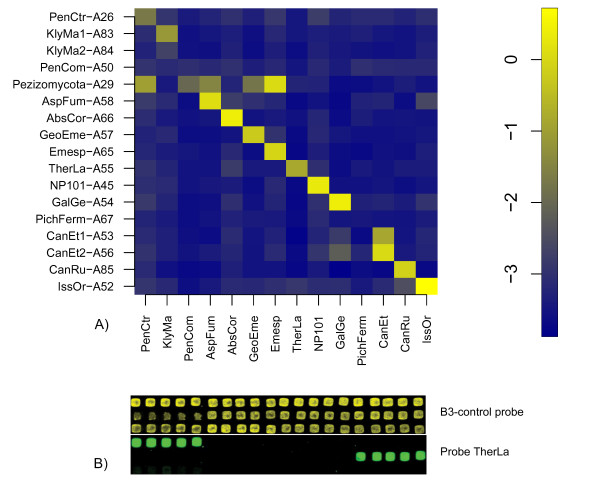
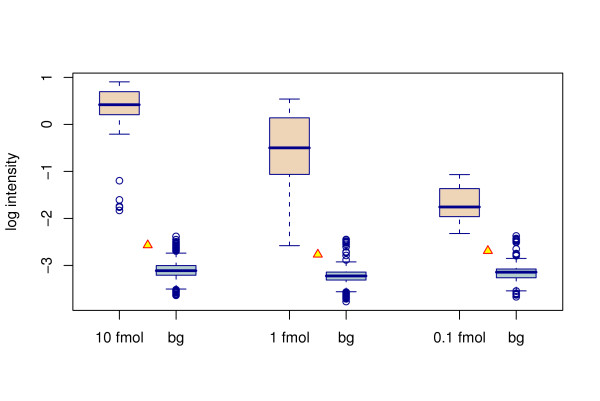
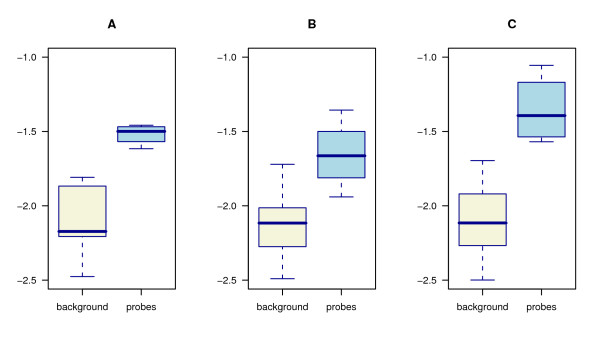
Probes targeted for fungi were able to detect 0.1 fmol of target ribosomal PCR product in an artificial reaction mixture containing 100 ng competing fungal ribosomal internal transcribed spacer (ITS) area or herring sperm DNA. The detection level was therefore approximately 0.04% of total DNA. Clone libraries were constructed from eight compost samples. The LDR microarray results were in concordance with the clone library sequencing results. In addition a control probe was used to monitor the per-spot hybridisation efficiency on the array.
This study demonstrates that the LDR microarray method is capable of sensitive and accurate species-level detection from a complex microbial community. The method can detect key species from compost samples, making it a basis for a tool for compost process monitoring in industrial facilities.
堆肥是回收有机城市垃圾所采用的方法之一。堆肥过程依赖于需氧微生物活动,并通过一系列不同阶段进行,每个阶段由特定微生物主导。在本研究中,一种基于连接检测反应(LDR)的微阵列方法被用于对堆肥过程各阶段特有的堆肥微生物进行物种水平检测。LDR利用连接酶的特异性将两个相邻杂交的探针共价连接。一个拉链寡核苷酸连接到一个探针的3'端,荧光标记连接到另一个探针的5'端。连接后,探针在同一分子中结合,并可在通用微阵列上的特定位置检测,该微阵列带有互补的拉链寡核苷酸,可为所有探针提供等效的杂交条件。在用真菌纯培养物和环境克隆进行测试和优化后,该方法应用于北欧堆肥设施的样本。
针对真菌的探针能够在含有100 ng竞争性真菌核糖体内部转录间隔区(ITS)区域或鲱鱼精DNA的人工反应混合物中检测到0.1 fmol的目标核糖体PCR产物。因此,检测水平约为总DNA的0.04%。从八个堆肥样本构建了克隆文库。LDR微阵列结果与克隆文库测序结果一致。此外,使用了一个对照探针来监测阵列上每个点的杂交效率。
本研究表明,LDR微阵列方法能够从复杂的微生物群落中进行灵敏且准确的物种水平检测。该方法可以检测堆肥样本中的关键物种,使其成为工业设施中堆肥过程监测工具的基础。